





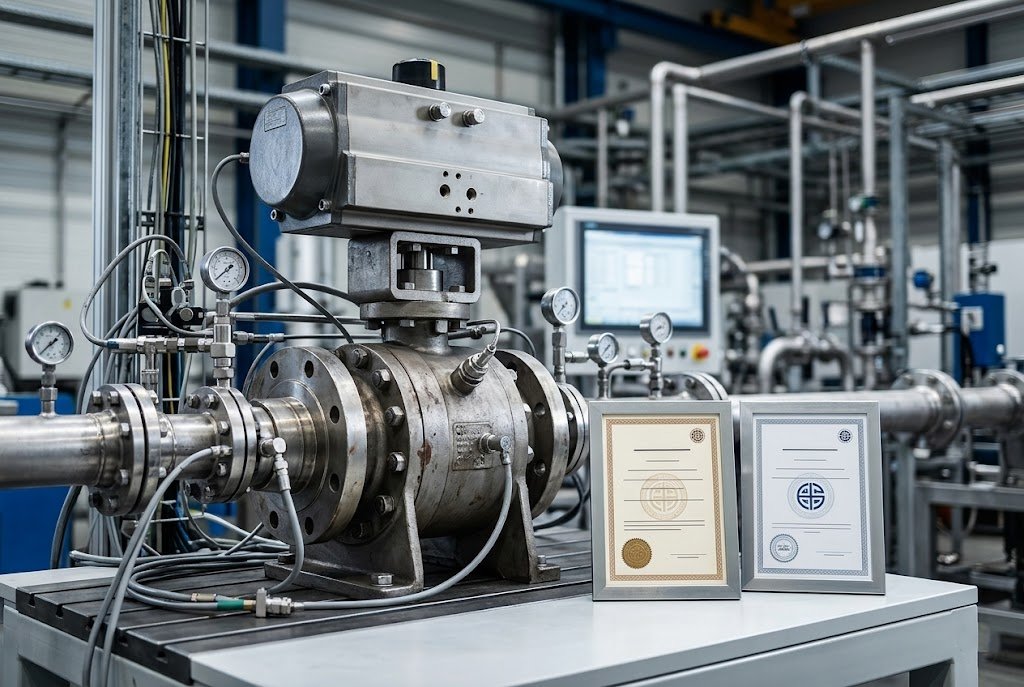
Fire-safe valve testing proves that a specific valve design can limit internal and external leakage, retain pressure-containing capability, and meet defined operability requirements during and after a controlled fire exposure test. It does not prove that every valve shipped is fireproof, that every size and pressure class is covered, or that the actuator will survive a real plant fire. The two standards most often seen on certificates are API 607 and API 6FA.
In buyer terms, API 607 is commonly associated with quarter-turn valves and valves with nonmetallic seats, while API 6FA has historically been associated with API 6A/API 6D pipeline and production valves. Because project specifications and standard editions vary, the certificate must always be checked against the exact valve design, size, class, seat/trim materials, and service.
GlobalSpec’s API STD 607 listing describes the standard as a fire type-test method for confirming pressure-containing capability of quarter-turn valves and other valves with nonmetallic seating under pressure during and after a fire test. Industry summaries commonly describe a fire test as roughly 30 minutes of flame exposure near 760°C / 1400°F, with leakage monitored during and after cooling. This article explains the API 607 vs API 6FA difference, what the test sequence looks like, and how Carter Valve buyers should review fire-safe certificates before accepting a valve for refinery, petrochemical, LNG, tank farm, or hazardous isolation service.
Why “Fire-Safe” Is a Performance Claim, Not a Magic Label
The phrase fire-safe valve can sound reassuring, but it should not be treated as a vague marketing phrase. A fire-safe certificate is evidence that a valve design was tested under a defined standard, at defined pressure and fire exposure conditions, with measured leakage limits. It is a type-test performance record, not a promise that the valve will survive every possible fire scenario indefinitely.
In a refinery or petrochemical unit, the concern is straightforward. If a fire damages soft seats, seals, packing, or gaskets, the valve still needs to contain hazardous or flammable media long enough to support isolation and emergency response. Fire-safe designs often use graphite packing, fire-resistant gaskets, anti-blowout stem designs, anti-static devices, and secondary metal-to-metal sealing paths. SVF’s fire-safe valve guidance describes these design elements and notes that API 607 testing exposes a pressurized valve to direct flame for approximately 30 minutes around 1400°F / 760°C while leakage is monitored.
For butterfly valve applications, Carter Valve’s critical isolation butterfly valve selection guide is a useful companion resource. Fire-safe certification is one layer of the specification, but leakage class, materials, temperature, pressure, actuator sizing, and service duty must also be reviewed.
API 607 vs API 6FA: The Practical Difference
The most common buyer question is whether a valve should have API 607 or API 6FA. The short answer is that the correct standard depends on valve type, applicable project specifications, end-user requirements, and the edition status referenced in the contract.
Public summaries generally describe API 607 as a fire test for quarter-turn valves such as ball, butterfly, and plug valves, especially where nonmetallic seats or seals are present. Industry sources describe API 6FA as a fire test historically used for API 6A and API 6D valves, including certain ball, gate, and plug valves in production or pipeline service. Some current summaries state that API 6FA has been withdrawn or its requirements have been incorporated into newer API 607 practice, but because project specifications may still reference API 6FA, buyers should verify the official standard status and the governing project documents before rejecting or accepting a certificate.
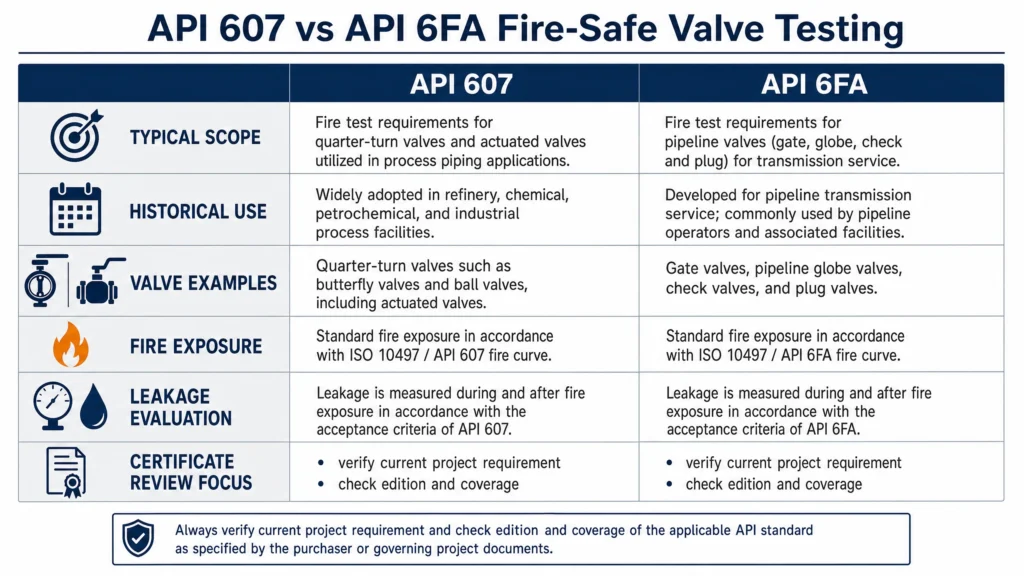
| Comparison point | API 607 | API 6FA |
|---|---|---|
| Typical association | Quarter-turn valves and valves with nonmetallic seats | Historically API 6A/API 6D production and pipeline valves |
| Common valve examples | Ball, butterfly, plug valves; some other valves with nonmetallic seating | Ball, gate, plug, and pipeline isolation valves depending on specification |
| Test objective | Confirm pressure-containing capability and leakage performance during/after fire | Confirm fire test performance for valves in pipeline/production context |
| Fire exposure | Commonly summarized as about 30 minutes near 760°C / 1400°F | Commonly summarized as similar fire exposure duration and temperature |
| Buyer concern | Certificate coverage must match valve type, size, pressure class, and seat/trim materials | Certificate relevance must match project requirement and valve design |
| Caution | Check edition and coverage, not only the standard number | Check whether the project still requires it and whether the certificate is current/accepted |
The important lesson is not that one label is always superior. The important lesson is that a certificate must match the valve you are buying. A fire test on a 6-inch Class 150 soft-seated ball valve does not automatically prove a 20-inch Class 600 butterfly valve with different seat material is qualified.
Fire-Safe Testing Sequence: What Happens in the Test
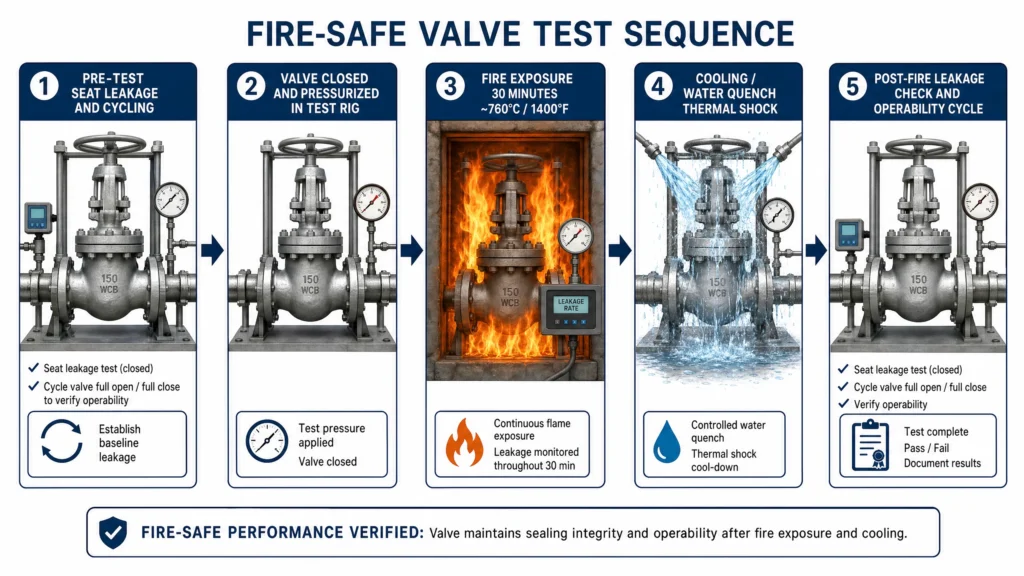
A fire test is designed to simulate a severe thermal event under controlled conditions. The exact procedure and acceptance criteria depend on the standard and edition, so buyers should avoid relying on generic summaries for contractual decisions. Still, the broad sequence is consistent enough to understand what the certificate is trying to prove.
First, the valve is prepared, cycled, and leakage-tested before the fire exposure. This establishes baseline performance. Second, the valve is installed in a test rig, usually closed and pressurized. Third, flame exposure is applied for a defined period while leakage is measured. Fourth, the valve is cooled, sometimes with water spray or quench, creating thermal shock. Finally, leakage and operability are evaluated after the fire.
| Test stage | What it checks |
|---|---|
| Pre-test inspection and cycling | Confirms the valve begins in working condition and establishes baseline leakage |
| Pressurized fire exposure | Measures whether the valve contains pressure and limits leakage during flame exposure |
| External leakage monitoring | Checks body joints, stem seals, packing, gaskets, and other external leakage paths |
| Internal or seat leakage monitoring | Checks leakage across the closed valve seat during defined test conditions |
| Cool-down or quench | Challenges the valve with thermal shock after fire exposure |
| Post-fire operation | Confirms whether the valve can be operated as required by the standard |
| Final leakage check | Verifies leakage after fire and cooling remains within acceptance criteria |
Dervos summarizes the practical distinction between three claims: fire-safe by design means the valve is designed with fire-safe features but has not necessarily been tested; fire-safe tested means a test was performed but may not be third-party approved; fire-safe approved and certified means testing and certification were performed by a recognized third party to a standard such as API 607, API 6FA, or ISO 10497. That distinction is one of the most useful ideas for procurement teams.
What a Fire-Safe Certificate Actually Proves
A valid fire-safe certificate proves that a tested valve configuration met the referenced standard’s acceptance criteria under the specified test conditions. It should identify the valve model, valve type, size or size range, pressure class, end connection, materials, seat and trim arrangement, test pressure, test duration, leakage results, operability results, test lab, report number, and standard edition.
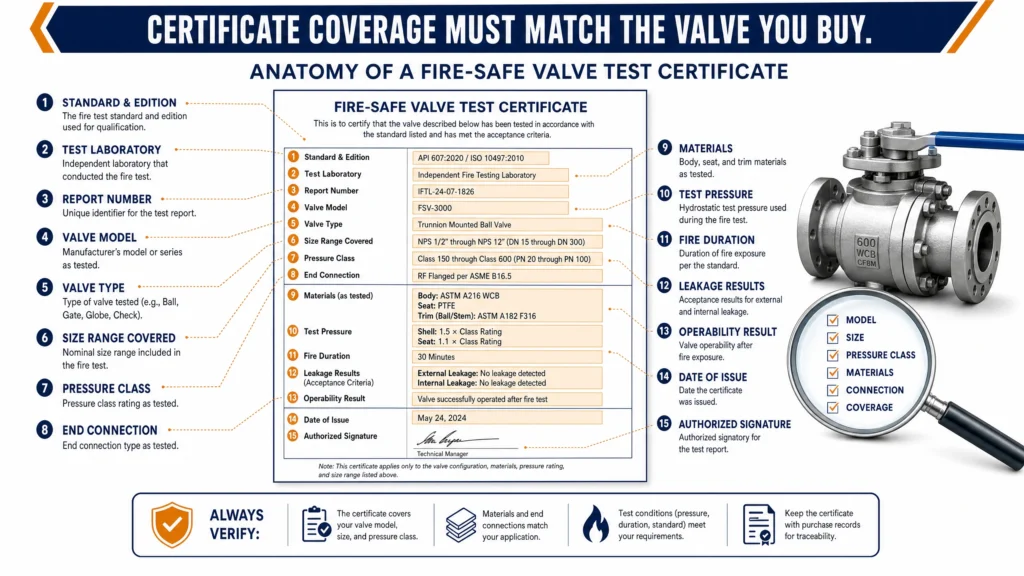
| Certificate field | Why buyers must check it |
|---|---|
| Standard and edition | API 607 and API 6FA requirements and project acceptance can depend on edition |
| Valve model or series | A certificate for another model may not apply |
| Valve type | Ball, butterfly, plug, gate, and check valves are not interchangeable in coverage |
| Size range covered | Type-test coverage is not always unlimited across all sizes |
| Pressure class | Class 150 evidence may not qualify Class 600 service |
| Seat and trim materials | Fire behavior changes when seat, seal, packing, or trim material changes |
| End connection | Flanged, threaded, welded, lug, wafer, or other connections can affect test relevance |
| Leakage results | The certificate should show actual measured results or pass/fail basis |
| Test lab and report number | Traceability matters for QA, audits, and project acceptance |
This is where buyers often discover problems. The certificate may be real, but it may cover a different pressure class, old seat material, different end connection, or a smaller size range than the valve being supplied. That is not a paperwork detail; it can be a safety and acceptance problem.
What the Certificate Does Not Prove
A fire-safe certificate is valuable, but its limits are just as important as its proof. A certificate does not mean the valve is fireproof forever. It does not prove the actuator, solenoids, positioner, limit switches, or cabling will function during a fire unless those items were included in the relevant test or protected by separate design measures. GlobalSpec’s API 607 scope note states that the standard does not cover testing requirements for valve actuators other than manually operated gearboxes or similar mechanisms when they form part of the normal valve assembly; other actuators may need special protection, and their fire testing is outside that scope.
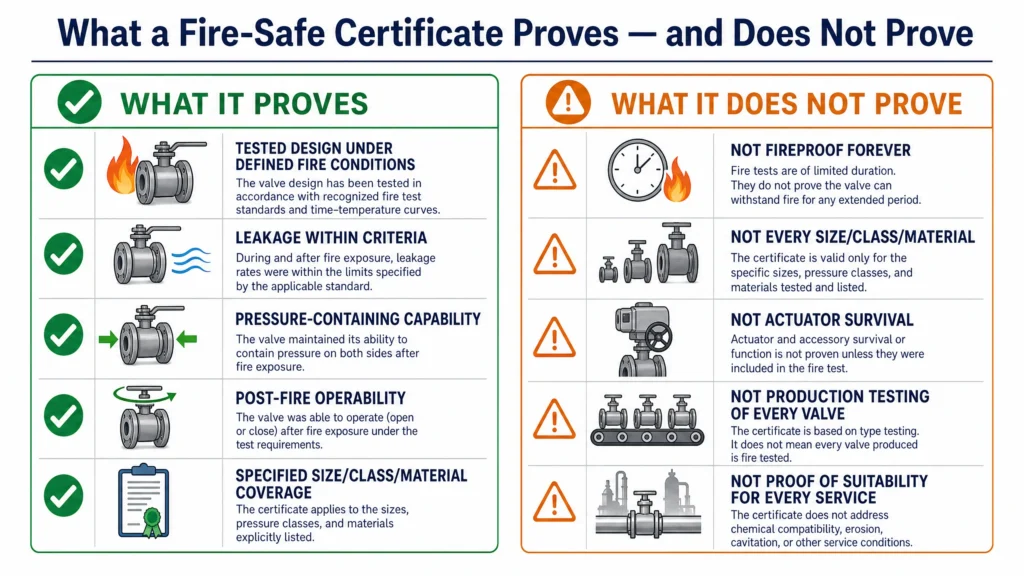
| A certificate can prove | A certificate does not automatically prove |
|---|---|
| A tested design met a defined fire test standard | The valve is fireproof for any duration or fire intensity |
| Leakage stayed within criteria during and after the test | Every possible size, pressure class, end connection, or material variant is covered |
| The valve retained pressure-containing capability under test conditions | The actuator and accessories will survive unless tested or protected separately |
| Post-fire operability met the standard’s requirement | Every production valve was fire-tested individually |
| The tested configuration has traceable evidence | The valve is suitable for corrosion, erosion, cryogenic, or severe service without further review |
This distinction is particularly important for automated ESD valves. A bare valve may have a valid fire-safe certificate, but the emergency shutdown function also depends on actuator survival, air supply, power, solenoid valves, cables, fireproofing, logic, and proof testing. Carter Valve’s ESD valve selection, leakage, and stroke time guide is a useful internal link for connecting fire-safe valve certificates with shutdown system performance.
Fire-Safe Butterfly Valves: Why Seat Design Matters
Butterfly valves can be fire-safe, but the design details matter. Many butterfly valves rely on soft seats for normal tight shutoff. During a fire, nonmetallic materials may degrade, melt, or lose sealing force. A fire-safe butterfly valve therefore needs a secondary sealing path or metal backup sealing geometry capable of limiting leakage after the primary soft seal is damaged.
High-performance double-offset butterfly valves and triple-offset butterfly valves often appear in fire-safe discussions because their offset geometry can reduce rubbing and enable more reliable secondary sealing behavior. Carter Valve’s high-performance double-offset butterfly valve, metal-to-metal seated butterfly valve, and ultra-high-pressure triple-offset butterfly valve resources explain the design context behind this type of severe-service isolation.
| Design feature | Fire-safe relevance |
|---|---|
| Secondary metal sealing surface | Provides a backup path if soft seat materials are compromised |
| Graphite packing or fire-resistant packing | Helps limit stem leakage after high-temperature exposure |
| Anti-blowout stem | Helps maintain pressure boundary integrity |
| Anti-static device | Reduces ignition risk in flammable service |
| Offset geometry | Reduces seat wear and can support more reliable sealing under severe duty |
| Proper actuator/fireproofing plan | Supports valve function when automation is required during emergencies |
For critical hydrocarbon isolation, buyers should also review Carter Valve’s bi-directional zero leakage guide and valve leakage classes guide to avoid confusing normal seat leakage testing with fire-test leakage performance.
Buyer Checklist: How to Review a Fire-Safe Certificate
Procurement should not simply ask, “Do you have API 607?” A better question is: “Show me the fire-test report proving that this exact valve design, in this size/class/material configuration or approved coverage range, meets the applicable project standard and edition.”
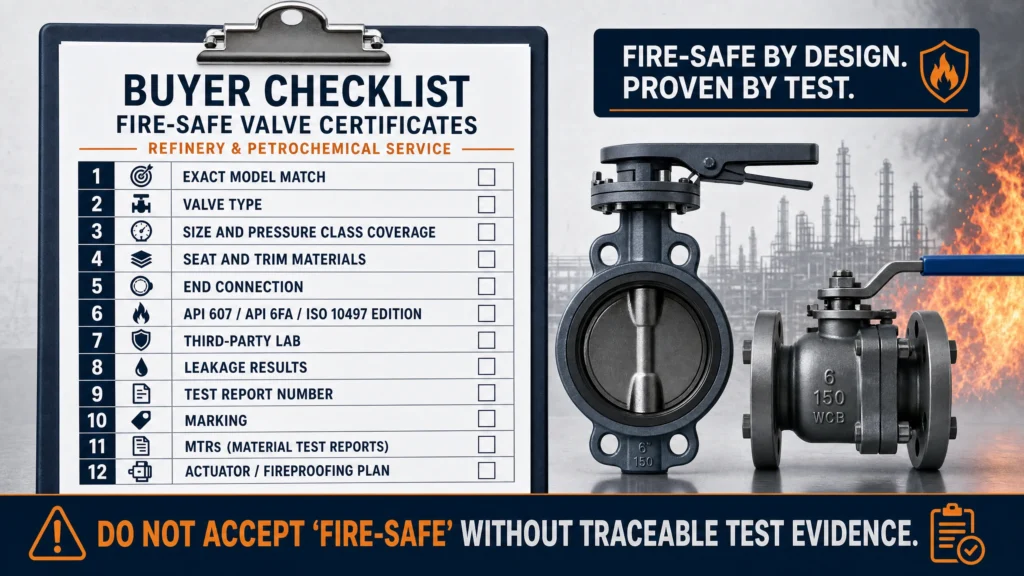
| Checklist item | What to verify |
|---|---|
| Exact valve model | Certificate model or series matches quotation and data sheet |
| Valve type | Butterfly, ball, gate, plug, or other type is within the certificate scope |
| Size coverage | Supplied size is explicitly listed or covered by the test report rules |
| Pressure class | Supplied class/rating is covered by the tested configuration |
| Seat and trim materials | Soft seat, metal backup, stem packing, gaskets, and trim match certificate |
| End connection | Flanged, threaded, lug, wafer, or welded construction matches or is covered |
| Standard edition | API 607/API 6FA/ISO 10497 edition matches project requirement |
| Test laboratory | Third-party lab or accepted test authority is identified |
| Leakage data | Internal and external leakage results meet acceptance criteria |
| Actuator plan | Automation survival or fireproofing is addressed separately if needed |
| Traceability | MTRs, markings, drawings, and certificate report number align |
Carter Valve’s valve markings, rating, and standards page is helpful for checking whether nameplate and documentation data align. For broader project selection, Carter’s oil and gas solutions and isolation valves category provide relevant context.
Common Certificate Pitfalls
One common pitfall is accepting a certificate for a different valve family because the model names sound similar. Another is accepting a certificate for the same model but a different seat material. A third is assuming that a fire test certificate for a manually operated valve proves an actuated ESD assembly will function through fire.
A fourth pitfall is confusing “fire-safe by design” with “fire-safe certified.” A supplier may have a sensible design with graphite packing and metal backup seating, but without a traceable test report it is still a design claim, not tested evidence. A fifth pitfall is ignoring standard edition. A certificate to an older edition may be acceptable on some legacy projects and unacceptable on others.
The safest procurement practice is to add a certificate review step before purchase order release and again before shipment. If the valve is mission-critical, involve process safety, piping, instrumentation, and QA/QC teams in the review rather than leaving the certificate to procurement alone.
Practical Specification Wording
A strong specification should state the required fire-test standard, edition, valve type, coverage expectation, and documentation package. It should also clarify whether the actuator and accessories require fireproofing or separate qualification.
| Specification section | Example wording concept |
|---|---|
| Fire-test requirement | “Valve design shall be fire-tested to API 607, ISO 10497, API 6FA, or project-approved standard as specified on the valve data sheet.” |
| Certificate coverage | “Certificate shall cover supplied model, size, pressure class, end connection, and seat/trim materials.” |
| Documentation | “Supplier shall submit full fire-test report or accepted certificate, MTRs, GA drawing, and compliance matrix.” |
| Actuation | “Actuator and accessories are not assumed fire-tested unless specifically documented; provide fireproofing plan where required.” |
| Marking and traceability | “Valve marking and serial number shall align with test reports, MTRs, and inspection records.” |
For severe butterfly valve projects, Carter’s six-eccentric vs triple-offset butterfly valve guide can help buyers understand how geometry affects sealing, wear, and severe-service performance beyond the certificate itself.
Conclusion
API 607 vs API 6FA is not only a standards-name comparison. It is a certificate interpretation problem. A fire-safe valve certificate proves that a tested valve configuration met defined leakage, pressure-containing, and operability requirements during and after a controlled fire test. It does not prove unlimited fire survival, automatic coverage for every size/class/material, actuator survival, or suitability for every refinery or petrochemical service.
For buyers, the best practice is to verify the standard and edition, exact valve model, size and pressure class coverage, seat and trim materials, end connection, leakage results, test laboratory, report number, and actuator/fireproofing strategy. Carter Valve can support this review with fire-safe butterfly valve selection, metal-seated and high-performance isolation designs, leakage-class guidance, and application-based engineering for critical hydrocarbon services.
Frequently Asked Questions
What is a fire-safe valve?
A fire-safe valve is designed and tested to limit leakage and maintain pressure containment during and after a defined fire exposure. It is not fireproof forever; it is qualified for a specific test standard, duration, pressure, and leakage acceptance criteria.
What is API 607?
API 607 is a fire test standard commonly associated with quarter-turn valves and valves with nonmetallic seats. Public standards listings describe it as a fire type-test method for confirming pressure-containing capability under pressure during and after a fire test.
What is API 6FA?
API 6FA has historically been used for fire testing of API 6A and API 6D valves in production and pipeline service. Some current sources describe it as withdrawn or incorporated into newer API 607 practice, so buyers should verify official standard status and project requirements.
Does a fire-safe certificate mean every shipped valve was fire-tested?
Usually no. Fire-safe certificates are typically based on type testing of a representative valve design. Production valves normally receive standard production testing, not destructive fire testing, unless a project explicitly requires otherwise.
Does API 607 prove actuator survival?
Not automatically. API 607 scope summaries state that actuator testing beyond certain manual gear mechanisms is outside the standard’s scope. Automated ESD valves may need separate actuator fireproofing or qualification review.
Can a certificate for one size cover another size?
Sometimes, depending on the standard, edition, test report, and coverage rules. Buyers should not assume coverage. The supplied valve size and pressure class must be explicitly listed or demonstrably covered by the report.
What should I check on a fire-safe valve certificate?
Check the standard and edition, test lab, report number, valve model, valve type, size range, pressure class, end connection, seat and trim materials, test pressure, leakage results, operability result, and whether the certificate matches the supplied valve.
Is “fire-safe by design” the same as “fire-safe certified”?
No. “Fire-safe by design” is a design claim. “Fire-safe certified” should mean the valve has been tested and documented to a recognized standard by an accepted test authority or third party.
References
[2] Projectmaterials — API 607 vs API 6FA: Fire Test Standards
[3] SVF Flow Controls — Fire Safe Ball Valves: Why Certification Matters
[4] Dervos Valve — Fire Safe Test API 6FA and API 607
[5] NSW Valve — Difference between API 607 and API 6FA
[6] IPC Valves — Fire Safe Valves: Beyond the Label with API 607/6FA Compliance
[7] TG Valve — API 607 vs API 6FA Fire-Safe Valve Testing Standards
[8] American Petroleum Institute — Standards
[9] Carter Valve — Butterfly Valve Selection Guide for Critical Isolation & Severe Service