





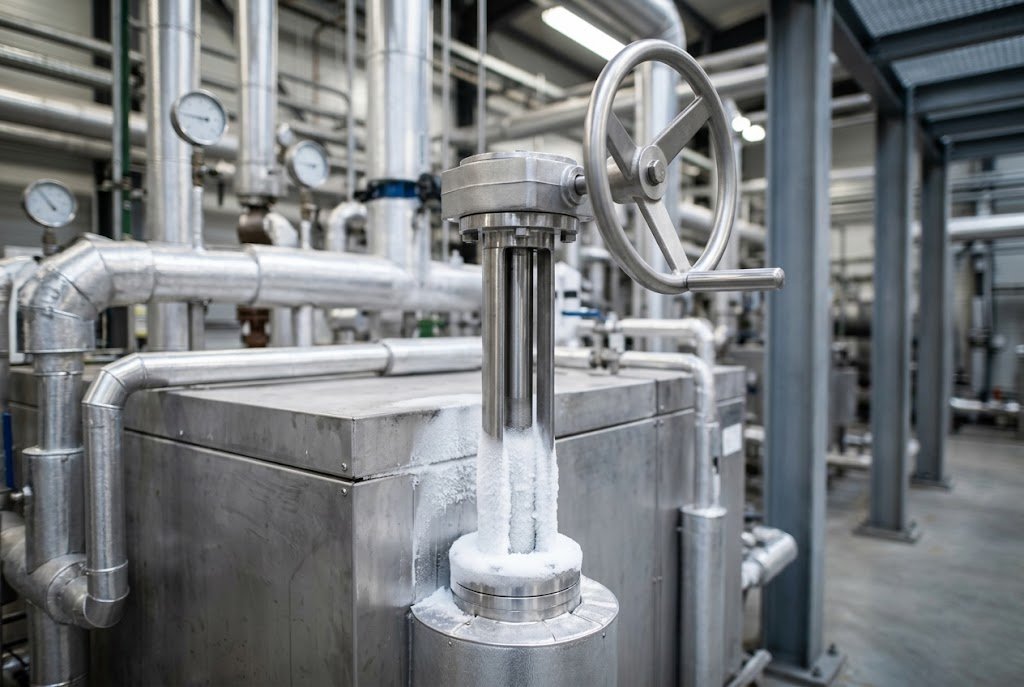
A Kryo-Klappenventil ist ein Vierteldrehventil, das so konstruiert ist, dass Absperrung, Funktionsfähigkeit und Spindelabdichtung bei Temperaturen weit unter der Umgebungstemperatur erhalten bleiben, wie sie üblicherweise bei LNG, Flüssigstickstoff, Flüssigsauerstoff, Ethylen, Wasserstoff und Luftzerlegung auftreten. Die wichtigste Schlussfolgerung aus der Konstruktion ist einfach: das verlängerte Ventiloberteil ist kein Zubehör; es ist die Wärmebrücke, die die Schnittstelle zwischen Stopfbuchse und Stellantrieb aus der Gefrierzone heraushält, während das Ventilgehäuse im Tieftemperaturbetrieb bleibt. In der Sprache der US-Regulierungsbehörden können kryogene Bedingungen Gase bedeuten, die bei -130°F oder weniger, und LNG-Dienste werden häufig in der Öffentlichkeit diskutiert. -162°C.
Für Ingenieure, die LNG- oder Cold-Box-Ventile spezifizieren, lautet die eigentliche Frage nicht einfach “Kann diese Absperrklappe mit niedrigen Temperaturen umgehen?” Die bessere Frage lautet: Dichtet das Ventil auch nach Abkühlung, Temperaturwechsel, Isolierung und jahrelangem Betrieb bei niedrigen Temperaturen noch ab, hat es noch einen Hub und lässt sich warten? In diesem Leitfaden wird erläutert, wie man die Länge der verlängerten Ventilhaube, die Cold-Box-Konfiguration und die Materialauswahl so gestaltet, dass gefrorene Packungen, Leckagen an der Spindel, Probleme beim Zugang zum Stellantrieb und Versagen von sprödem Material vermieden werden.
Warum kryogene Absperrklappen anders konstruiert sind
Bei Umgebungstemperatur konzentriert sich die Auswahl von Absperrklappen häufig auf die Druckklasse, den Durchflusskoeffizienten, die Leckageklasse, das Sitzmaterial, das Antriebsdrehmoment und die Flanschbohrung. Diese Faktoren sind auch im Tieftemperaturbereich wichtig, aber sie reichen nicht aus. Kryogene Systeme bringen zusätzliche thermische Kontraktion, Eisbildung, verringerte Materialduktilität, Tieftemperatur-Dichtungsverhalten, Temperaturkontrolle der Stielpackung und Zugänglichkeit der Cold Box.
Eine Standardklappe kann in einer Werkstatt perfekt schließen und trotzdem in einer LNG-Leitung versagen, weil Scheibe, Sitz, Spindel, Lager und Gehäuse unterschiedlich schnell schrumpfen. Packungen, die bei Raumtemperatur gut funktionieren, können aushärten, undicht werden oder einfrieren, wenn die Stopfbuchse in die Kältezone gezogen wird. Schmiermittel können ungeeignet werden, Antriebskomponenten können vereisen und kleine Spielräume können während der Abkühlung verschwinden.
Aus diesem Grund betrachtet Carter Valve die Auswahl eines Tieftemperaturventils als eine Entscheidung für einen anspruchsvollen technischen Service und nicht als den Kauf eines Gebrauchsgegenstands. Weitere Informationen zu den Produkten finden Sie in der Carter Valve kryogene sechsfach exzentrische Absperrklappe und das breitere Plattform für sechs exzentrische Absperrklappen, die von Bedeutung sind, wenn geringe Leckage, kontrolliertes Drehmoment und metallisches Dichtungsverhalten wichtig sind.
Erweiterte Motorhaubenlänge: Was sie tatsächlich zu tun hat
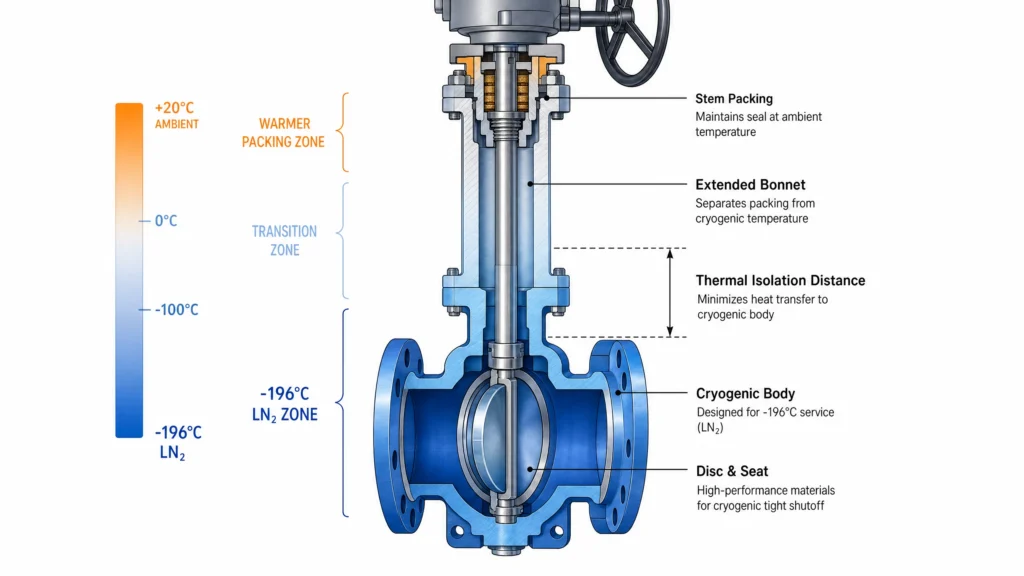
Das verlängerte Ventiloberteil trennt den kalten Ventilkörper von der Spindelpackung und dem Montagebereich des Antriebs. In der Praxis schafft es einen ausreichenden thermischen Abstand, so dass die Stopfbuchspackung innerhalb ihres Arbeitstemperaturbereichs bleibt, während das Ventilgehäuse, der Ventilteller und der Ventilsitz kryogenen Temperaturen ausgesetzt sind.
In den Anleitungen für Tieftemperaturventile wird häufig darauf hingewiesen, dass verlängerte Ventiloberteile oder Stopfbuchsen erforderlich sind, damit die Spindelpackung warm genug für einen zuverlässigen Betrieb bleibt. Die MSS SP-134 wird auch häufig für Tieftemperaturventile mit Gehäuse- oder Ventiloberteilverlängerungen herangezogen, und in den Zusammenfassungen der Industrie wird ihr Zweck als Isolierung der Spindelpackung und des Betriebsmechanismus von den Temperatureinflüssen der Tieftemperaturflüssigkeit beschrieben.
| Erweiterte Motorhaubenfunktion | Warum es im Feldeinsatz wichtig ist |
|---|---|
| Hält die Verpackung wärmer | Verringert das Risiko, dass die Verpackung einfriert, aushärtet oder die Dichtungsspannung verliert |
| Bewegt die Aktorschnittstelle nach oben | Ermöglicht die Montage des Stellantriebs außerhalb der Isolierung oder über frostgefährdeten Bereichen |
| Bietet ein thermisches Gefälle | Reduziert den direkten Wärmeaustritt und schützt die Stopfbuchse |
| Unterstützt die Wartungsfreundlichkeit | Ermöglicht die Inspektion oder Anpassung der Verpackung ohne Störung der Kälteisolierung |
| Verbessert die Flexibilität bei der Installation | Hilft beim Ausrichten von Ventilkörper, Cold-Box-Wand und Zugangsplattform zum Stellantrieb |
Die richtige Ventilhaubenlänge wird nicht nach dem Aussehen gewählt. Sie hängt von der Betriebstemperatur, der Isolierstärke, der Spindelausrichtung, der Ventilgröße, dem Packungsmaterial, der Cold-Box-Geometrie, dem Antriebstyp und davon ab, ob das Ventil für Flüssigkeiten oder Gase eingesetzt wird. Ein zu kurzes Ventiloberteil kann dazu führen, dass sich die Stopfbuchse innerhalb der Frostzone befindet. Ein zu langes Ventiloberteil kann die Biegebelastung erhöhen, zu Vibrationen führen und den Zugang erschweren, wenn es nicht richtig abgestützt ist.
Ein gutes Ventil-Datenblatt sollte daher folgende Angaben enthalten Mindestbetriebstemperatur, gewünschte Spindelausrichtung, Dicke der Isolierung oder der Coldbox, Temperatur der Verpackungskonstruktion, Standort des Stellantriebs, und geforderter Prüfstandard. Wenn das Ventil in einem Kühlraum installiert werden soll, sollte der Lieferant dies vor der Planung der Erweiterung wissen.
Cold-Box-Konfiguration: Das Ventil ist Teil des Isolationssystems
Cold-Box-Anwendungen unterscheiden sich von offenen kryogenen Rohrleitungen. In einer Cold Box kann sich das Ventilgehäuse in einem isolierten Gehäuse befinden, während das Ventiloberteil und die Spindelverlängerung die Isolierung durchdringen, so dass der Stellantrieb von außen zugänglich bleibt. Diese Anordnung schützt die Wartungsfreundlichkeit, birgt aber auch Schnittstellenrisiken: Durchdringung der Isolierung, Dampfsperren, Stützlasten, Spindelwinkel und Stellantriebsspiel.
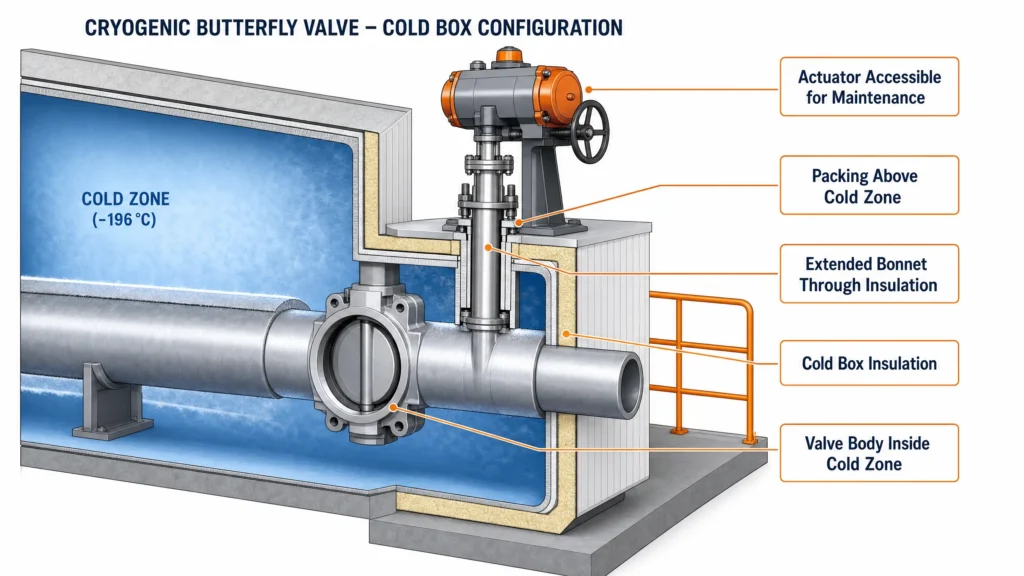
In den Zusammenfassungen der BS 6364-Anforderungen wird häufig zwischen allgemeinen Flüssigkeitsanwendungen, Gasanwendungen und Cold-Box-Anwendungen unterschieden. In diesen Zusammenfassungen werden Ventile für den Flüssigkeitsbetrieb üblicherweise so beschrieben, dass sie mit einer Spindelstellung von 45° oder mehr über der Horizontalen betrieben werden müssen, während Cold-Box-Anwendungen einen Betrieb bei 15° oder mehr über der Horizontalen erlauben. Bei der Konstruktion geht es nicht darum, eine Zahl auswendig zu lernen, sondern darum Überprüfung der erforderlichen Ausrichtung für die geltende Norm, die Projektspezifikation und die Ventilkonstruktion.
| Cold box design item | Zu stellende Spezifikationsfrage |
|---|---|
| Lage des Ventilgehäuses | Befindet sich die Leiche vollständig in der Kühlbox, teilweise eingebettet oder außerhalb der Isolierung? |
| Eindringen in die Motorhaube | Wie weit muss die Motorhaube über Dämmung und Dampfsperre hinausragen? |
| Ausrichtung des Stiels | Entspricht die Installation dem erforderlichen Winkel für Flüssigkeits-, Gas- oder Cold-Box-Service? |
| Zugang zum Aktuator | Können die Techniker den Antrieb, das Handrad, die Endschalter und das Zubehör sicher erreichen? |
| Thermische Unterstützung | Werden die Biegebelastungen durch lange Verlängerungen und das Gewicht des Aktuators angemessen unterstützt? |
| Umschlag für Wartungsarbeiten | Können Packung, Stellungsregler, Antrieb und Zubehör gewartet werden, ohne die Isolierung zu entfernen? |
Cold-Box-Projekte scheitern oft an den Schnittstellendetails. Der Ventillieferant kann ein korrektes Tieftemperaturventil entwerfen, aber das EPC-Team kann später feststellen, dass der Stellantrieb mit der Stahlkonstruktion kollidiert, der Isolierunternehmer nicht genügend Abstand hat oder die Haube nicht weit genug über die Cold-Box-Wand hinausragt. Diese Probleme sind kostspielig, denn Änderungen an der Coldbox zu einem späteren Zeitpunkt sind selten einfach.
Verbinden Sie bei der Überprüfung von frühen Layouts die Ventiltechnik mit der Planung von Rohrleitungen, Isolierung, Struktur und Wartung. Für den Kontext von Öl- und Gas- und LNG-Systemen bietet Carter Valve's Öl- und Gaslösungen Seite ist eine nützliche interne Referenz für die Anpassung der Ventilfunktion an die Betriebsbedingungen des Projekts.
Materialauswahl: Zähigkeit geht vor Bequemlichkeit
Tieftemperaturbetrieb bestraft Werkstoffe, die nur aufgrund ihrer Festigkeit bei Umgebungstemperatur oder ihrer Kosten ausgewählt wurden. Bei sehr niedrigen Temperaturen verlieren einige Metalle ihre Duktilität und können spröde werden. Nichtmetallische Sitze und Packungen können schrumpfen, verhärten oder an Elastizität verlieren. Verschraubungen, Lager, Schmiermittel und Dichtungsaktivatoren müssen ebenfalls mit der Mindesttemperatur kompatibel sein.
In der Fachliteratur von Wettbewerbern und Herstellern werden in der Regel folgende Punkte genannt Rostfreier Stahl 304L und 316L als typische Tieftemperaturoptionen für Gehäuse und Klappenscheiben von Tieftemperaturklappen, während in speziellen Datenblättern Kombinationen wie Gehäuse und Klappenscheiben aus Edelstahl 316, XM-19-Spindeln, PTFE- oder Graphitpackungen und verlängerte Deckel aus Edelstahl 316 aufgeführt sind. Diese Beispiele sind nützlich, aber die endgültige Materialauswahl muss immer noch unter Berücksichtigung der Druck-Temperatur-Bewertung des Projekts, der Medien, der Sauberkeitsanforderungen, der Korrosionsumgebung und der geltenden Vorschriften geprüft werden.
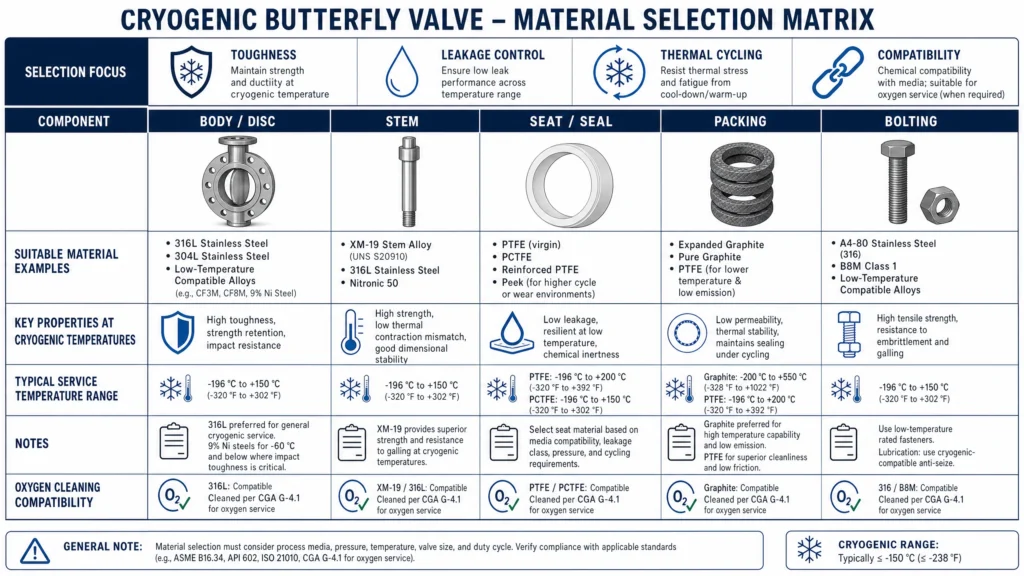
| Komponente | Typische Auswahlschwerpunkte | Praktische Hinweise |
|---|---|---|
| Körper und Scheibe | Tieftemperaturzähigkeit, Druckfestigkeit, Korrosionsbeständigkeit | 304L/316L-Edelstahl ist üblich; für ungewöhnliche Medien können spezielle Legierungen erforderlich sein |
| Vorbau | Festigkeit, Abriebfestigkeit, Maßhaltigkeit | Hochfeste rostfreie oder stickstoffverstärkte Legierungen können spezifiziert werden. |
| Sitz oder Dichtung | Widerstandsfähigkeit bei niedrigen Temperaturen und Leckagekontrolle | Dichtungen auf PTFE-, PCTFE-, Graphit- oder Metallbasis können je nach Einsatzbereich in Betracht gezogen werden. |
| Verpacken | Spindelabdichtung bei Temperaturgefälle | Die Verpackung muss bei der erwarteten Temperatur in der Stopfbuchse funktionsfähig bleiben. |
| Verschraubung | Festigkeit und Zähigkeit im Betriebszustand | Verwendung von für das Projekt zugelassenen Niedertemperaturverschraubungen und Anti-Ablagerungsmethoden |
| Schmierstoffe | Funktionsfähigkeit bei niedrigen Temperaturen | Standardschmierstoffe sind in kryogenen Umgebungen möglicherweise nicht mehr verwendbar |
Materialzertifikate sollten nicht nur als Papierkram betrachtet werden. Für kritische kryogene Dienste, fordern Sie Materialprüfberichte, Die ASME B16.34 behandelt die Anforderungen an die Kerbschlagbiegefestigkeit, gegebenenfalls die Anforderungen an die Kerbschlagbiegefestigkeit, die Aufzeichnungen über die Wärmebehandlung und die Bestätigung, dass die drucktragenden Werkstoffe der Mindesttemperatur des Auslegungsmetalls entsprechen. ASME B16.34 umfasst Druck-Temperatur-Bewertungen, Abmessungen, Toleranzen, Werkstoffe, zerstörungsfreie Prüfung, Tests und Kennzeichnung für die Ventilkonstruktion. API legt außerdem Wert auf konsensbasierte Normen für eine sichere und zuverlässige Praxis in der Öl- und Gasindustrie.
Eine genauere Erläuterung des Absperrverhaltens und der Dichtungstechnologien finden Sie in Carter Valve's Guide to Metallisch dichtende Absperrklappen und der Artikel über Ventil-Leckageklassen helfen, die Wahl der Materialien mit den erwarteten Leckagen zu verbinden.
Abdichtung und Wärmekontraktion: Das verborgene Designproblem
Die thermische Kontraktion ist einer der Hauptgründe, warum Tieftemperaturklappen eine sorgfältige Konstruktion erfordern. Das Gehäuse, die Klappenscheibe, die Spindel, die Lager, der Sitz und die Befestigungselemente schrumpfen nicht immer in gleichem Maße. Wenn die Abstände zu eng sind, kann die Klappe klemmen. Wenn das Spiel zu groß wird, kann die Leckage zunehmen. Wenn die Spindel und der Teller nicht mehr fluchten, kann die Sitzbelastung ungleichmäßig werden.
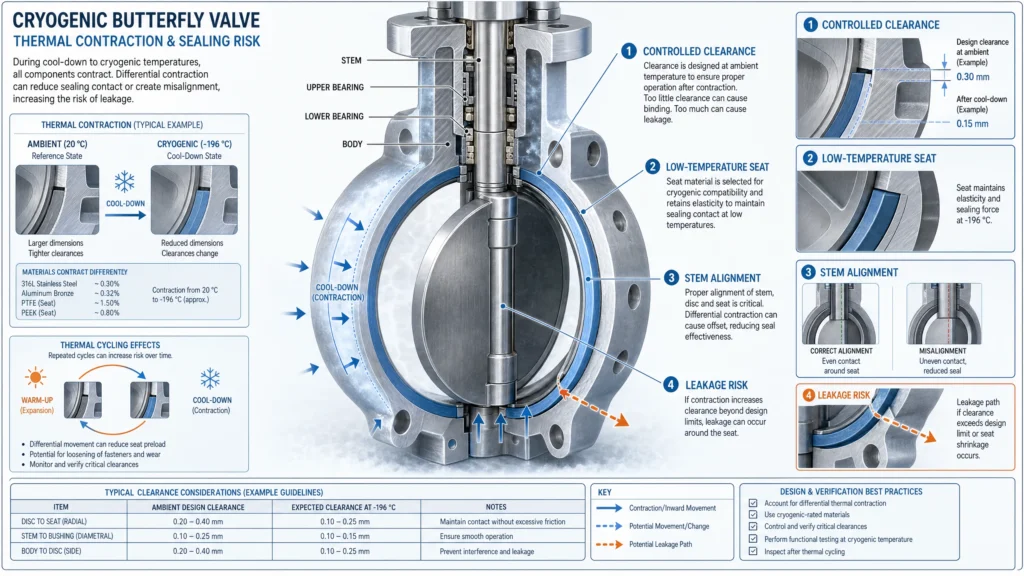
Eine gute Konstruktion der Kryoklappe steuert daher das Verhältnis zwischen Scheibengeometrie, Sitzkompression, Wellenabstützung, Lagerauswahl und Gehäusespiel. Für Hochzyklus- oder Thermozyklusbetrieb ist dieses Verhältnis ebenso wichtig wie die Nennleckageklasse. Das Ventil muss nach wiederholten Abkühl- und Aufwärmzyklen abdichten, nicht nur während der ersten Werksprüfung.
| Gestaltungsrisiko | Wie es im Betrieb aussieht | Methode der Prävention |
|---|---|---|
| Verpacken einfrieren | Frost um die Stopfbuchse, hohes Drehmoment, Leckage der Spindel | Richtige Länge der verlängerten Motorhaube und Auswahl der Packung |
| Schrumpfung des Sitzes | Leckage nach Abkühlung oder nach Temperaturwechsel | Tieftemperatur-Sitzmaterial und verifizierte Tieftemperaturtests |
| Fehlausrichtung des Schaftes | Ungleichmäßiges Drehmoment, Scheibenreibung, schlechtes Abschalten | Robuste Spindel-Scheiben-Verbindung und Lagerabstützung |
| Körper-Scheiben-Interferenz | Ventil klemmt beim Öffnen oder Schließen | Kontrollierte Abstände und Entwurfsprüfung im kalten Zustand |
| Unterdimensionierung des Stellantriebs | Langsamer Hub oder kein Schließen bei niedriger Temperatur | Berechnung des Drehmoments unter kryogenen Bedingungen und mit Sicherheitsmarge |
Hier kann auch die sechsfach exzentrische Konstruktionsphilosophie von Carter Valve von Bedeutung sein. Eine nicht reibende, kontrollierte Dichtungsgeometrie kann den Verschleiß und die Drehmomentempfindlichkeit bei anspruchsvollen Isolationsanwendungen reduzieren. Für Leser, die Dichtungsgeometrien vergleichen, ist der interne Leitfaden auf sechsfach exzentrische vs. dreifach exzentrische Absperrklappen bietet einen natürlichen nächsten Schritt.
Betätigung, Spindelausrichtung und Zugänglichkeit
Kryogene Absperrklappen werden häufig automatisiert, da sie in LNG-Transferleitungen, Prozesssträngen, Lagereinrichtungen oder Coldboxen eingesetzt werden können, wo eine manuelle Bedienung unerwünscht oder schwierig ist. Der Antrieb selbst befindet sich zwar nicht in der kältesten Zone, ist aber dennoch von Frost, Kondensation, Vibrationen, Notabschaltlogik und Zugangsbeschränkungen betroffen.
Ein Lieferant sollte das Drehmoment für den gesamten Betriebsbereich berechnen, nicht nur für eine Armatur mit sauberer Umgebung. Die Berechnung sollte Losbrechmoment, Laufmoment, Sitzdrehmoment, Reibung der Packung, Verhalten der Lager bei niedrigen Temperaturen, Differenzdruck und jegliches zusätzliche Drehmoment durch thermische Kontraktion berücksichtigen. Wenn die Armatur für eine Notabschaltung vorgesehen ist, sollten auch die Ansprechzeit und die Ausfallfunktion angegeben werden. Carter Valve's Antriebsauslegung für Absperrklappen ist ein hilfreicher interner Leitfaden für die Umsetzung des Drehmomentbedarfs der Armatur in die Auswahl des Antriebs.
Die Ausrichtung der Spindel ist ebenso wichtig. Im Flüssigkälteservice kann eine zu nahe an der Horizontalen installierte Spindel dazu führen, dass das Verhalten von kalten Flüssigkeiten oder Dämpfen die Packungszone in einer Weise beeinflusst, für die das Ventiloberteil nicht vorgesehen ist. Im Cold-Box-Betrieb kann die zulässige Geometrie abweichen, sie sollte jedoch immer in der Projektspezifikation und den Zeichnungen des Herstellers bestätigt werden.
Prüfung und Dokumentation: Akzeptieren Sie keine reinen Umgebungsnachweise
Eine kryogene Absperrklappe sollte für die Bedingungen, denen sie tatsächlich ausgesetzt ist, geprüft werden. In den Datenblättern der Hersteller wird häufig auf Tieftemperaturtests nach Normen wie BS 6364 und ISO 28921, zusammen mit allgemeineren Ventilnormen wie ASME B16.34, API 609, ISO 5208 oder EN 12266, je nach Konstruktion und Markt. Der Käufer sollte angeben, welche Prüfungen erforderlich sind, anstatt eine allgemeine Aussage wie “geprüft” zu akzeptieren.
Bei LNG-, Sauerstoff-, Stickstoff-, Wasserstoff- oder Ethylenbetrieb sollte die Dokumentation den Prüfdruck, die Prüftemperatur, die Abnahme der Sitzleckage, den Gehäusetest, die Leckage der Spindelabdichtung, die Anzahl der Zyklen (falls zutreffend), die Ausrichtung des Ventils während der Prüfung und die Angabe, ob es sich bei der Prüfung um einen Prototyp, eine Produktion oder ein Projekt handelt, enthalten. Für den Betrieb mit Sauerstoff sind möglicherweise auch Reinigungs- und Kompatibilitätskontrollen erforderlich.
| Dokument oder Prüfprotokoll | Warum das wichtig ist |
|---|---|
| Kryogenes Prüfzeugnis | Bestätigt die Dichtheit und Funktionsfähigkeit bei der angegebenen niedrigen Temperatur |
| Materialprüfberichte | Bestätigt druckhaltende Materialien und Rückverfolgbarkeit |
| Dokumentation der Folgenabschätzung | Unterstützt die Anforderungen an die Tieftemperaturzähigkeit, wo anwendbar |
| Bericht der Leckageklasse | Verhindert Verwechslungen zwischen Ansprüchen auf Abschaltung bei Umgebungstemperatur und bei Tieftemperatur |
| Sauerstoff-Reinigungszertifikat | Kritisch für LOX und sauerstoffreiche Dienste |
| Auslegungsblatt für Drehmoment oder Stellantrieb | Bestätigt den Spielraum des Stellantriebs unter Tieftemperaturbedingungen |
| Allgemeine Anordnungszeichnung | Zeigt die Länge der Motorhaube, die Cold-Box-Schnittstelle, den Freiraum des Stellantriebs und den Spindelwinkel |
Das nützlichste Abnahmepaket ist eines, das ein Betriebs- oder Wartungsteam später verwenden kann. Basisdrehmoment, Hubzeit, Lecktestdaten, Packungsanordnung und Ersatzteildetails sollten für die künftige Fehlersuche aufbewahrt werden.
Eine praktische Checkliste für die Spezifikation
Bevor Sie eine Absperrklappe für die Tieftemperaturtechnik bestellen, sollten Sie das Datenblatt so verfassen, als ob ein Wartungsbeauftragter die nächsten zehn Jahre mit dieser Klappe leben müsste. Die Spezifikation sollte Unklarheiten beseitigen, bevor die Fertigung beginnt.
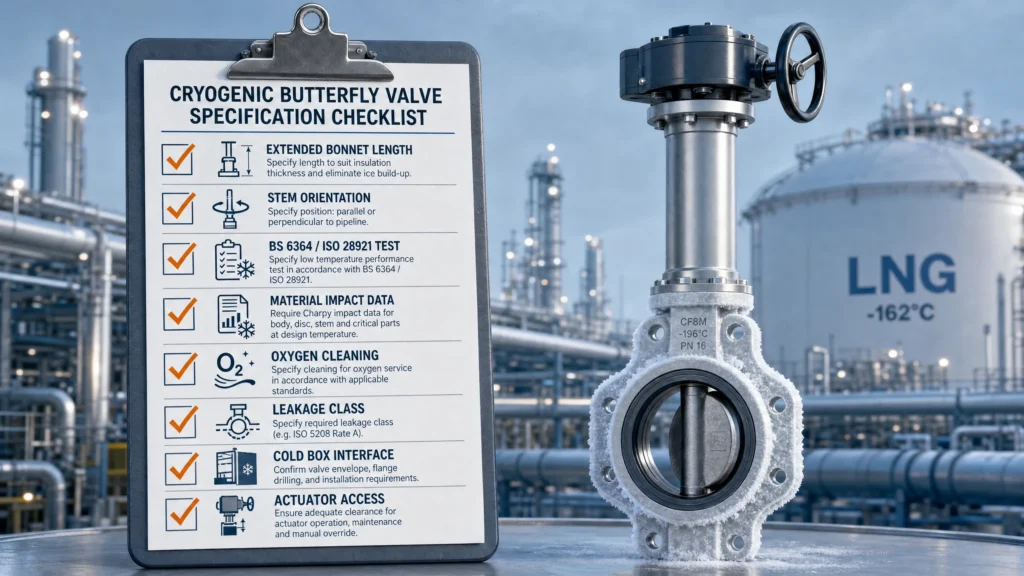
| Punkt der Checkliste | Empfohlener Wortlaut oder einzubeziehende Daten |
|---|---|
| Minimale Auslegungstemperatur | Nennen Sie die niedrigste Metalltemperatur und die Prozessflüssigkeit |
| Wartung der Ventile | LNG, LIN, LOX, LAr, LH2, Ethylen, Methan, Stickstoff oder andere Medien |
| Verlängerte Motorhaube | Erforderliche Verlängerung über der Dämmung oder der Cold-Box-Wand definieren |
| Ausrichtung des Stiels | Angabe der Anforderungen an die Ausrichtung der Flüssigkeits-, Gas- oder Coldbox |
| Leckagebedarf | Geben Sie die Akzeptanz von Leckagen bei Umgebungstemperatur und Tiefsttemperatur separat an. |
| Materialien | Definieren Sie die Anforderungen an Gehäuse, Scheibe, Spindel, Sitz, Packung, Verschraubung und Sonderlegierungen |
| Prüfung | Geben Sie BS 6364, ISO 28921, ISO 5208, API 609, ASME B16.34 oder die entsprechende Projektnorm an. |
| Betätigung | Definition von Drehmomentbasis, Fail Action, Zubehör und manueller Überbrückung |
| Reinigung | Gegebenenfalls Angabe der Anforderungen an die Sauerstoffreinigung oder die besondere Sauberkeit |
| Dokumentation | GA-Zeichnung, MTRs, Prüfberichte und Installationsanweisungen sind erforderlich |
Wenn Sie sich noch in der Auswahlphase befinden, sollten Sie Carter Valve's Auswahl von Absperrklappen für kritische Absperrungen und Produktkategorie Absperrklappen einen nützlichen internen Kontext für den Vergleich von Isolationspflichten und Entwurfsplattformen liefern.
Häufige Fehler, die ich bei Projekten mit kryogenen Absperrklappen sehe
Der erste Fehler ist die Verwendung der gleichen Ventilverlängerung für jede kryogene Anwendung. Ein Ventil in einer freiliegenden LNG-Rohrleitung und ein Ventil in einer Cold Box können unterschiedliche Verlängerungsgeometrien, Isolationsschnittstellen und einen anderen Zugang zum Antrieb erfordern.
Der zweite Fehler ist die Annahme, dass rostfreier Stahl automatisch das Materialrisiko löst. Nichtrostende Stähle sind in der Tieftemperaturtechnik weit verbreitet, aber es kommt immer noch auf die genaue Sorte, die Wärmebehandlung, die Kerbschlagprüfung, die Verschraubung und die Kompatibilität mit den Prozessmedien an.
Der dritte Fehler besteht darin, eine Leckageangabe zu akzeptieren, ohne zu fragen, ob sie bei Umgebungstemperatur oder bei kryogener Temperatur gilt. Einige Produkte werben damit, dass sie bei Raumtemperatur leckagefrei sind, während sie die Leckage bei kryogenen Temperaturen separat angeben. Diese Unterscheidung sollte vor dem Kauf klar sein.
Der vierte Fehler ist das Vergessen des Wartungszugangs. Wenn der Antrieb, die Stopfbuchse oder die Endschalter nach dem Einbau nicht sicher erreicht werden können, wird selbst eine technisch einwandfreie Armatur zum Zuverlässigkeitsproblem.
Schlussfolgerung
Die Konstruktion von Tieftemperaturklappen ist dann erfolgreich, wenn die Armatur als ein komplettes thermisches, mechanisches, abdichtendes und wartungsrelevantes System betrachtet wird. Das verlängerte Ventiloberteil muss die Stopfbuchspackung und die Schnittstelle zum Stellantrieb aus der Kältezone heraushalten. Die Cold-Box-Konfiguration muss mit der Isolierung, der Spindelausrichtung, der Abstützung und dem Zugang koordiniert werden. Die Materialien müssen bei der minimalen Auslegungstemperatur widerstandsfähig, kompatibel und rückverfolgbar sein. Die Tests müssen die kryogene Leckage und die Funktionsfähigkeit nachweisen, nicht nur die Leistung bei Umgebungstemperatur.
Für LNG, Luftzerlegung, Flüssigstickstoff, Flüssigsauerstoff, Ethylen und andere Niedertemperaturdienste ist die beste Spezifikation eine, die eine Verbindung zwischen verlängerte Motorhaubenlänge, Cold-Box-Geometrie, Materialauswahl, Stellglieddimensionierung, Leckageklasse und Tieftemperaturprüfung in einem einzigen Paket. Carter Valve kann diesen Prozess mit einer anwendungsbezogenen Auswahl von Absperrklappen, kryogenen sechsexzentrischen Ventilkonfigurationen und einer technischen Überprüfung für kritische Isolationsaufgaben unterstützen.
Häufig gestellte Fragen
Was ist eine kryogene Absperrklappe?
Eine kryogene Absperrklappe ist eine Vierteldrehklappe, die für den Betrieb und die Abdichtung bei sehr niedrigen Temperaturen ausgelegt ist, z. B. für LNG, flüssigen Stickstoff, flüssigen Sauerstoff, Argon, Methan, Ethylen oder Wasserstoff. Sie verwendet tieftemperaturtaugliche Werkstoffe, kontrollierte Abstände, geeignete Dichtelemente und in der Regel eine verlängerte Haube zum Schutz des Packungsbereichs.
Warum brauchen Kryogenik-Ventile eine verlängerte Haube?
Durch die verlängerte Haube wird die Spindelpackung vom kryogenen Ventilgehäuse wegbewegt. Dies trägt dazu bei, dass die Packung warm genug bleibt, um die Dichtungsspannung aufrechtzuerhalten, und verhindert Einfrieren, Aushärten, Leckagen oder übermäßiges Betriebsdrehmoment.
Wie lang sollte die verlängerte Motorhaube sein?
Es gibt keine Universallänge. Die erforderliche Verlängerung hängt von der minimalen Betriebstemperatur, der Isolierstärke, der Wandstärke der Coldbox, der Ventilgröße, der Spindelausrichtung, der Packungskonstruktion, der Position des Stellantriebs und der geltenden Projektnorm ab. Im Datenblatt sollte der erforderliche Abstand über der Isolierung oder der Cold-Box-Schnittstelle angegeben werden.
Was ist anders an der Cold-Box-Ventilkonfiguration?
Im Cold-Box-Betrieb kann sich das Ventilgehäuse innerhalb eines isolierten Gehäuses befinden, während das Ventiloberteil und der Stellantrieb für Betrieb und Wartung nach außen ragen. Die Konstruktion muss die Durchdringung der Isolierung, die Dampfsperre, den Spindelwinkel, die Stützlasten und den Zugang zum Stellantrieb koordinieren.
Welche Materialien werden üblicherweise für kryogene Absperrklappen verwendet?
Zu den gängigen Werkstoffen gehören Edelstahl 304L oder 316L für Gehäuse und Scheiben, hochfeste Edelstahllegierungen für Spindeln, PTFE- oder Graphitpackungen und für niedrige Temperaturen geeignete Verschraubungen. Die endgültige Auswahl hängt von Druck, Temperatur, Medien, Korrosion, Sauerstoffverträglichkeit und Projektstandards ab.
Sind Weichsitze in kryogenen Absperrklappen akzeptabel?
Sie können akzeptabel sein, wenn das Sitzmaterial speziell für die kryogenen Temperatur-, Medien-, Druck- und Leckageanforderungen ausgelegt ist. Standard-Weichsitze können bei niedrigen Temperaturen aushärten, schrumpfen oder reißen, daher müssen Sitzmaterial und kryogene Testdaten überprüft werden.
Welche Prüfungen sollten für kryogene Absperrklappen verlangt werden?
Beantragen Sie die Überprüfung der Kryositzleckage, der Schalen- und Spindelabdichtung, der Betriebszyklen (falls erforderlich), der Rückverfolgbarkeit des Materials und aller projektspezifischen Tests gemäß Normen wie BS 6364, ISO 28921, ISO 5208, API 609 oder ASME B16.34.
Kann eine Standard-Absperrklappe für den Einsatz in LNG verwendet werden?
Eine Standard-Absperrklappe sollte nicht für LNG-Einsätze verwendet werden, es sei denn, sie ist speziell für die erforderlichen Temperatur-, Druck-, Leckage- und Betriebsbedingungen konstruiert, werkstoffgeprüft, mit erweiterter Haube konfiguriert und kryogengetestet.
Referenzen
[1] U.S. EPA - Was wird als kryogene Bedingungen angesehen?
[3] QRC Valves - Kryogenische Ventile: Verwendungen, Typen, Normen und Prüfungen
[4] Bray - McCannalok Kryo-Hochleistungs-Absperrklappe Datenblatt
[5] ASME - B16.34 Ventile: Flansch-, Gewinde- und Schweissenden
[6] American Petroleum Institute - Normen
[7] Carter Valve - Kryogenische sechsfach exzentrische Absperrklappe