





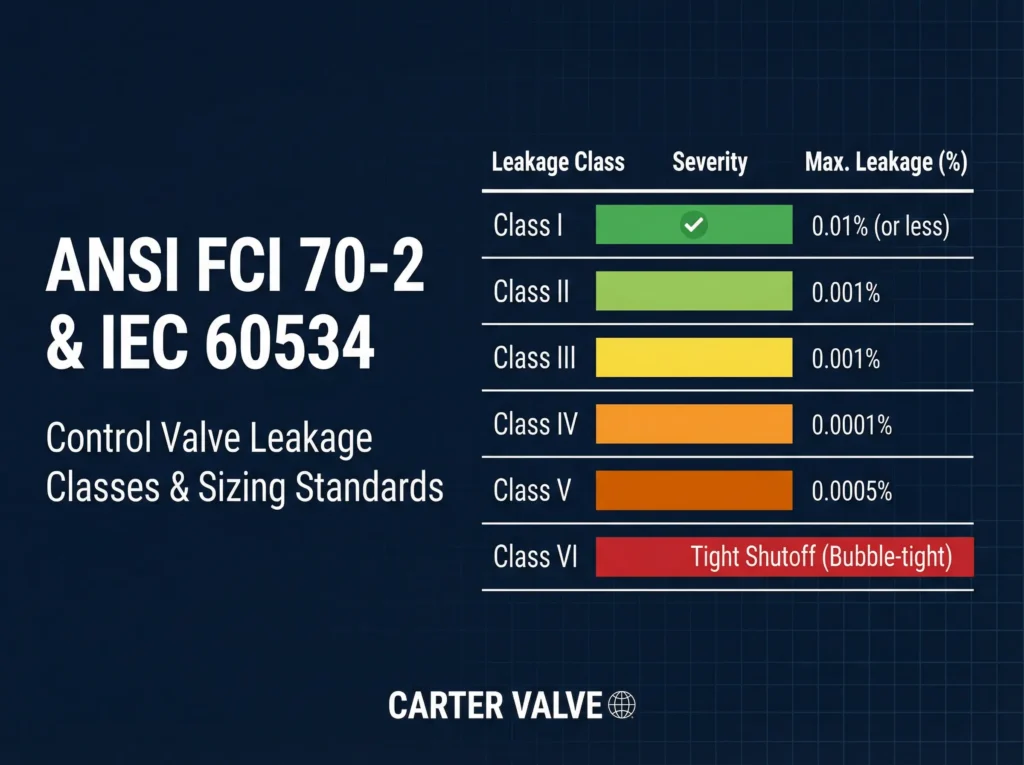
Die Auswahl eines Regelventils ohne Festlegung seiner zulässigen Leckagerate ist ein sicheres Rezept für eine Betriebskatastrophe. Wenn ein Ventil geschlossen werden soll, gehen Anlagenbetreiber davon aus, dass der Durchfluss des Mediums vollständig zum Stillstand kommt. In der mechanischen Realität industrieller Ventile bedeutet “geschlossen” jedoch selten eine perfekte, absolute Abdichtung.
Wenn ein Ventil im geschlossenen Zustand leicht undicht ist, mag dies in einem Kühlwasser-Bypasskreislauf noch akzeptabel sein. Wenn aus demselben Ventil jedoch giftige Chemikalien oder Hochdruckdampf austreten, reichen die Folgen von verdorbenen Produktchargen bis hin zu katastrophalen Sicherheitsvorfällen. Ingenieure benötigen eine standardisierte, quantifizierbare Methode, um genau zu definieren, wie viel Leckage für eine bestimmte Anwendung akzeptabel ist.
Die Norm ANSI/FCI 70-2 bietet genau diesen Rahmen und definiert sechs verschiedene Klassen von Sitzleckagen. In Kombination mit der Norm IEC 60534 zur aerodynamischen und hydrodynamischen Dimensionierung bilden diese beiden Dokumente die Grundlage für die korrekte Auslegung von Regelventilen. Das Verständnis dieser Normen ist entscheidend für die Auswahl der richtigen Ventilgarnitur, die Gewährleistung der Prozesssicherheit und die Vermeidung kostspieliger Überdimensionierung.
Was sind die ANSI/FCI 70-2-Leckageklassen für Ventilsitze?
Das American National Standards Institute (ANSI) und das Fluid Controls Institute (FCI) haben die Norm 70-2 entwickelt, um einheitliche Prüfverfahren und maximal zulässige Leckageraten für Regelventile festzulegen. Die Norm definiert sechs Klassen, die von Klasse I (die am wenigsten strenge) bis Klasse VI (die strengste) reichen.
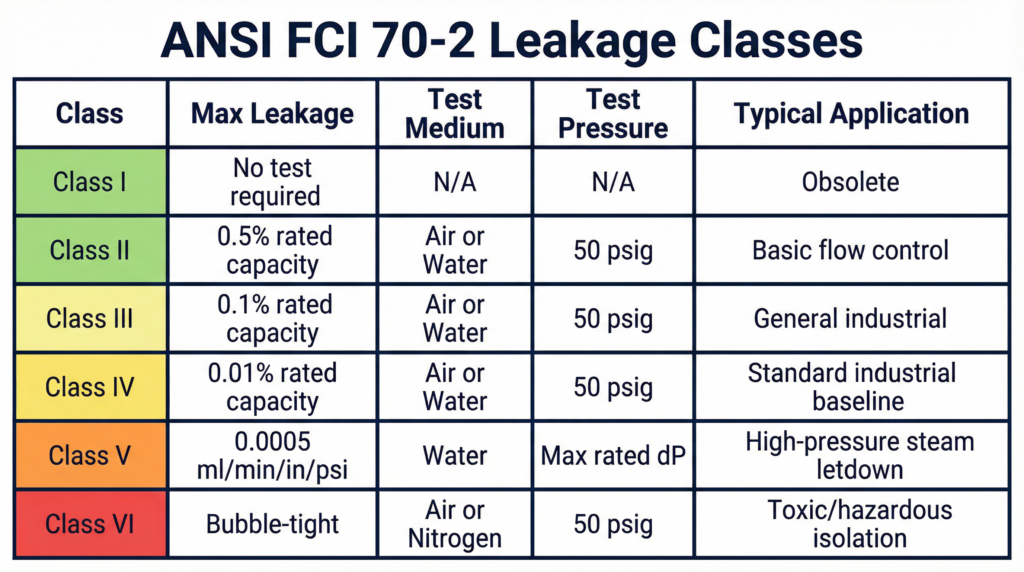
Es ist wichtig zu verstehen, dass diese Klassen die Leckagerate eines neuen Ventils unter kontrollierten Werksprüfbedingungen definieren. Sie garantieren nicht, dass das Ventil diese genaue Leckagerate auch nach jahrelangem Einsatz in einer korrosiven oder erosiven Umgebung beibehält.
Die einzelnen Leckageklassen (I–VI) verstehen
Die sechs Klassen sind so ausgelegt, dass sie den mechanischen Eigenschaften der verschiedenen Ventilkonstruktionen und den betrieblichen Anforderungen verschiedener Branchen entsprechen.
Klasse I: Diese Klasse ist weitgehend überholt. Es handelt sich um eine Vereinbarung zwischen dem Anwender und dem Hersteller, dass keine spezifische Prüfung erforderlich ist. In modernen industriellen Anwendungen wird sie nur noch selten vorgeschrieben.
Klasse II: Diese Klasse lässt eine maximale Leckage von 0,51 TP3T der Nennkapazität des Ventils zu. Sie wird in der Regel mit handelsüblichen Doppelanschluss-Absperrventilen oder ausgeglichenen Einfachanschluss-Ventilen mit Metall-auf-Metall-Sitzen erreicht. Sie eignet sich für die einfache Durchflussregelung, bei der ein dichtes Absperren nicht entscheidend ist.
Klasse III: Diese Klasse lässt eine maximale Leckage von 0,11 TP3T der Nennkapazität zu. Sie erfordert eine verbesserte Sitzläppung und engere Fertigungstoleranzen als Klasse II. Sie wird häufig vorgeschrieben für Allzweck-Durchgangsregelventil Anwendungen, bei denen eine moderate Absperrung erforderlich ist.
Klasse IV: Dies ist die industrielle Standard-Grundspezifikation für Einwegventile mit Metallsitz. Sie lässt eine maximale Leckage von 0,011 TP3T der Nennkapazität zu. Die Erfüllung der Klasse IV erfordert eine präzise Bearbeitung und eine hohe Sitzkraft des Stellantriebs. Sie ist die Standardspezifikation für die meisten Produktpalette der Regelventile Anwendungen.
Klasse V: Diese Klasse stellt eine erhebliche Verschärfung der Anforderungen dar. Die Leckage wird nicht als Prozentsatz der Kapazität angegeben, sondern anhand einer bestimmten Formel berechnet: 0,0005 ml Wasser pro Minute, pro Zoll Anschlussdurchmesser und pro psi Differenzdruck. Klasse V ist für kritische Anwendungen vorgeschrieben, wie beispielsweise bei der Hochdruck-Dampfdruckreduzierung, wo bereits geringfügige Leckagen zu starkem Drahtziehen und einer raschen Zerstörung des Sitzes führen würden.
Klasse VI: Oft als “blasendichte Absperrung” bezeichnet, ist dies die strengste Klasse. Die Leckage wird je nach Anschlussdurchmesser in Luft- oder Stickstoffblasen pro Minute gemessen. Um Klasse VI zu erreichen, ist fast immer ein elastischer Elastomer- oder PTFE-Weichsitz erforderlich. Sie wird vorgeschrieben, wenn aus Sicherheits- oder Umweltgründen eine absolute Isolierung erforderlich ist.
Wie werden Leckageklassen geprüft?
Die Norm ANSI/FCI 70-2 legt für jede Klasse spezifische Prüfverfahren fest, um eine einheitliche Handhabung bei allen Herstellern zu gewährleisten.
Für die Klassen II, III und IV kann das Prüfmedium Luft oder Wasser mit einer Temperatur von 50–125 °F (10–52 °C) sein. Der Prüfdruck beträgt in der Regel 50 psig oder den maximalen Betriebsdifferenzdruck, je nachdem, welcher Wert niedriger ist. Die Leckage wird gemessen und mit dem berechneten Prozentsatz der Nennkapazität (Cv) des Ventils verglichen.
Die Prüfung der Klasse V ist wesentlich strenger. Als Prüfmedium muss Wasser verwendet werden. Der Prüfdruck muss dem maximalen, für den Ventilkegel angegebenen Betriebsdifferenzdruck entsprechen. Da die zulässige Leckage so gering ist, dauert die Prüfung länger, und die Messung muss äußerst präzise sein.
Für Prüfungen der Klasse VI wird Luft oder Stickstoff als Prüfmedium benötigt. Der Prüfdruck beträgt 50 psig oder den maximalen Nenn-Differenzdruck, je nachdem, welcher Wert niedriger ist. Die Leckage wird gemessen, indem das entweichende Gas aufgefangen und die Blasen pro Minute mithilfe eines standardisierten, in Wasser getauchten Rohrs gezählt werden.
Die Norm IEC 60534 zur Dimensionierung
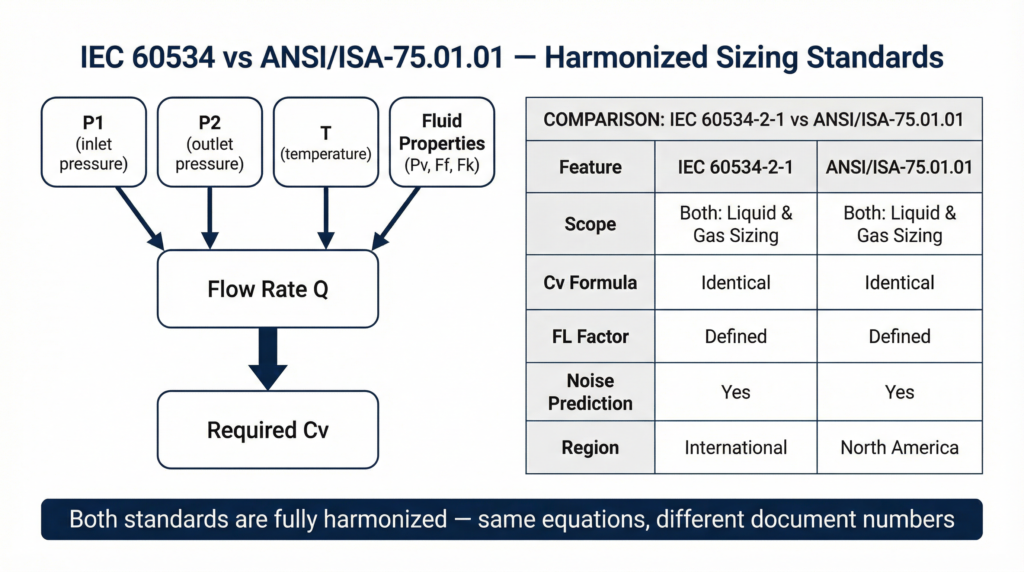
Während die Norm ANSI/FCI 70-2 die Leckage regelt, regelt die Norm 60534 der Internationalen Elektrotechnischen Kommission (IEC) die aerodynamische und hydrodynamische Auslegung von Regelventilen. IEC 60534-2-1 und ANSI/ISA-75.01.01 sind harmonisiert, was bedeutet, dass sie dieselben Grundgleichungen zur Berechnung des erforderlichen Durchflusskoeffizienten (Cv) verwenden.
Die richtige Dimensionierung eines Ventils ist ebenso entscheidend wie die Festlegung der richtigen Leckageklasse. Ist ein Ventil überdimensioniert, arbeitet es zu nah am Sitz, was zu einer schlechten Regelgenauigkeit und einem schnellen Drahtzug führt, wodurch die Fähigkeit des Ventils, die vorgeschriebene Leckageklasse einzuhalten, rasch beeinträchtigt wird. Ist ein Ventil zu klein dimensioniert, kann es die erforderliche Durchflussmenge nicht durchlassen, was zu einem Engpass im Prozess führt.
Die Gleichungen der Norm IEC 60534 berücksichtigen komplexe strömungstechnische Phänomene, darunter das spezifische Gewicht des Mediums, den Druckabfall über dem Ventil, den Dampfdruck von Flüssigkeiten und die Kompressibilität von Gasen. Durch die genaue Berechnung des erforderlichen Cv-Werts stellen Ingenieure sicher, dass das Ventil in seinem optimalen mittleren Betriebsbereich arbeitet, wodurch die Regelgenauigkeit maximiert und die Lebensdauer der Dichtflächen verlängert wird.
Praktischer Entscheidungsbaum für die Kurswahl
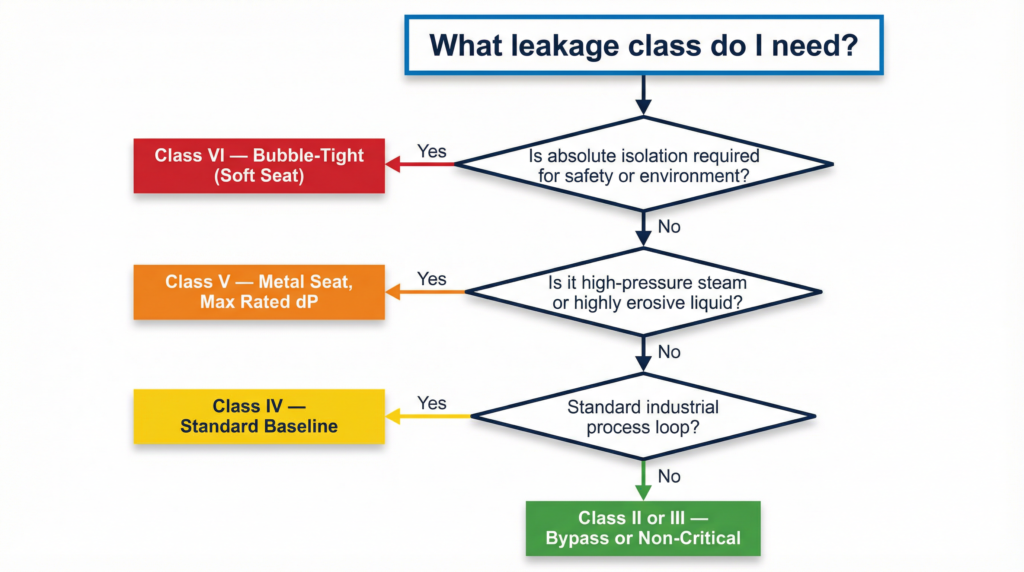
Die Auswahl der richtigen Leckageklasse erfordert einen praxisorientierten Entscheidungsbaum, der betriebliche Anforderungen, Sicherheitsanforderungen und Kosten gegeneinander abwägt. Die Überdimensionierung eines Ventils der Klasse VI mit Weichsitz für eine Hochtemperatur-Dampfanwendung führt zu einem sofortigen Versagen des Sitzes. Die Unterdimensionierung eines Ventils der Klasse II für eine Leitung mit giftigen Chemikalien führt zu einer gefährlichen Leckage.
Schritt 1: Ist eine vollständige Isolierung aus Sicherheits- oder Umweltgründen erforderlich?
Falls ja, geben Sie Klasse VI an. Stellen Sie sicher, dass die Prozesstemperatur mit weichen Elastomersitzen kompatibel ist (in der Regel unter 400 °F/204 °C).
Schritt 2: Handelt es sich bei dem Medium um Hochdruckdampf oder um eine stark erosive Flüssigkeit?
Falls ja, geben Sie bitte Klasse V an. Die Metall-auf-Metall-Dichtung hält der Temperatur und der Geschwindigkeit stand, und die strengen Anforderungen an die Dichtheit verhindern ein Drahtziehen. Dies ist entscheidend für ANSI-Regelventil für hohe Beanspruchung Anwendungen.
Schritt 3: Handelt es sich um einen industriellen Standardkreislauf (Wasser, Niederdruckgas, Öl)?
Falls ja, geben Sie bitte Klasse IV an. Diese bietet eine hervorragende Absperrwirkung für allgemeine Regelungszwecke, ohne die zusätzlichen Kosten und die komplexere Fertigung der Klassen V oder VI.
Schritt 4: Handelt es sich um eine Bypass-Schleife oder um eine Durchflussanwendung, bei der ein dichtes Absperren keine Rolle spielt?
Falls ja, sind die Klassen II oder III zulässig, wobei häufig symmetrische Steckerkonstruktionen zum Einsatz kommen, die kleinere und kostengünstigere Betätigungselemente erfordern.
Was CARTER auszeichnet
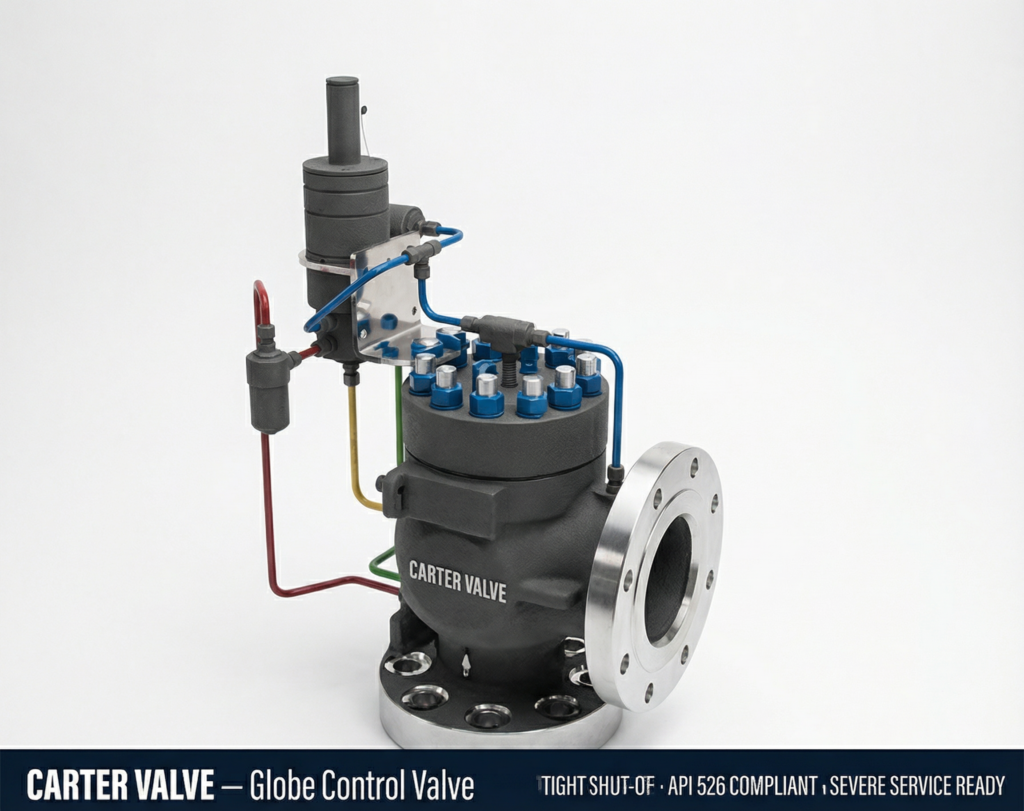
Carter Technologies produziert ein umfassendes Sortiment an Regelventilen, die so konstruiert sind, dass sie die strengsten Normen ANSI/FCI 70-2 und IEC 60534 erfüllen und sogar übertreffen. Bei unseren Konstruktionen steht die langfristige Stabilität im Vordergrund. Durch den Einsatz hochbelastbarer Spindelführungen und präzisionsgeläppter Einbaumaterialien stellen wir sicher, dass Ihre Ventile auch lange nach der Installation ihre spezifizierte Leckageklasse beibehalten.
Wir garantieren die Einhaltung der Anforderungen an die druckdichte Absperrung über unser gesamtes Sortiment hinweg. Jedes von uns gefertigte Ventil entspricht vollständig der Norm API 526 und verfügt über eine Garantie für druckdichte Absperrung gemäß 98%. Ganz gleich, ob Sie ein Ventil der Klasse VI mit Weichdichtung für die absolute Absperrung oder eine feste Stellite-Einheit der Klasse V für die Hochdruck-Dampfdruckminderung benötigen – unsere Leistungsfähigkeit unter extremen Betriebsbedingungen gewährleistet, dass Ihr Prozess sicher und effizient bleibt.
Sollten Sie Probleme mit internen Leckagen oder komplexen Dimensionierungsberechnungen haben, steht Ihnen unser Team gerne zur Verfügung, um Ihre Prozessdaten zu prüfen und Ihnen die geeignete Konfiguration zu empfehlen. Um mehr über unsere Basistechnologien zu erfahren, lesen Sie unseren Leitfaden unter Was ist ein Steuerventil?. Für sicherheitskritische Anwendungen lesen Sie bitte unsere ESD-Ventil-Auswahlhilfe.
Für eine ausführliche technische Beratung und eine maßgeschneiderte Größenanalyse, Kontakt zu unserem Ingenieurteam heute.