





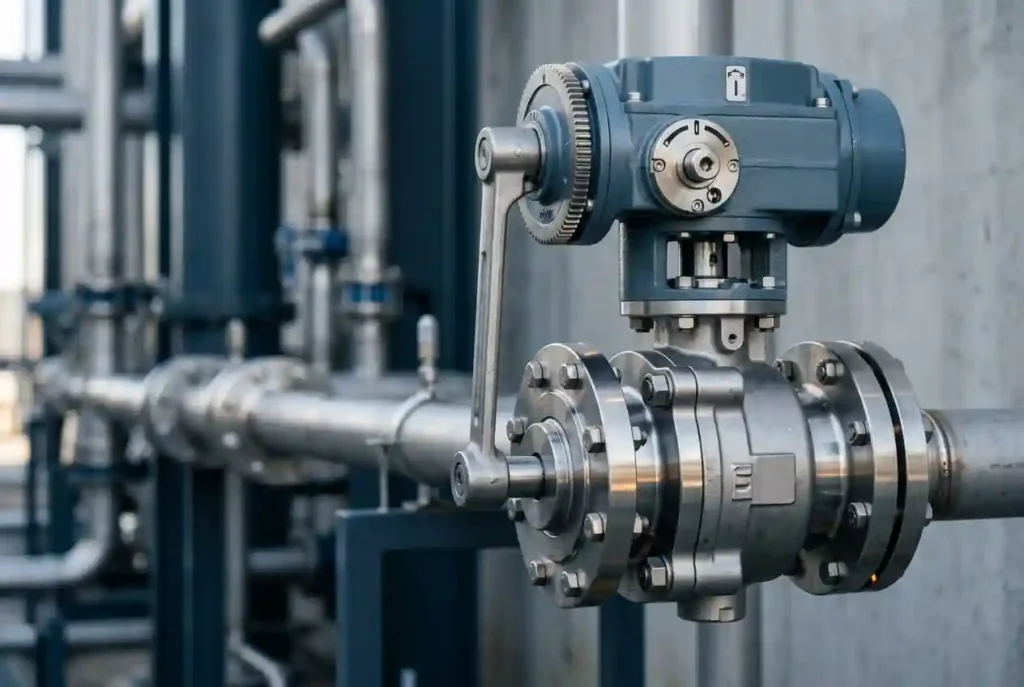
In industrial process plants, the choice of valve seat material is rarely a minor detail. For applications involving high temperatures, aggressive media, or stringent zero-leakage requirements, metal-to-metal seated butterfly valves are the engineering solution of choice.
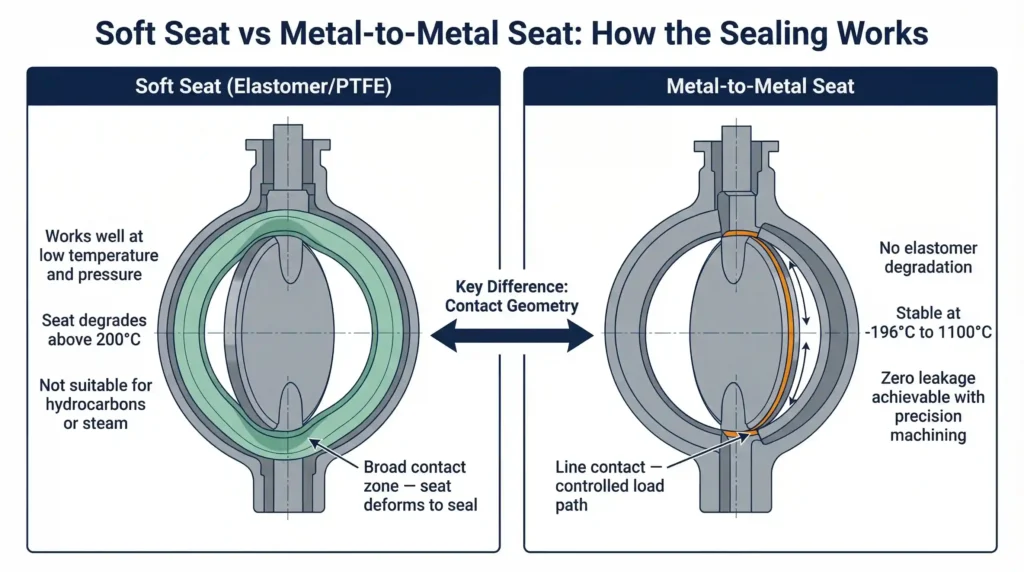
Unlike soft-seated designs that rely on elastomer or PTFE deformation to achieve a seal, metal-to-metal seated valves achieve closure through precision contact between hardened metallic surfaces. This mechanism is inherently more stable across extreme temperature ranges and more resistant to the degradation that causes soft seats to fail in demanding service.
This article covers the engineering principles behind metal-to-metal seating, the hardfacing materials used, the standards that govern specification and testing, and the practical criteria for selecting the right design. For a broader introduction to butterfly valve types, see our guide to high performance butterfly valves and the overview of types of butterfly valve.
1. Why Metal-to-Metal Seating? The Limits of Soft Seats
A standard resilient-seated butterfly valve uses an elastomeric seat — typically EPDM, NBR, or BUNA-N — that deforms under disc closure load to create a seal. This approach works well in clean water, HVAC, and general utility service, but it encounters fundamental material limits in more demanding conditions.
Elastomeric seats begin to degrade above approximately 120°C (250°F), and they are chemically incompatible with hydrocarbons, solvents, and steam. Reinforced PTFE seats extend the range to approximately 200–260°C (390–500°F) and offer broader chemical resistance, but PTFE creeps under sustained load at elevated temperatures and cannot survive the thermal cycles found in refinery or power plant service.
Above these thresholds — or in services where zero leakage must be maintained after thousands of operating cycles — a fundamentally different approach is required. The transition to metal-to-metal seating is not simply a material substitution. It requires a change in the valve’s offset geometry to ensure that metal disc and seat surfaces make controlled, repeatable contact without generating the sliding abrasion that would rapidly destroy a metal seating surface. This is why metal-to-metal seated butterfly valves are almost always triple offset or more advanced multi-eccentric designs.
2. The Engineering Principle: Line Contact and Controlled Load Path
A soft seat achieves sealing through broad-area contact — the elastomer or PTFE deforms under load to fill microscopic surface irregularities. This is forgiving of minor imperfections but temperature-limited, because it depends on the material’s ability to deform and recover.
A metal-to-metal seat achieves sealing through line contact between a spherical disc edge and a precisely machined conical seat surface. As the disc closes, it approaches the seat along a cam-like path with minimal sliding contact, and sealing engagement occurs only at the final degrees of rotation. At the moment of closure, the disc edge presses against the seat cone along a narrow circumferential line, generating high contact stress per unit length — sufficient to prevent leakage, provided the surfaces are machined to the required tolerances.
This mechanism has two important properties. It is self-energizing at low pressure: the mechanical closing force alone creates enough contact stress to achieve a seal. It also becomes pressure-energized at higher pressures: as line pressure increases, it acts on the seat geometry to push the seat more firmly against the disc, improving the seal further. This dual mechanism allows well-designed metal-seated butterfly valves to achieve zero leakage across a wide pressure range.
The critical requirement is surface precision. Seating surfaces must be machined to tight tolerances — typically within a few microns — and finished to a surface roughness that allows consistent line contact without micro-leakage paths. Carter Valves’ Hexa platform achieves a sealing surface profile tolerance of 0.01 mm and a surface roughness of Ra 0.156 µm, approaching a mirror finish. These specifications are the physical conditions required to achieve verifiable zero leakage to ISO 5208 Rate A in severe service.
3. Offset Geometry: Why Triple Offset and Six-Eccentric Designs Are Required
A standard concentric or double offset design cannot achieve true metal-to-metal sealing without unacceptable wear. The disc edge slides against the seat through a significant portion of the closing stroke, generating abrasion, galling, and progressive surface damage that degrades sealing performance.
Triple offset geometry solves this by introducing a third geometric offset — the seat cone axis is tilted relative to the shaft axis — creating a true cam-like closing path. The disc approaches the seat without any sliding contact: the surfaces are not in contact until the final moment of closure, at which point they engage along the design contact line with a pure compressive load and no tangential sliding component. This is the geometric prerequisite for durable metal-to-metal sealing.
The six-eccentric (Hexa) design developed by Carter Valves extends this principle further. Additional eccentricities beyond the three offsets of a conventional triple offset valve reshape the contact path so that sealing load is distributed more evenly around the full circumference — including the critical shaft-area zones where conventional triple offset designs often struggle to maintain consistent contact. The result is a more uniform contact stress distribution, slower wear progression, and more stable long-term sealing behaviour — particularly important in cyclic services where the valve opens and closes thousands of times per year.
For a detailed technical comparison of these geometries, see our article on six-eccentric vs triple offset butterfly valve: what’s the real difference in sealing and wear?
4. Hardfacing Materials: Matching the Seat to the Service
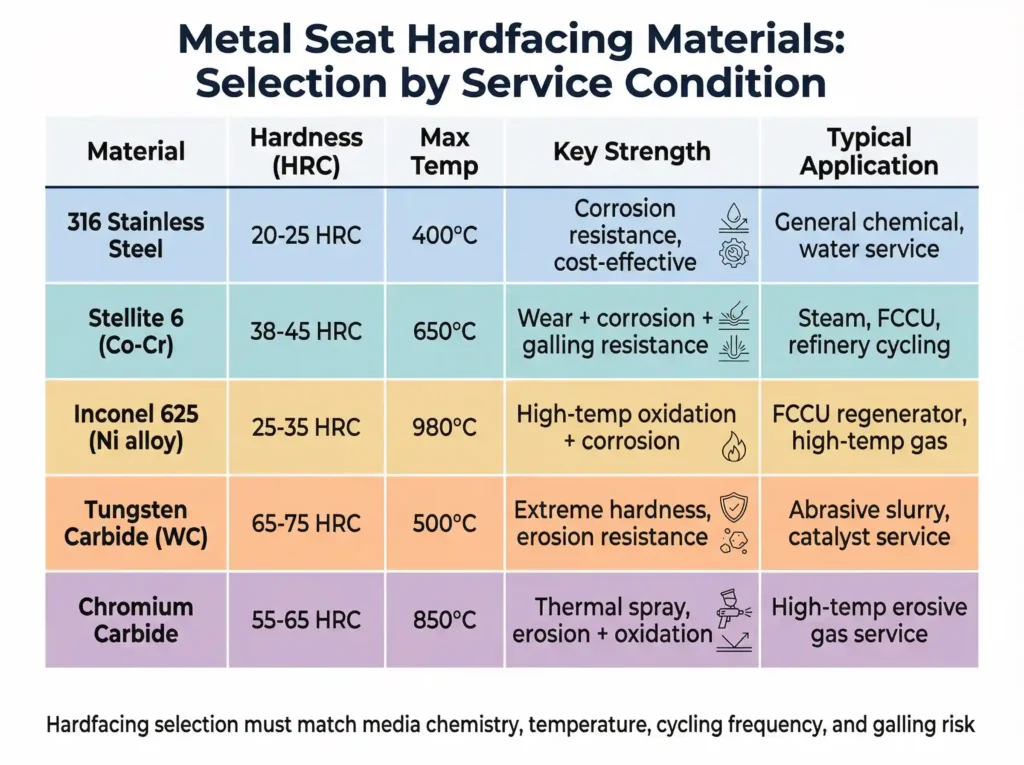
The seating surfaces of a metal-to-metal seated butterfly valve are almost never left in the base material condition. Instead, they are protected by a hardfacing layer — a thin coating or weld overlay of a harder, more wear-resistant alloy applied to the contact surfaces of both the disc edge and the seat ring.
The choice of hardfacing material is one of the most consequential decisions in metal-seated valve specification. It determines the valve’s resistance to wear, corrosion, galling, and thermal degradation in service.
316 Stainless Steel is the baseline option for moderate service conditions. With a hardness of approximately 20–25 HRC and good corrosion resistance, it suits general chemical service and clean water at elevated temperatures. However, its relatively low hardness makes it susceptible to galling in cyclic or abrasive service, and its temperature ceiling of approximately 400°C limits its use in high-temperature applications.
Stellite 6 (Cobalt-Chromium alloy) is the most widely specified hardfacing material for demanding butterfly valve applications. At 38–45 HRC and a maximum service temperature of approximately 650°C, it provides an excellent combination of wear resistance, corrosion resistance, and galling resistance. It is the standard choice for steam isolation, FCCU cycling service, and refinery applications where the valve must maintain reliable sealing after thousands of thermal cycles. Stellite 21 is an alternative formulation with improved corrosion resistance, preferred in more corrosive environments.
Inconel 625 (Nickel alloy) offers superior high-temperature oxidation and corrosion resistance, with a service temperature capability approaching 980°C. It is the preferred choice for FCCU regenerator isolation and high-temperature gas service where the media is both hot and corrosive. Inconel 625 is less hard than Stellite (25–35 HRC), but its high-temperature stability makes it indispensable in the most extreme thermal environments.
Tungsten Carbide (WC), applied as a thermal spray coating, provides the highest hardness of any commonly used hardfacing material (65–75 HRC) and exceptional resistance to abrasive and erosive wear. It is the preferred choice for catalyst-laden gas service and abrasive slurry applications. Its temperature ceiling of approximately 500°C limits its use in the highest-temperature services.
Chromium Carbide, also applied as a thermal spray coating, combines high hardness (55–65 HRC) with good resistance to high-temperature oxidation and erosion. It is suitable for hot erosive gas service at temperatures up to approximately 850°C where tungsten carbide would be limited by oxidation.
Hardfacing selection requires careful consideration of media chemistry, operating temperature, thermal cycling frequency, differential pressure at closure, and the galling risk between disc and seat materials. Carter Valves’ application engineers work with customers to select the optimal hardfacing combination for each service — contact our team to discuss your specific requirements.
5. Operating Envelope: Where Metal-Seated Valves Are Required
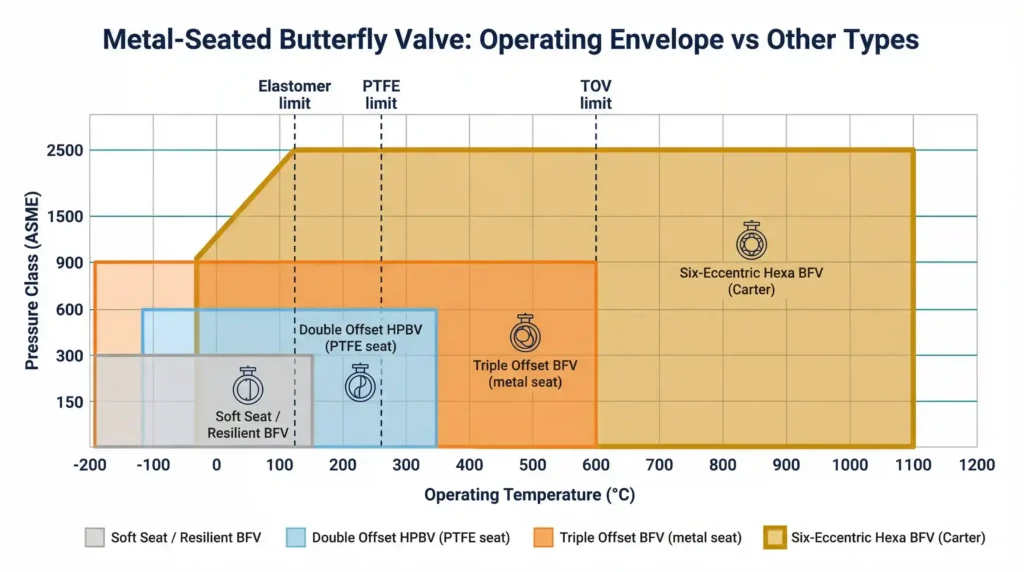
The soft-seated resilient valve is limited to approximately 120°C by elastomer degradation. The double offset HPBV with PTFE seat extends to approximately 260°C. Above 260°C, metal-to-metal seating is required, and the choice between triple offset and six-eccentric designs depends on the specific combination of temperature, pressure class, and leakage requirements.
Standard triple offset designs (such as Carter’s CVS-288) cover the range from –29°C to 600°C at pressure classes from 150 to 600, addressing the majority of refinery, power generation, and chemical processing applications that require metal-to-metal seating. The Carter six-eccentric Hexa platform (CVS-290 and CVS-290C) extends this envelope in both directions — down to –196°C for cryogenic LNG service and up to 1,100°C for the most extreme high-temperature applications — while also offering pressure classes up to ASME Class 2500.
This extended envelope is not simply a matter of material selection. It requires the six-eccentric geometry’s ability to maintain controlled contact load distribution across the full temperature range, compensating for the dimensional changes that occur as the valve body, disc, and seat ring expand or contract with temperature. Conventional triple offset designs are more sensitive to these dimensional changes, which is why their practical temperature ceiling is lower than the theoretical material limit.
6. Industry Standards and Testing Requirements
The specification and procurement of metal-to-metal seated butterfly valves is governed by a well-established framework of international standards. Understanding these standards is essential for writing correct purchase specifications and evaluating vendor compliance.
API 609 is the primary design standard for butterfly valves in industrial service. It distinguishes between Category A valves (concentric, resilient-seated) and Category B valves (offset designs, including all metal-seated types). Category B requirements cover body wall thickness, shaft sizing, seat retention, end-to-end face dimensions, and the mandatory test protocol. All triple offset and six-eccentric butterfly valves are Category B valves under API 609.
API 598 defines the inspection and testing requirements for industrial valves, including shell hydrostatic tests and seat leakage tests. For metal-seated butterfly valves, API 598 specifies allowable leakage rates in drops per minute (liquid test) or bubbles per minute (gas test) as a function of valve size. Importantly, the standard API 598 allowance for metal-seated valves is not zero — a small amount of leakage is permitted by default. Where zero leakage is required, this must be explicitly specified in the purchase order, referencing ISO 5208 Rate A.
ISO 5208 Rate A — the highest leakage grade — is defined as “no visually detectable leakage for the duration of the test.” This is the standard against which Carter Valves’ Hexa platform is tested and certified. Achieving Rate A with a metal-seated valve requires the combination of precise offset geometry, correct hardfacing selection, and the surface finish tolerances described in Section 2. For more on what zero leakage means in practice, see our article on bi-directional zero leakage: what it means and why it matters in severe service.
API 607 fire-safe testing is required for metal-seated butterfly valves installed in hydrocarbon service where fire is a credible risk. The test verifies that leakage rates remain within acceptable limits after a defined fire event. Metal-to-metal seated designs have an inherent advantage here, because the sealing mechanism does not depend on materials that burn or melt.
ASME B16.34 defines the allowable pressure-temperature ratings for valves by material class, providing the P-T envelope within which a given valve body and trim material combination may be operated. This standard is the basis for the pressure class designations (Class 150, 300, 600, 900, 1500, 2500) used in valve specifications.
The following table summarises the key standards and their relevance to metal-seated butterfly valve specification:
| Standard | Scope | Key Requirement for Metal-Seated BFV |
|---|---|---|
| API 609 Cat. B | Design and testing of offset butterfly valves | Body, shaft, seat design requirements; mandatory test protocol |
| API 598 | Valve inspection and testing | Shell test + seat leakage test; metal-seat allowance is not zero by default |
| ISO 5208 Rate A | Zero leakage classification | Must be specified in PO where zero leakage is required |
| API 607 | Fire-safe testing for quarter-turn valves | Required for hydrocarbon service; metal seat has inherent advantage |
| ASME B16.34 | Pressure-temperature ratings by material | Defines allowable P-T envelope for body/trim material combination |
| EN 593 | European butterfly valve design standard | European projects; equivalent to API 609 in scope |
| PED 2014/68/EU | European pressure equipment directive | CE marking required for European market |
7. Key Applications for Metal-to-Metal Seated Butterfly Valves
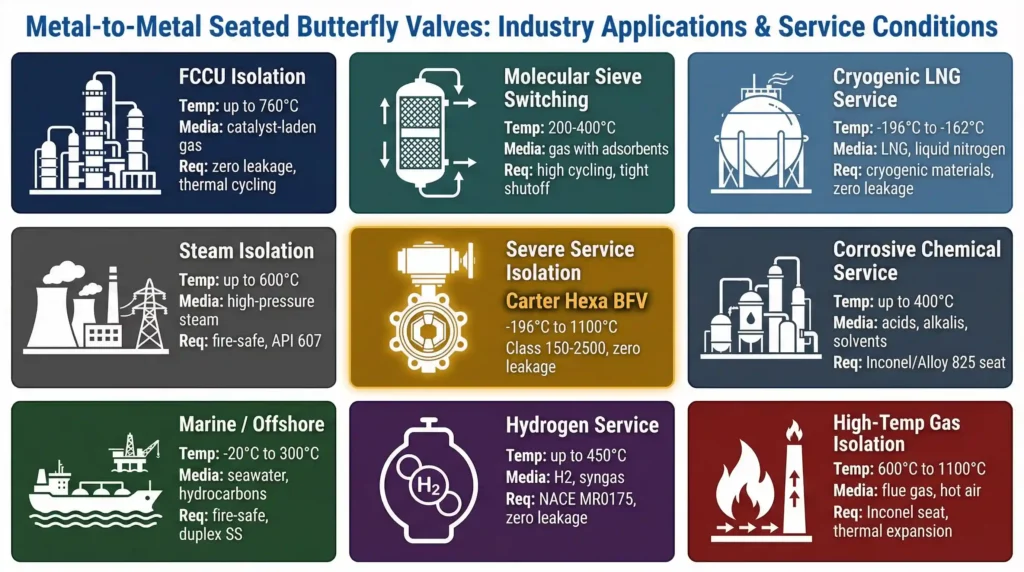
7.1 FCCU Isolation (Refining)
Fluid Catalytic Cracking Unit (FCCU) isolation is one of the most demanding applications for any valve type. The regenerator side of an FCCU operates at temperatures up to 760°C with catalyst-laden gas that is both abrasive and corrosive.
The valve must maintain zero leakage after thousands of thermal cycles over its service life. Tungsten carbide or Inconel hardfacing is typically required to resist catalyst erosion, and the valve geometry must maintain consistent contact load as the body and disc expand and contract with temperature. Carter Valves’ oil and gas solutions include the CVS-290 Hexa BFV specifically configured for FCCU service.
7.2 Molecular Sieve Switching
Molecular sieve dehydration units use switching valves that open and close on a timed cycle — typically every few minutes — to direct gas flow between adsorption and regeneration beds. The combination of high cycling frequency, temperature swings up to 300–400°C, and the requirement for tight shutoff to prevent cross-contamination makes this one of the most wear-intensive applications for butterfly valves.
Metal-to-metal seating with Stellite hardfacing is the standard specification for molecular sieve switching valves. For more on this application, see our dedicated article on valves for molecular sieve service.
7.3 Cryogenic LNG Service
LNG service at –162°C to –196°C presents a different set of challenges. Materials contract at cryogenic temperatures, and the dimensional changes must be accounted for in the valve geometry to ensure sealing contact is maintained. Galling between metal surfaces also becomes a more significant risk at cryogenic temperatures because lubricating films are less effective.
The Carter Cryogenic Six-Eccentric Butterfly Valve (CVS-290C) is specifically engineered for LNG and liquid nitrogen service, with material selections optimised for cryogenic galling resistance and extended bonnet/stem options to keep packing in a manageable temperature zone.
7.4 High-Temperature Steam Isolation (Power Generation)
High-pressure steam isolation in power plants — including main steam isolation, turbine bypass, and boiler feed water systems — requires valves rated for temperatures up to 600°C and pressures to Class 600 or beyond.
Metal-to-metal seated butterfly valves with Stellite hardfacing are the standard choice, offering reliable shutoff after extended periods of inactivity and fire-safe certification to API 607. Explore Carter Valves’ power and energy applications for more information on steam service configurations.
7.5 Hydrogen and Syngas Service
Hydrogen molecules are extremely small and can permeate through microscopic leakage paths that would be acceptable for larger molecules. Zero leakage to ISO 5208 Rate A is typically specified for hydrogen isolation valves, and the valve must comply with NACE MR0175 for sour service where hydrogen sulphide is present.
Metal-to-metal seating with appropriate material selection for hydrogen embrittlement resistance is the standard approach for H2 and syngas isolation.
7.6 Marine and Offshore Applications
Offshore platforms, FPSOs, and LNG carriers require valves that combine compact dimensions, high reliability, and resistance to marine corrosion. Metal-seated butterfly valves in duplex stainless steel or super duplex, with API 607 fire-safe certification, are widely specified for hydrocarbon isolation on marine installations.
Carter Valves’ marine and shipbuilding solutions cover the full range of offshore valve requirements.
8. Selection Criteria: When to Specify a Metal-to-Metal Seated Butterfly Valve
The decision to specify a metal-to-metal seated butterfly valve should be driven by the specific service conditions of the application, not by a general preference for higher performance. Metal-seated valves are more expensive than soft-seated designs and may require more careful installation and maintenance. They are the correct choice when one or more of the following conditions apply.
Temperature above 260°C. This is the most common driver. PTFE and reinforced PTFE seats begin to creep and degrade above approximately 200–260°C, and elastomers fail at even lower temperatures. Above 260°C, metal-to-metal seating is the only reliable option for a butterfly valve.
Zero leakage required over extended service life. Soft-seated valves can achieve zero leakage when new, but their sealing performance degrades with cycling and temperature exposure. Metal-to-metal seating maintains consistent sealing performance over a much longer service life — provided the hardfacing materials are correctly matched to the service conditions.
Media incompatible with soft seat materials. Hydrocarbons, many solvents, strong acids and alkalis, and steam at elevated temperatures are all incompatible with elastomeric seats. Metal-to-metal seating eliminates the compatibility constraint entirely.
High cycling frequency. Applications such as molecular sieve switching, where the valve opens and closes hundreds of times per day, generate accelerated wear in soft-seated designs. Metal-to-metal seating with appropriate hardfacing extends the maintenance interval significantly.
Fire-safe requirements in hydrocarbon service. Metal-to-metal seated designs have an inherent advantage in fire-safe performance, and API 607 certification is more straightforward to achieve with a metal seat than with a soft seat.
For a structured approach to valve type selection, see our high performance butterfly valve selection guide and our article on butterfly valve selection for critical isolation.
9. Carter Valves’ Metal-Seated Butterfly Valve Range
Carter Valves manufactures a complete range of metal-to-metal seated butterfly valves, from the established triple offset CVS-288 to the advanced six-eccentric Hexa platform. All products are manufactured under ISO 9001 quality management, with full documentation support for API 609, API 607, API 598, ASME B16.34, and PED 2014/68/EU as required by project specifications.
| Product | Model | Type | Size Range | Pressure Class | Temperature Range | Seat / Hardfacing |
|---|---|---|---|---|---|---|
| Ultra High-Pressure Triple Offset BFV | CVS-288 | Triple Offset | DN50–DN2400 | Class 150–600 | –29°C to 600°C | Stellite 6 / Inconel 625 |
| Next-Gen Six-Eccentric BFV | CVS-290 | Six-Eccentric | DN50–DN2400 | Class 150–2500 | –196°C to 1,100°C | Stellite / Inconel / WC (by service) |
| Cryogenic Six-Eccentric BFV | CVS-290C | Six-Eccentric (Cryo) | DN50–DN1200 | Class 150–600 | –196°C to +200°C | Cryogenic-grade hardfacing |
Browse the full Six-Eccentric Hexa Butterfly Valve category or the complete isolation valve range for detailed specifications and configuration options.
Carter Valves also supplies complete actuation packages for metal-seated butterfly valves, including pneumatic diaphragm actuators and smart electric actuators with integrated positioner and diagnostic capability — important considerations given the higher operating torques associated with metal-seated designs at elevated temperatures and pressures.
Ready to Specify Your Metal-Seated Butterfly Valve?
Metal-to-metal seated butterfly valves require careful matching of geometry, hardfacing material, and pressure-temperature rating to the specific service conditions of each application. Carter Valves’ engineering team works directly with project engineers, procurement teams, and EPC contractors to provide technically correct specifications and competitive proposals.
Request a Technical Quotation — provide your service conditions (pressure class, temperature, media, size, cycling frequency, leakage class, and applicable standards), and our engineering team will respond with a specific product recommendation, datasheet, and dimensional drawing within one business day.
Talk to an Application Engineer — for complex or unusual applications, including FCCU, molecular sieve, cryogenic, or hydrogen service, our application engineers are available to discuss your requirements in detail and provide a written technical recommendation.
View Our Manufacturing and Testing Capabilities — Carter Valves provides not only valve supply but also complete actuation packages, third-party witnessed testing, and full documentation packages for major project requirements.
Related Articles
- What Is a High Performance Butterfly Valve (HPBV)? Types, Standards, and When to Specify One
- Six-Eccentric vs Triple Offset Butterfly Valve: What’s the Real Difference in Sealing and Wear?
- How Does a Six-Eccentric Butterfly Valve Achieve Metal-to-Metal Sealing?
- Bi-Directional Zero Leakage: What It Means and Why It Matters in Severe Service
- Valves for Molecular Sieve Service
- General Service vs High Performance Butterfly Valves: What’s the Difference?
- Butterfly Valve Selection for Critical Isolation
References
Union Valve. Soft-Seated vs Metal-Seated Butterfly Valves Explained. January 2026.
Bryant, P. High Performance Butterfly Valve Seating Principles – Metal Seats. MSEC Inc., February 2015.
Carter Valves. CARTERUS Six-Eccentric Butterfly Valve — Product Overview.
American Stainless and Supply. Triple Offset Butterfly Valves for Severe Service.
Control and Instrumentation. Valve Seat Material Selection for Your Application.
Velan ABV. Butterfly Valve Technical Reference — Hardfacing and Alloy Options. 2024.
American Petroleum Institute. API 609: Butterfly Valves — Double Flanged, Lug- and Wafer-Type.
Valve Specifications. Valve Leakage Class: ISO 5208, API 598, EN 12266-1, ANSI/FCI 70-2. 2023.
International Organization for Standardization. ISO 5208: Industrial Valves — Pressure Testing of Metallic Valves. 2015.
American Petroleum Institute. API 607: Fire Test for Quarter-Turn Valves and Valves Equipped with Nonmetallic Seats.
American Society of Mechanical Engineers. ASME B16.34: Valves — Flanged, Threaded, and Welding End.
Carter Valves is a specialist valve manufacturer supplying metal-to-metal seated butterfly valves, triple offset valves, and six-eccentric Hexa butterfly valves to the oil and gas, refining, power generation, LNG, and chemical processing industries. For enquiries, contact info@cartervalves.com or visit cartervalves.com/contact.