





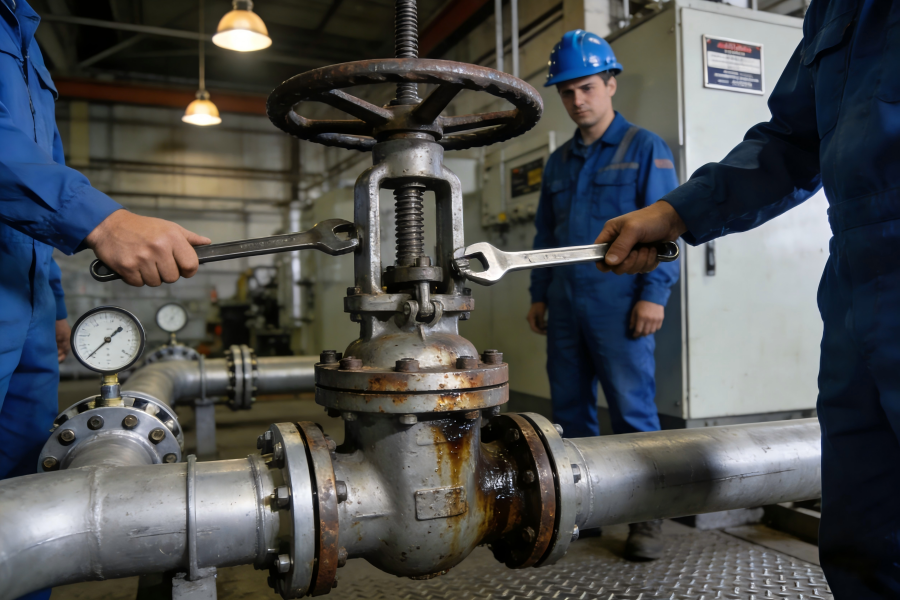
Butterfly valves are widely used because they offer compact geometry, low mass for a given diameter, and fast quarter-turn operation. Within this broad family, however, not all butterfly valves serve the same duty. Two categories appear frequently in specifications and bid packages: general service butterfly valves and high-performance butterfly valves.
Although the names sound self-explanatory, the practical differences are often misunderstood. The result is either over-specification (paying for performance that is not required) or under-specification (leading to leakage, unstable shutoff, or premature wear). This article explains how the two categories differ in construction, sealing behaviour, operating envelope, and typical applications, and how that affects selection.
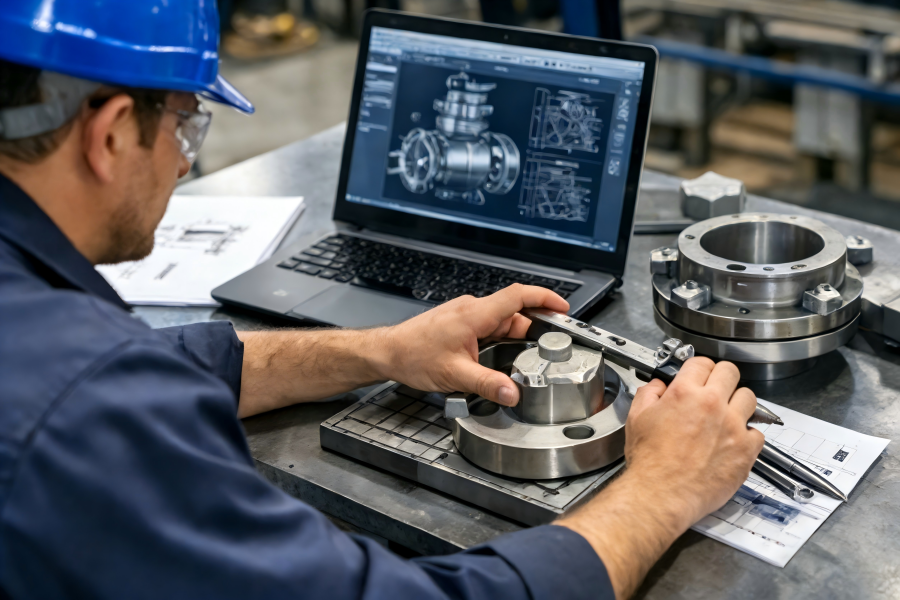
1. What “General Service” Means in Practice
“General service” is not a strict standards term. In industrial usage, it usually describes butterfly valves intended for:
- Moderate pressure and temperature ranges
- Non-severe media (clean water, air, neutral gases, some mild process fluids)
- Applications where bubble-tight shutoff is not the primary design driver, or where soft seats can provide it within a limited envelope
- Duty cycles that are not highly frequent or highly abrasive
1.1 Typical Construction Features
Most general service butterfly valves are:
- Concentric (zero-offset) or simple double-offset designs
- Equipped with elastomer or polymer seats (e.g., EPDM, NBR, PTFE variants)
- Designed so the disc remains in contact with the seat during most of the closing and opening stroke
This geometry is simple and cost-effective. It also explains both the strengths and the limits of the category:
- Strengths: low torque at low pressure, good shutoff in clean service, simple maintenance, attractive total installed cost.
- Limits: seat wear due to continuous rubbing, sensitivity to temperature and chemical compatibility of the soft seat, and limited pressure-temperature envelopes.
You may want to know Butterfly valve types and operation.
1.2 Where General Service Valves Make Sense
General service butterfly valves are commonly used in:
- HVAC and utility water systems
- Cooling water, fire protection, and non-critical plant services
- Low-pressure air and gas lines
- Process lines where the media is clean and temperatures are compatible with soft seats
In these duties, the valve is often selected for flow isolation or throttling with moderate tightness requirements, and the main risks are mechanical fit, material compatibility, and actuator sizing—not severe sealing performance.
2. What Defines a High-Performance Butterfly Valve
A high-performance butterfly valve (HPBV) is not simply a “better” general service valve. It is a different engineering approach to sealing and load management. In practice, HPBVs are used when one or more of the following apply:
- Higher pressure and/or higher temperature than soft-seated concentric designs can tolerate
- Tighter and more predictable shutoff requirements over the service life
- More demanding cycling, or higher differential pressure at closure
- Media that would rapidly degrade or extrude a soft elastomer seat
2.1 Offset Geometry and Sealing Concept
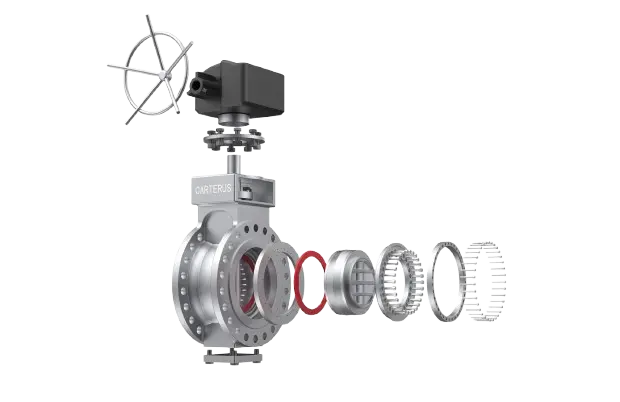
High-performance butterfly valves typically use double-offset or more advanced offset geometries. The purpose of the offset is to reduce or eliminate rubbing between disc and seat during most of the stroke.
- In a double-offset (high-performance) design, the disc is offset from the shaft centreline and the pipe centreline. This creates a cam-like action: the disc approaches the seat only near the closed position, rather than sliding against it through the entire rotation.
- In triple-offset and multi-eccentric (such as Carter Valve’s six-eccentric) designs, the geometry is further refined so that sealing occurs with controlled, progressive contact and minimal sliding friction.
More reading: USA Carter Valve Inc. Launches CARTERUS Six-Eccentric Butterfly Valve for Critical Service Applications
The exact performance depends on the detailed design, materials, and manufacturing tolerances, which must be verified against project requirements and applicable test standards.
2.2 Seat Types and Temperature Capability
High-performance designs often use:
- Reinforced soft seats (e.g., PTFE with backing or lamination) for moderate high-performance service
- Or metal-to-metal seats for higher temperatures, higher pressures, or services where soft materials are unsuitable
Compared with general service valves, these seats are intended to:
- Withstand higher mechanical loads at closure
- Maintain more stable geometry over temperature excursions
- Deliver repeatable sealing behaviour over a longer service life, assuming correct application and installation
3. Sealing Behaviour: The Real Engineering Difference
The most important technical distinction between general service and high-performance butterfly valves is how the disc contacts the seat.
3.1 General Service: Continuous or Early Contact
In a concentric or simple design:
- The disc typically contacts the seat early in the closing stroke
- There is continuous sliding contact between disc edge and seat for a significant part of the rotation
- Sealing depends heavily on seat elasticity and surface condition
This is perfectly acceptable in clean, low-stress services. However, it also means:
- Higher wear rates on the seat in cycling service
- Greater sensitivity to particles in the media
- Higher risk of torque increase over time as the seat deforms or degrades
3.2 High-Performance: Controlled, Late Contact
In an offset high-performance design:
- The disc remains clear of the seat for most of the stroke
- Contact is concentrated near the final closing angle, often with a cam or wedge effect
- Sealing load is generated in a more predictable and mechanically defined way, rather than relying only on elastomer compression
The practical outcome is:
- Reduced wear during opening and closing
- More stable torque characteristics over the valve’s life
- Better suitability for higher differential pressures and more demanding services
Again, actual performance must be validated by type testing and project-specific requirements; the geometry alone does not guarantee a particular leakage class or life cycle.
More reading:How Does a Six-Eccentric Butterfly Valve Achieve Metal-to-Metal Sealing.
4. Pressure, Temperature, and Media: How Far Each Can Go
It is tempting to draw a simple line—general service for “low”, high-performance for “high”. In reality, the boundary is defined by materials, seat design, and applicable standards, not by the label alone.
4.1 General Service Envelope
General service butterfly valves are usually limited by:
- The temperature rating of the elastomer or polymer seat
- The pressure rating of the body and seat retention design
- The risk of seat extrusion or permanent deformation under load
They can perform very well within that envelope, but outside it, failure modes become less predictable: loss of tightness, accelerated wear, or increased operating torque.
4.2 High-Performance Envelope
High-performance butterfly valves extend the usable range by:
- Using offset geometry to control contact mechanics
- Employing reinforced or metal seating systems
- Designing the seat retention and disc structure to carry higher loads
For example, in services such as high-temperature FCCU isolation, molecular sieve switching, or cryogenic LNG isolation, the choice is not just “butterfly valve or not”, but which sealing concept can maintain predictable behaviour under those specific thermal and mechanical conditions. The final selection must always reference the relevant design code, pressure-temperature rating method, and qualification tests required by the project.
5. Torque, Actuation, and System Implications
Valve selection does not stop at the valve. Actuator sizing, control philosophy, and emergency operation are directly affected by the sealing concept.
5.1 General Service Torque Characteristics
- Typically low breakaway torque at low pressure
- Torque increases as the seat ages or deforms
- In higher differential pressure service, torque margins can become tight, especially near closure
This is manageable in many utility services, but it requires attention in automated or fail-safe applications.
5.2 High-Performance Torque Characteristics
- More defined torque curve, with peak torque often near the final closing position
- Better stability over time because wear during the stroke is reduced
- Higher absolute torque in some designs, which must be accounted for in actuator selection
From a system perspective, the benefit is predictability: once the valve and actuator are correctly matched, performance is more repeatable over the service life, assuming maintenance and operating conditions remain within the design basis.
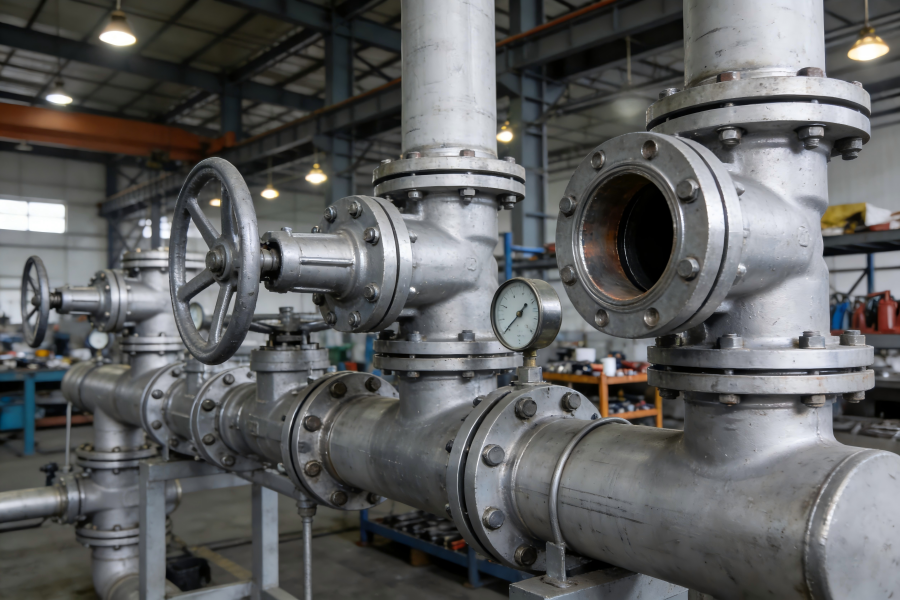
6. Cost Is Not Just Purchase Price
A common mistake in specifications is to compare general service and high-performance butterfly valves only on initial cost. A more useful comparison considers:
- Expected service life in the given duty
- Maintenance intervals and seat replacement frequency
- Risk and consequence of leakage or unplanned shutdown
- Availability of local manufacturing support, spares, and documentation when that matters for the project schedule or operating strategy
In low-demand utility service, a general service valve may deliver the lowest total cost of ownership. In more demanding isolation duties, a high-performance or even a metal-to-metal seated design may reduce overall risk, even if the initial price is higher. The correct choice depends on service conditions, not on category labels.
7. Where Carter Valve’s Portfolio Fits
Carter Valve focuses on engineered butterfly valve solutions rather than one-size-fits-all products. Within the butterfly valve range, this includes:
- High-Performance Butterfly Valves for applications that exceed the practical limits of general service designs
- Triple Offset Butterfly Valves and Metal-to-Metal Seated Butterfly Valves for higher temperature, higher pressure, or more demanding isolation duties
- The Six-Eccentric Butterfly Valve as a signature line, aimed at services where controlled, progressive sealing contact and long-term mechanical stability are required
- Zero leakage isolation solutions, where the term “zero leakage” is used only in the context of defined test standards, acceptance criteria, and service conditions that must be verified for each project
In projects such as molecular sieve switching, high-temperature FCCU isolation, or cryogenic LNG service, the selection process typically starts with the sealing concept and mechanical behaviour, not with a generic valve type. Localised manufacturing and service capability can then play a role in reducing lead time, supporting documentation requirements, and simplifying lifecycle support, depending on the project context.
8. A Practical Selection Checklist
When deciding between a general service and a high-performance butterfly valve, a structured checklist helps avoid both over- and under-specification:
- Process conditions: Maximum and minimum pressure, temperature, and differential pressure at closure.
- Media: Clean or contaminated, corrosive, erosive, or temperature-sensitive.
- Shutoff requirement: What leakage rate is acceptable, and under which test or operating conditions must it be demonstrated?
- Duty cycle: On/off frequency, throttling duty, and expected number of cycles.
- Actuation: Manual or automated, fail-safe requirements, and available torque margins.
- Lifecycle considerations: Access for maintenance, spares strategy, and consequence of failure.
If the answers stay comfortably within the envelope of soft-seated, low-stress service, a general service butterfly valve may be the most rational choice. If not, a high-performance or more advanced eccentric design should be evaluated against the project’s technical and commercial risk profile.
9. Summary: The Difference That Actually Matters
The real difference between general service and high-performance butterfly valves is not marketing language. It is how the valve manages contact, load, and sealing over time.
- General service valves rely on simple geometry and soft seats, and perform well in clean, moderate conditions.
- High-performance valves use offset geometry and more robust sealing systems to deliver more predictable behaviour in more demanding duties.
Choosing correctly requires an honest assessment of service conditions, performance expectations, and lifecycle risk—not just a line item comparison. For critical isolation duties, especially in temperature- or pressure-challenging services, the sealing concept and mechanical design should always lead the specification.