



Chloridespanningscorrosiescheuren kondigen zichzelf niet aan met geleidelijk metaalverlies, zichtbare roest of veranderingen in het bedieningsgedrag. Een afsluiterhuis of motorkap gemaakt van 316L roestvast staal kan in een zeewater service lijn zitten, elke visuele inspectie doorstaan en geen corrosie vertonen bij standaard onderzoek - en dan catastrofaal doorscheuren, zonder waarschuwing voor plastische vervorming en zonder detecteerbare eerdere lekkage.
Deze faalwijze doodt apparatuur, creëert ongeplande shutdowns, en in de ergste gevallen creëert het veiligheidsincidenten op platforms en proceseenheden waar het vrijkomen van vloeistof geen onderhoudskwestie is maar een insluitingscrisis. Het komt onevenredig vaak voor in offshore olie en gas, marine, ontzilting, en aan de kust chemische fabriek omgevingen - precies de industrieën waar 316 roestvast staal routinematig wordt gespecificeerd omdat het eruit ziet als een corrosiebestendig materiaal.
Het mechanisme is chloride spanningscorrosie kraken (CSCC). Het is geen materiaalfout, geen fabricagefout en geen onvoorspelbare afwijking. Het is een goed begrepen elektrochemisch en mechanisch fenomeen dat voorspelbare regels volgt - en het is te voorkomen, mits vanaf het begin het juiste materiaal wordt gespecificeerd.
Wat is chloride spanningscorrosie?
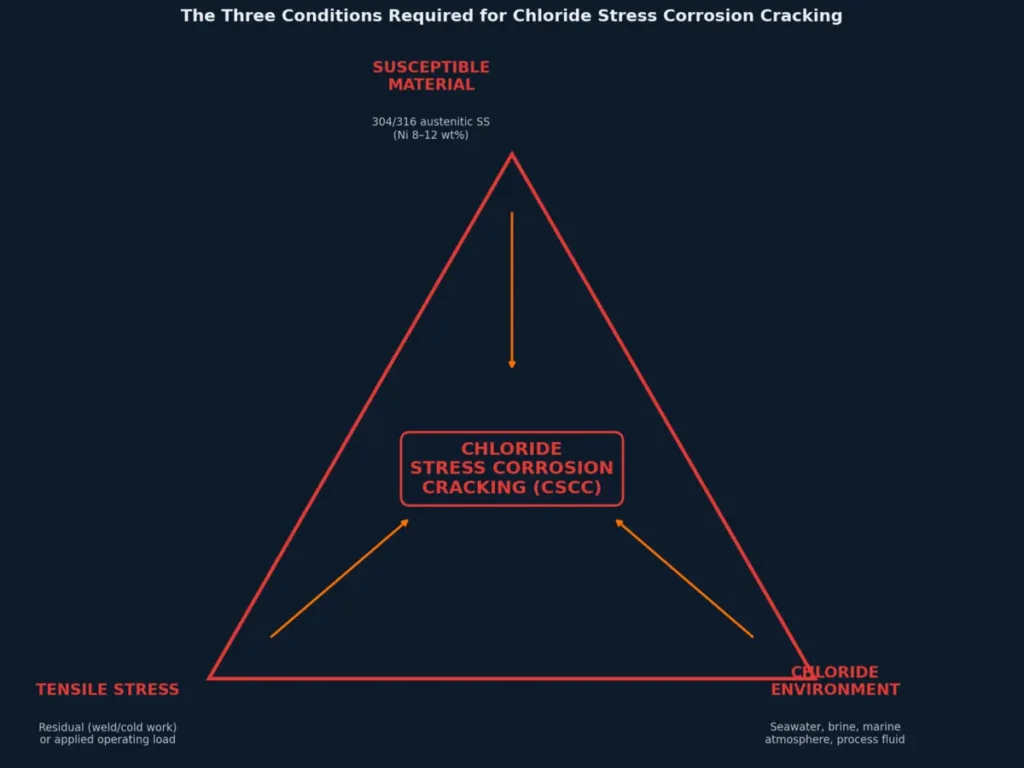
Chloride spanningscorrosie is de brosse breuk van een metaal onder de gelijktijdige invloed van drie condities:
- Trekspanning - Toegepast (bedrijfsdruk, mechanische belasting) of overblijvend (door lassen, koudbewerking, thermische cycli of assemblage door persen).
- Chloridehoudende omgeving - zeewater, pekel, mariene atmosfeer, geproduceerd water of een procesvloeistof of externe omgeving die chloride-ionen bevat
- Gevoelig materiaal - voornamelijk austenitische roestvaste staalsoorten met een nikkelgehalte van 8-12 wt%, waaronder de alomtegenwoordige 304, 304L, 316 en 316L soorten.
Verwijder een van deze drie voorwaarden en CSCC kan niet optreden. Maar in de meeste industriële omgevingen op zee en aan de kust zijn ze alle drie tegelijk aanwezig.
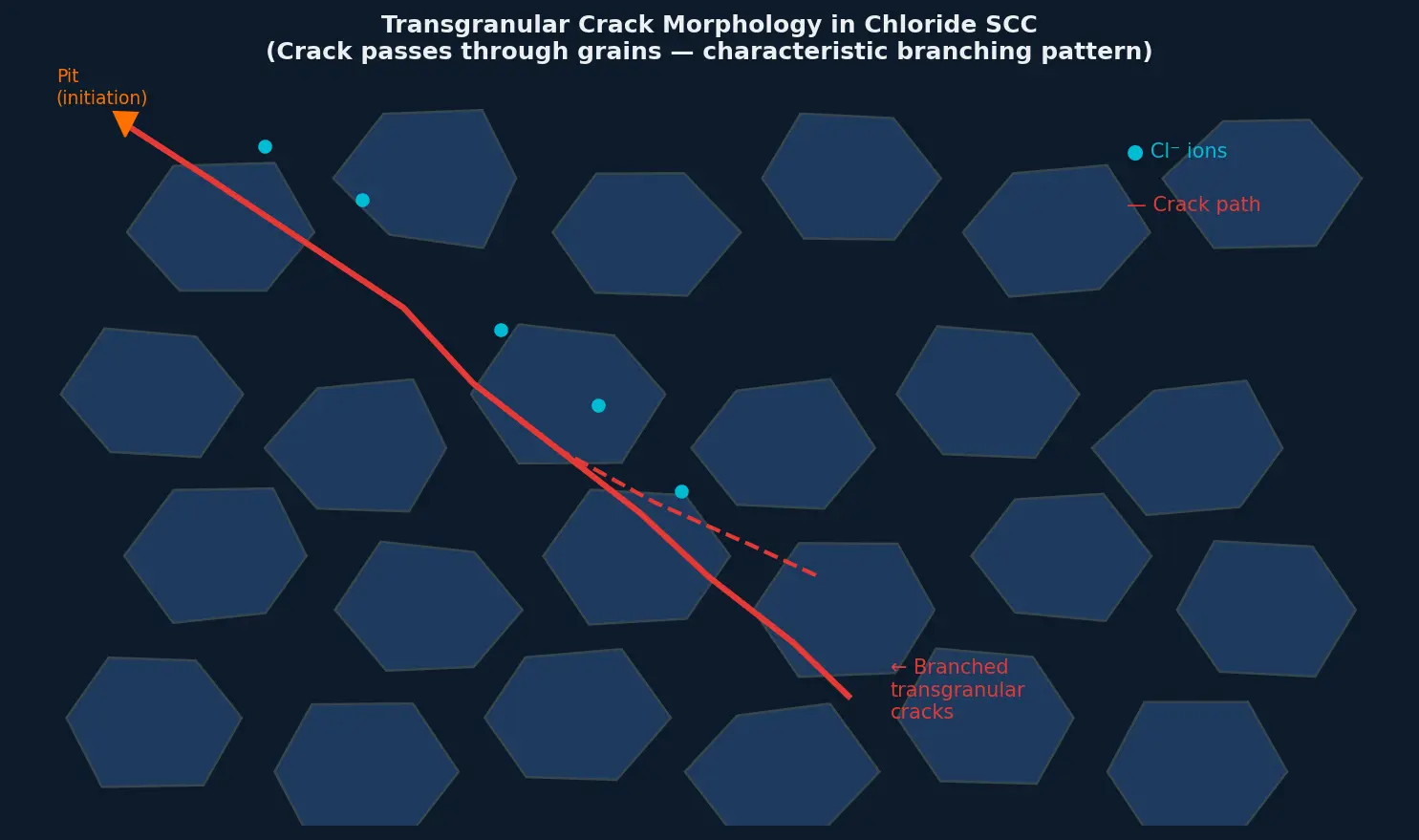
De scheurmorfologie is karakteristiek en diagnostisch. CSCC in austenitisch roestvast staal is transgranulair - de scheur gaat door korrels heen in plaats van langs korrelgrenzen. Bij metallografisch onderzoek vertoont het scheurtraject een kenmerkend vertakt uiterlijk, met secundaire scheuren die zich van het primaire scheurtraject afsplitsen. Deze vertakking is een vingerafdruk: als een forensisch metallurg dit ziet, is CSCC bevestigd.
Het breukvlak ziet er bros uit - geen significante plastische vervorming, geen halsvorming, geen kneedbaar scheuren. Een onderdeel dat vóór breuk een aanzienlijke taaiheid zou moeten hebben, gedraagt zich alsof het keramiek is. Dit plotse, brosse karakter is wat CSCC tot een veiligheidskritische zorg maakt in plaats van enkel een onderhoudskost.
Het elektrochemische mechanisme
Begrijpen waarom CSCC optreedt, helpt voorspellen wanneer het zal optreden en welke materiaalveranderingen het zullen voorkomen.
Op microscopisch niveau begint CSCC met een afbraak van de passieve oxidelaag die roestvrij staal zijn corrosiebestendigheid geeft. Chloride-ionen zijn agressieve anionen die concurreren met de zuurstofionen die de passieve chroomoxidelaag stabiliseren en deze verdringen. Op plaatsen met spanningsconcentratie - lasnaden, bewerkte schroefdraden, perspassingen, putlittekens - breekt de passieve laag plaatselijk af, waardoor kaal metaal bloot komt te liggen aan de elektrolyt.
Zodra de passieve laag is doorbroken, begint de anodische ontbinding van het blootliggende metaal, waardoor een microput ontstaat. De geometrie van de put creëert een spanningsconcentratie die de lokale trekspanning versterkt. Tegelijkertijd verandert de chemie in de put: chloride-ionen migreren naar binnen om de ladingsbalans in stand te houden, waardoor de lokale pH daalt en er een zure, depassiverende micro-omgeving in de put ontstaat. Waterstof wordt gegenereerd in de kathodische gebieden en kan diffunderen in het staal vóór de scheurtip, waardoor het materiaal verder wordt verbrijzeld.
De scheur breidt zich voort door afwisselend anodische ontbinding aan de punt en spanningsgedreven breuk van de afgebrokkelde zone ervoor. Het resultaat is een scheur die korrel voor korrel door het materiaal voortschrijdt - snel genoeg om onverwacht structureel falen te veroorzaken, maar langzaam genoeg om tijdens het gebruik weken of maanden onopgemerkt te blijven voordat de scheur door de wand dringt.
De temperatuur- en chloridedrempels
CSCC in 304/316 roestvast staal is niet onder alle omstandigheden even waarschijnlijk. Het risico is een functie van zowel de chlorideconcentratie als de temperatuur en hun interactie.
Temperatuurdrempel: De algemeen vermelde drempelwaarde voor SCC-gevoeligheid van 304/316 austenitische kwaliteiten in chloridehoudende omgevingen is ongeveer 50-60 °C bij chlorideconcentraties boven ongeveer 100 ppm. Onder deze temperatuurdrempel is de kinetiek van het oplossings- en scheurgroeimechanisme langzaam genoeg dat scheurvorming zich niet voortplant op praktische technische tijdschalen - hoewel dit geen immuniteit is en de drempel verschuift met de chlorideconcentratie en het spanningsniveau.
Geen veilige chlorideconcentratie voor 304/316: Bij verhoogde temperaturen, is er geen lagere chloride limiet die 304 of 316 immuun voor CSCC maakt. Onderzoek toont consequent aan dat 304 en 316 presteren vergelijkbaar in chloride SCC gevoeligheid - de molybdeen toevoeging in 316 dat putjes weerstand verbetert biedt weinig voordeel voor SCC weerstand. Beide kwaliteiten kunnen barsten bij chlorideconcentraties van een paar honderd ppm bij temperaturen boven 60 ° C.
Verdamping en concentratie-effecten: Een vaak over het hoofd gezien scenario is verdampingsconcentratie. Als een chloridehoudende oplossing verdampt op een heet oppervlak van roestvast staal - inclusief het buitenoppervlak van een klepbehuizing in een maritieme atmosfeer - kan de lokale chlorideconcentratie aan het metaaloppervlak ordes van grootte hoger zijn dan de bulkvloeistofconcentratie. Onder deze omstandigheden kan CSCC beginnen bij temperaturen en bulkconcentraties die veilig lijken.
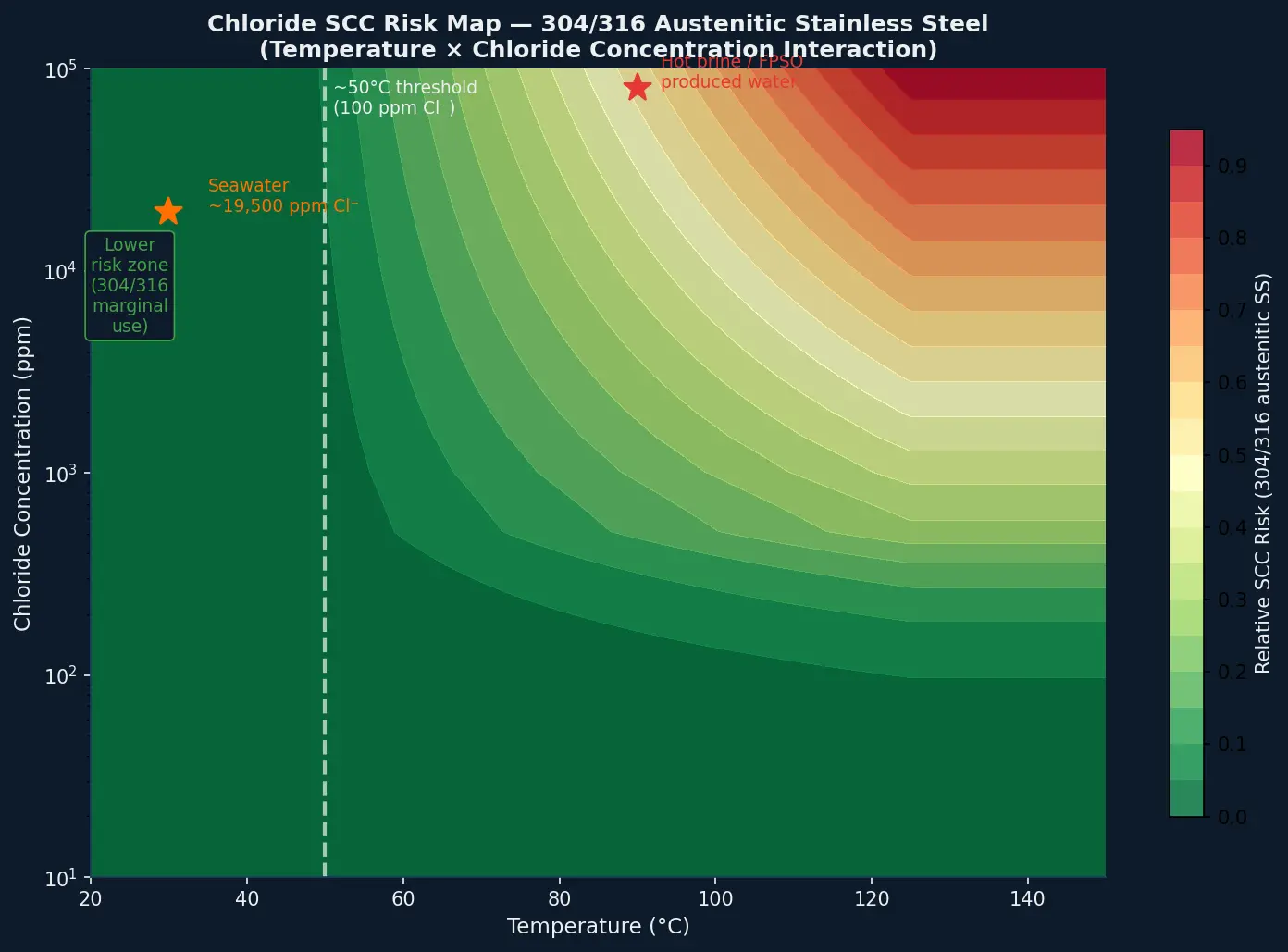
Dit is de reden waarom offshore platform apparatuur - blootgesteld aan nevel en hitte van proceslijnen - CSCC storingen heeft gezien in 316L afsluiters en leidingen, zelfs wanneer de bulk zeewater temperatuur onder de nominale drempel ligt. De risicozone is breder dan de drempelwaarden suggereren in verdampings- of spatzone omstandigheden.
Waarom kleponderdelen bijzonder kwetsbaar zijn
Kleppen concentreren verschillende CSCC-risicofactoren tegelijkertijd:
Restlasspanningen. Klephuizen worden aan leidingen gelast. Warmte-beïnvloede laszones bevatten hoge resttrekspanningen van de thermische cyclus en de lasmicrostructuur kan gevoelig zijn - chroomcarbideprecipitatie bij korrelgrenzen put chroom uit de aangrenzende korrelgrensgebieden, waardoor de lokale corrosieweerstand afneemt en er preferentiële paden ontstaan voor de initiatie van CSCC.
Bewerkte spanningsconcentraties. Schroefdraadverbindingen, O-ringgroeven, boringovergangen en spiebanen creëren allemaal geometrische spanningsconcentraties die de plaatselijke trekspanning boven de nominale bedrijfsspanning verhogen. Dit zijn precies de locaties waar CSCC het eerst optreedt.
Gevangen omgevingen. Spleten onder pakkingen, tussen huis- en einddekselvlakken en rond pakkingglancomponenten creëren stilstaande micromilieus waar chloride zich kan concentreren en de lokale pH kan dalen - beide verergerende omstandigheden voor CSCC in vergelijking met blootstelling aan bulkvloeistof.
Door druk veroorzaakte stress. Een klepbehuizing onder druk staat onder hoepelspanning. Voor een 150 lb klasse klep op de maximaal toelaatbare werkdruk, zijn de trekspanningen in de wand van de behuizing ruim binnen de vloeigrens van 316L - maar het zijn aanhoudende trekspanningen die, in combinatie met de residuele lasspanning, gemakkelijk de drempel voor CSCC initiatie in een chloride omgeving kunnen overschrijden.
De combinatie van deze factoren betekent dat een klep gespecificeerd als 316L roestvast voor “corrosiebestendigheid” in een offshore zeewatersysteem binnen 12-24 maanden na ingebruikname kan falen door CSCC - niet omdat de specificatie onzorgvuldig was, maar omdat CSCC niet de faalwijze was die werd beoordeeld. NACE MR0175/ISO 15156 regelt de materiaalselectie voor zure toepassingen en de NORSOK M-001 standaard behandelt de materiaalselectie voor offshore omgevingen in de Noordzee.
Materiaalkeuze: Opklimmen op de weerstandsladder
De oplossing voor CSCC is in principe eenvoudig: verander het materiaal in een materiaal dat bestand is tegen het scheurmechanisme. De keuze hangt af van de gebruiksintensiteit.
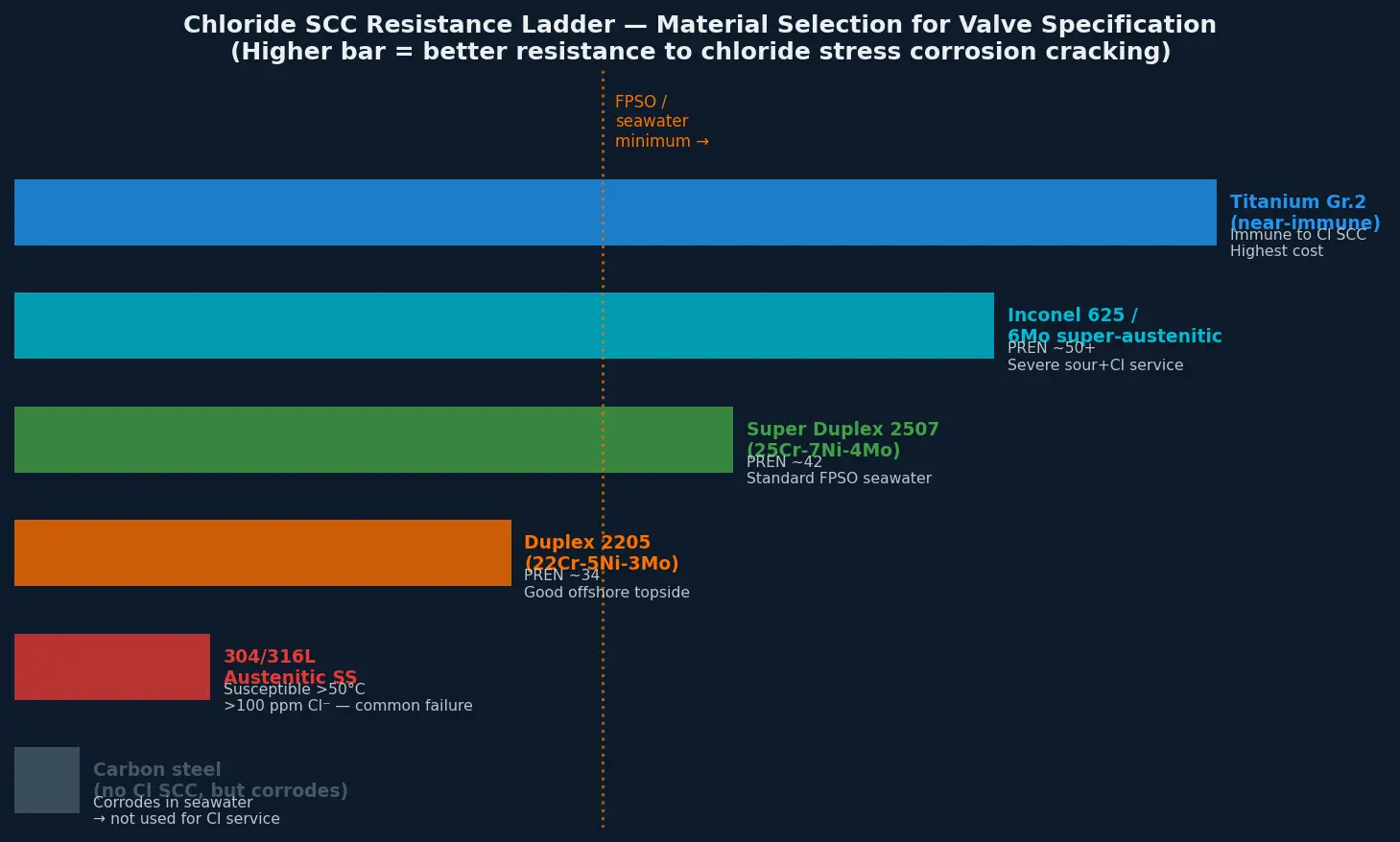
Duplex roestvast staal 2205 (UNS S31803/S32205) heeft een tweefasen austeniet-ferriet microstructuur in ongeveer gelijke verhoudingen. De ferrietfase onderbreekt de continue austenitische matrix en blokkeert fysiek de transgranulaire scheurgroei. Het resultaat is een aanzienlijk betere CSCC-bestendigheid dan 304/316, gecombineerd met ongeveer twee keer de vloeigrens. Het PREN (Pitting Resistance Equivalent Number = %Cr + 3,3×%Mo + 16×%N) voor 2205 is ongeveer 34, waardoor het geschikt is voor offshore topside process service met matige blootstelling aan chloride.
Super duplex roestvast staal 2507 (UNS S32750) heeft een hoger legeringsgehalte - 25% Cr, 7% Ni, 4% Mo - wat een PREN van ongeveer 42 oplevert. Dit is het standaardmateriaal voor zeewaterleidingen en kleppen in offshore- en FPSO-toepassingen volgens NORSOK M-001 en gelijkwaardige normen. Voor zeewaterkoeling, bluswater en ballastsystemen waar 304/316 het zou begeven bij CSCC, biedt 2507 een betrouwbare levensduur.
6Mo super-austenitisch roestvast staal (bijv. UNS N08367) bereikt PREN boven 40 in een austenitische microstructuur, met een betere lasbaarheid dan superduplex voor sommige toepassingen. De CSCC drempeltemperaturen liggen ruim boven 100 °C in neutrale chlorideoplossingen.
Inconel 625 en soortgelijke nikkellegeringen worden gespecificeerd voor de zwaarste combinaties van chloride, temperatuur en zure service (H₂S aanwezig). Deze materialen vallen onder NACE MR0175/ISO 15156 Deel 3 voor zure toepassingen en zijn vrijwel ongevoelig voor CSCC onder omstandigheden die duplexkwaliteiten vernietigen.
De selectielogica is:
- Offshore bovenbouw, matig chloride → Duplex 2205
- Zeewater, FPSO, pekel met hoog chloridegehalte → Super Duplex 2507 (PREN > 40)
- Zuur gebruik met chloriden → NACE MR0175-conforme legering, meestal Inconel of superduplex met geverifieerde warmtebehandeling
- Subsea of extreme toepassingen → Titanium of Inconel 625
Carter kleppen olie- en gasoplossingen materiaalkeuze voor FPSO-, platform- en onderzeese afsluitertoepassingen waarbij het CSCC-risico de specificatie afwendt van standaard roestvaststalen kwaliteiten.
Het PREN-nummer: Wat het je vertelt en wat niet
PREN (Pitting Resistance Equivalent Number) wordt veel gebruikt in offshore materiaalspecificaties als een indicatie voor corrosiebestendigheid. De formule weegt de bijdragen van chroom, molybdeen en stikstof aan de weerstand tegen putcorrosie in chlorideoplossingen.
Een PREN van meer dan 40 is de algemeen aanvaarde drempel voor zeewatertoepassingen. Super duplex 2507 met PREN ~42 en 6Mo-kwaliteiten met PREN ~46+ voldoen aan deze drempel.
Maar PREN heeft beperkingen die ingenieurs moeten begrijpen:
PREN voorspelt putweerstand, niet direct SCC-weerstand. De twee zijn verwant maar niet identiek. Een hoge PREN betekent dat de passieve laag stabieler is en pitting minder waarschijnlijk is - wat het mechanisme om pitting te veroorzaken voor CSCC vermindert. Maar een materiaal met een hoge PREN en een ongeschikte microstructuur kan nog steeds barsten. Een gepubliceerd defectgeval van een superduplexklep in zeewatertoepassing toonde aan dat zelfs gegoten materiaal met een 2507-specificatie aan SCC kan lijden als de ferrietfasedistributie niet uniform is als gevolg van gietsegregatie - waardoor er gebieden met een plaatselijk lage PREN ontstaan ondanks het feit dat het materiaal voldoet aan de specificatie voor bulkchemie.
Gegoten vs. gesmeed: Gegoten klephuizen kunnen gesegregeerde microstructuren hebben waarbij de ferrietverdeling en lokale samenstelling afwijken van het gesmede equivalent. Voor kritische zeewater- en hoogchlorideservice is het specificeren van materiaaltestrapporten met ASTM G48 putcorrosietests op de werkelijke materiaalwarmte - en niet alleen naleving van de chemie - een zinvolle extra waarborg.
Richtlijnen voor de wisselwerking tussen deze materiaalnormen en de vereisten voor de lekkageklasse van kleppen worden behandeld in het artikel over Carter Valve op lekkageklassen van kleppen: API 598, ANSI/FCI 70-2 en ISO 5208..
Veelgestelde vragen
Is 316L echt niet beter dan 304L voor chloride SCC weerstand?
Voor CSCC specifiek - ja, ze zijn in wezen gelijkwaardig. De 2% molybdeen in 316/316L verbetert de weerstand tegen putjes aanzienlijk, dat is de reden waarom 316 de voorkeur boven 304 in chloride omgevingen. Maar het molybdeen niet aanzienlijk vertragen de CSCC scheurgroei mechanisme zodra een put is begonnen en de voorwaarden voor scheurvorming wordt voldaan. De SCC drempel temperaturen voor 304 en 316 in neutrale chloride-oplossingen zijn vergelijkbaar - beide rond 50-60 ° C bij concentraties boven 100 ppm Cl-.
Kan warmtebehandeling na het lassen (PWHT) CSCC voorkomen?
PWHT (spanningsontlasting) vermindert restlasspanningen, dat is een van de drie voorwaarden vereist voor CSCC. Spanningsontlasting van 304/316 lasverbindingen vermindert het risico op CSCC in vergelijking met de toestand zoals gelast. De standaard gloeibehandeling voor austenitisch roestvast staal (snel afschrikken boven 1050 °C) is echter niet altijd praktisch voor geassembleerde kleponderdelen. Overschakelen op een resistenter materiaal is de meest betrouwbare oplossing voor nieuwe apparatuur, terwijl spanningsontlasting een haalbare oplossing is voor apparatuur die in gebruik is.
Hoe snel veroorzaakt CSCC falen?
De tijd tot breuk is sterk afhankelijk van het spanningsniveau, temperatuur, chloride concentratie en de aanwezigheid van putjes als initiatieplaatsen. In laboratorium versnelde testen (kokende MgCl₂ oplossing), kunnen 316 specimens scheuren in uren. In de echte offshore service, de typische faaltijdlijn voor 316L afsluiters en leidingen in zeewater varieert van maanden tot een paar jaar - dat is snel genoeg om binnen de normale onderhoudsintervallen te vallen, maar langzaam genoeg om geen waarschuwing te geven voordat doorwand scheurvorming optreedt.
Voorkomt verven of coaten CSCC?
Externe coatings verminderen de blootstelling van de klepbehuizing aan het chloride milieu, wat één van de drie CSCC condities verwijdert. Dit is een geldige beperking voor externe CSCC - bijvoorbeeld het beschermen van een 316 klepbehuizing in een maritieme atmosfeer. Echter, coatings kunnen breken, krassen of degraderen, en het beschermde oppervlak onder een coating falen is in een meer agressieve lokale omgeving dan blank metaal. Coatings zijn geen vervanging voor de juiste materiaalselectie in primaire natte componenten.
Welke inspecties detecteren CSCC voor het falen?
Chloride SCC-scheuren kunnen in een vroeg stadium te fijn zijn voor visuele inspectie. Penetrant onderzoek (PT) of kleurstofinspectie kunnen scheuren detecteren die het oppervlak doorbreken zodra ze groot genoeg zijn. Wervelstroomtests kunnen scheuren in de buurt van het oppervlak detecteren zonder dat toegang tot het oppervlak nodig is. Voor kritische afsluiters in bekende CSCC-omgevingen is periodieke PT-inspectie van lassen, schroefdraden en spanningsconcentratiezones - met intervallen die zijn afgestemd op de verwachte scheurgroeisnelheid - de juiste aanpak voor integriteitsbeheer. Het vervangen van 304/316 door duplex in nieuwe apparatuur elimineert de inspectielast.
Welke norm bepaalt de materiaalkeuze voor offshore afsluiters?
Voor offshore-omgevingen in de Noordzee is NORSOK M-001 de belangrijkste materiaalkeuzenorm. Deze norm bepaalt welke roestvast staalsoorten zijn toegestaan in zeewater en andere corrosieve omgevingen en specificeert PREN-minima en testvereisten. Voor zure toepassingen (H₂S aanwezig met chloriden) bepaalt NACE MR0175/ISO 15156 de materiaalselectie en hardheidslimieten om zowel CSCC als waterstofbrosheid te voorkomen. Carter Valve's mariene en scheepsbouwoplossingen op deze pagina wordt uitgelegd hoe deze vereisten de specificatie van afsluiters voor offshore- en scheepstoepassingen bepalen.
Technisch advies aanvragen over specificaties van corrosiebestendige kleppen
Als u afsluiters specificeert voor zeewater, scheepvaart, FPSO, offshore topside of elke andere toepassing met blootstelling aan chloride van meer dan 100 ppm bij temperaturen boven 50°C, is de materiaalkeuze geen standaardbeslissing - het is een technische berekening.
Het team van Carter Valve ondersteunt de materiaalselectie voor zwaar corrosieve toepassingen, inclusief CSCC-risicobeoordeling, PREN-verificatie en naleving van NORSOK, NACE MR0175 en projectspecifieke corrosiespecificaties. Wij leveren isolatie- en regelkleppen in duplex 2205, super duplex 2507 en nikkellegeringen voor de meest veeleisende offshore-omgevingen.
Vertel ons wat uw toepassing is - vloeistof, temperatuur, chloridegehalte, aanwezigheid van H₂S en toepasselijke norm - en wij zullen u een materiaalspecificatie aanbevelen die is afgestemd op uw taak en de vereisten voor naleving.
Ontdek Carter Valve's assortiment isolatiekleppen voor offshore en zwaar corrosief gebruik.
Referenties
- Netwerk voor informatie over roestvast staal (SSINA) Chloride spanningscorrosie — https://www.ssina.com/education/corrosion/chloride-stress-corrosion-cracking/
- Corrosiepedia - Chloride spanningscorrosie van Austenitisch roestvast staal — https://www.corrosionpedia.com/chloride-stress-corrosion-cracking-of-austenitic-stainless-steel/2/7216
- Digitale raffinage - Gevoeligheid van austenitisch roestvast staal type 304/304L en 316/316L voor chloriden in koelwater — https://www.digitalrefining.com/article/1002873
- Hindawi Internationaal Tijdschrift voor Corrosie. SCC en waterstofbrosheid van 304, 310 en 316 austenitisch SS in kokend MgCl₂ — https://www.hindawi.com/journals/ijc/2012/462945/
- ScienceDirect - Onverwachte breuk van gegoten super duplex roestvast staal blootgesteld aan water met een hoog chloridegehalte — https://www.sciencedirect.com/science/article/abs/pii/S1350630722001704
- ScienceDirect Onderwerpen - Overzicht zeewatercorrosie (verwijzing naar NORSOK M-001) - (verwijzing naar NORSOK M-001). https://www.sciencedirect.com/topics/engineering/seawater-corrosion
- Supreme kleppen - Selectiegids voor klepmaterialen: WCB, SS316, duplex, gelegeerd staal — https://www.supremevalves.in/blog/valve-material-selection-guide.html
- Eng-Tips Forums - Austenitisch roestvast staal - Chloride geïnduceerde spanningscorrosie (CSCC) — https://www.eng-tips.com/threads/austenitic-stainless-steels-chloride-induced-stress-corrosion-cracking-cscc.436517/
- FHWA / Amerikaanse snelwegen - Verkennende tests van spanningscorrosie in roestvast staal — https://highways.dot.gov/sites/fhwa.dot.gov/files/FHWA-HRT-24-132.pdf
- Keizerlijke klep - Welke materialen zijn het beste voor kleppen voor corrosief gebruik? — https://www.imperialvalve.eu/2026/01/23/what-materials-are-best-for-corrosive-service-valves/