





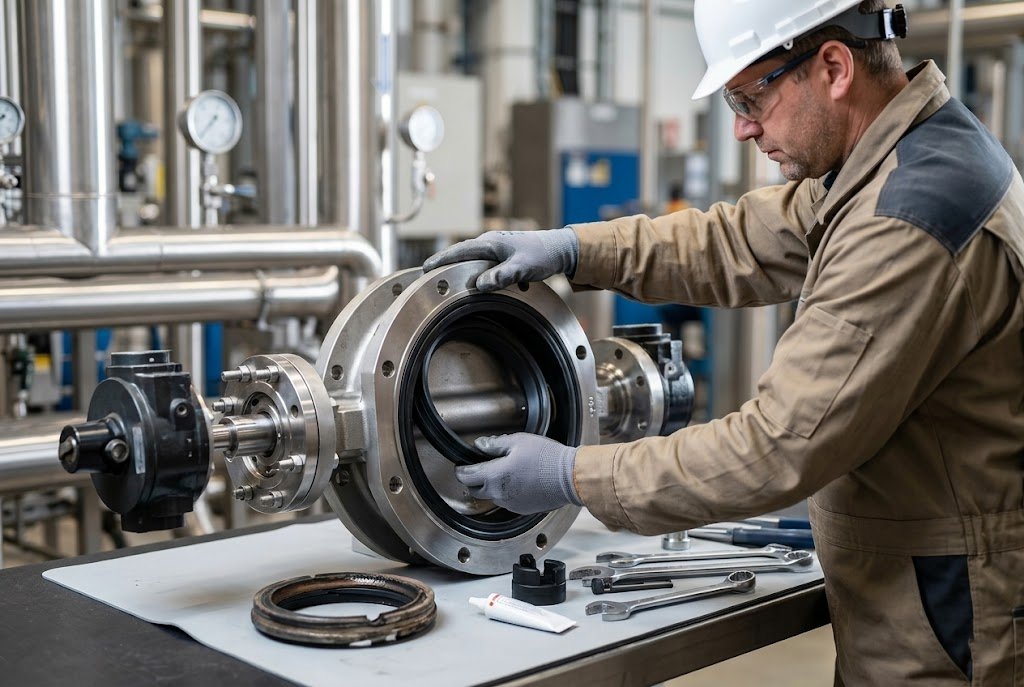
Vervanging van de zitting van een vlinderklep ter plaatse Dit is mogelijk wanneer de klep is ontworpen met een vervangbare zitting, de leiding veilig kan worden afgesloten en drukloos gemaakt, de afdichtingsvlakken van de klepschijf en het huis niet beschadigd zijn, de juiste vervangingsset beschikbaar is en gekwalificeerde technici de procedure uit de bedieningshandleiding van de fabrikant volgen.
Meestal is het niet dit is handig wanneer de zitting in de behuizing is gelijmd of gevulkaniseerd, wanneer de groef in de behuizing of de rand van de schijf beschadigd is, wanneer het ventiel erg groot is of op een moeilijk bereikbare plaats is gemonteerd, of wanneer de bedrijfsomstandigheden zo zwaar zijn dat reparatie in de werkplaats en gecontroleerde tests veiliger zijn. De praktische conclusie is eenvoudig: De onderhoudsvriendelijkheid van het veld wordt niet tijdens het onderhoud gerealiseerd; deze wordt vastgesteld voordat de klep wordt aangeschaft.
De klepzitting is het afdichtingsvlak waarmee een vlinderklep tegen de schijf afsluit. Wanneer deze verslijt, uithardt, opzwelt, barst, chemisch wordt aangetast of door vuil wordt beschadigd, kan de klep intern gaan lekken of moeilijk te bedienen worden. In onderhoudshandleidingen worden interne lekkage, toenemend koppel, gebarsten of verhard zittingmateriaal en verlies van elasticiteit van de zitting vaak genoemd als tekenen dat vervanging nodig kan zijn. Niet elke vlinderklepzitting kan echter ter plaatse worden vervangen. In dit artikel worden de beslissingslogica, de beperkingen en de inkoopterminologie uitgelegd die onderhoudsteams helpen onnodige stilstand te voorkomen.
Waarom het vervangen van stoelen een betrouwbaarheidsprobleem wordt
In veel fabrieken wordt gekozen voor vlinderkleppen omdat ze compact, snel te bedienen en voordelig zijn. Het onderhoudsprobleem doet zich pas later voor, wanneer een klep die ooit goed afsloot, vloeistof langs de zitting begint door te laten. Als de zitting vervangbaar is, kan de reparatie een geplande klus zijn met een reservekit en een korte stilstand. Als de zitting vastgelijmd is, het huis beschadigd is of de klep niet toegankelijk is, kan diezelfde lekkage leiden tot een volledige vervanging van de klep.
Het kostenverschil betreft niet alleen de prijs van een klep. Het omvat ook het afsluiten van de leiding, het aftappen, steigerwerk, hijswerkzaamheden, het verwijderen van de aandrijving, het opnieuw testen, productieverlies en veiligheidsrisico’s. In ondergrondse watersystemen waarschuwt de IOM bijvoorbeeld dat problemen kunnen leiden tot omvangrijke en kostbare graafwerkzaamheden, en het brengt veel storingen aan vlinderkleppen in verband met onjuiste installatie, bediening of onderhoud. In procesinstallaties geldt hetzelfde principe: een klep die niet is ontworpen met het oog op onderhoudsgemak kan een klein lek veranderen in een grote uitval.
Voor lezers die eerst de basisprincipes van de constructie van kleppen willen leren voordat ze zich er verder in verdiepen: de gids van Carter Valve over hoe een vlinderklep werkt en het overzicht van soorten vlinderkleppen bieden nuttige achtergrondinformatie. Voor zware isolatietaken is de kritische isolatie vlinderklep selectiegids legt uit waarom het ontwerp van de stoel, de lekkageklasse, de temperatuur en de bedrijfscyclus duidelijk moeten worden gespecificeerd.
Wanneer vervanging van de veldstoel mogelijk is
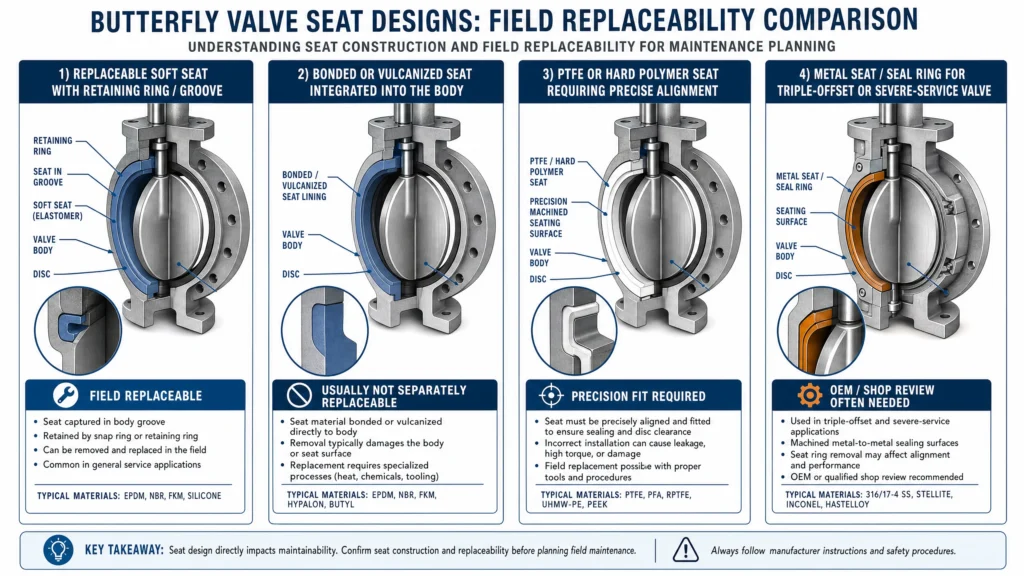
Het vervangen van de veldstoel is het meest realistisch voor een vervangbare vlinderklep met zachte zitting waarbij de elastomeerzitting een afzonderlijk onderdeel is dat op zijn plaats wordt gehouden door een groef, een ring of verwijderbare bevestigingsmiddelen. Union Valve beschrijft vervangbare zachte zittingen als afzonderlijke rubberen ringen, vaak van EPDM, NBR of FKM, die worden vastgehouden door een borgring of groef en zijn ontworpen om het onderhoud te vergemakkelijken. Bij deze ontwerpen kan de zitting vaak worden verwijderd zonder dat het gehele klephuis hoeft te worden vervangen, mits de afdichtingsvlakken nog in goede staat zijn.
Werkzaamheden ter plaatse moeten nog steeds worden beschouwd als gecontroleerd onderhoud, en niet als een snelle, geïmproviseerde reparatie. De leiding moet worden afgesloten, de druk moet worden afgebouwd, de klep moet worden leeggelaten en het personeel moet de procedures van de fabriek voor vergrendeling en het werken in een besloten ruimte volgen. De reparatiehandleiding van TG Valve legt de nadruk op voorbereiding, vergrendeling, aftappen, het verwijderen van de klep indien nodig, inspectie van de klepschijf en het klephuis, reiniging, correcte uitlijning van de zitting, hermontage, langzame drukopbouw, lektesten en het doorlopen van de cyclus.
| Terreinomstandigheden | Waarom het de vervanging van stoelen ondersteunt |
|---|---|
| Ontwerp met vervangbare zachte zitting | De stoel is bedoeld om te worden verwijderd en vervangen als reserveonderdeel |
| Er is een originele vervangende stoel verkrijgbaar | De afmetingen, het materiaal, de hardheid en het profiel komen overeen met het ontwerp van de klep |
| De rand van de schijf is glad en onbeschadigd | De nieuwe zitting kan worden afgedicht zonder dat deze wordt doorgesneden of vervormd |
| De groef of het bevestigingsvlak van de behuizing is schoon en onbeschadigd | De zitting blijft stabiel zitten zonder te verdraaien, omhoog te komen of uit te puilen |
| De leiding kan worden geïsoleerd en drukloos gemaakt | Het werk kan veilig en volgens de wet worden uitgevoerd |
| Er is gekwalificeerd personeel en de IOM-procedure is beschikbaar | De reparatie kan worden uitgevoerd zonder de klep te beschadigen |
| De test na de reparatie kan worden uitgevoerd | Voorafgaand aan het opnieuw in gebruik nemen kunnen lekkage en de werking worden gecontroleerd |
De uitdrukking “ter plaatse vervangbaar” moet daarom meer betekenen dan “de zitting kan in theorie worden verwijderd”. Het moet betekenen dat het ontwerp van de klep, de toegankelijkheid, de reserveonderdelen, het gereedschap, de instructies en het testplan een gekwalificeerd team in staat stellen de afdichtingsprestaties te herstellen met voorspelbare resultaten.
Wanneer het vervangen van de zitting niet aan te raden is
Vervanging ter plaatse wordt afgeraden wanneer de zitting is verlijmd, gegoten, gevulkaniseerd of op een andere manier in het klephuis is geïntegreerd. Union Valve wijst erop dat verlijmde zittingen doorgaans niet afzonderlijk kunnen worden vervangen en dat het wellicht nodig is om de gehele zittingconstructie of de klep te vervangen. Een poging om een dergelijke zitting te verwijderen kan het klephuis beschadigen of oneffenheden achterlaten die een goede afdichting verhinderen.
Vervanging ter plaatse is ook riskant wanneer het om een klep gaat die is ontworpen voor hoge temperaturen, cryogene toepassingen, schurende of corrosieve media, of voor kritieke afsluiting. Metalen zittingen en drievoudig-offset afdichtingsringen vereisen mogelijk een nauwkeurige passing, uitlijningsmarkeringen, een gecontroleerd aanhaalmoment, een specifieke oppervlakteafwerking en gespecialiseerde inspectie. Valve World Americas merkt op dat bij sommige onderhoudsprocedures voor drievoudig-offset-afsluiter of afsluiters voor zware toepassingen het vervangen van de afdichtingsring zonder de zitting te verwijderen niet geschikt is terwijl de afsluiter in de pijpleiding is geïnstalleerd, en dat dit mogelijk niet wordt aanbevolen voor grote afsluiters waarbij manipulatie moeilijk is.
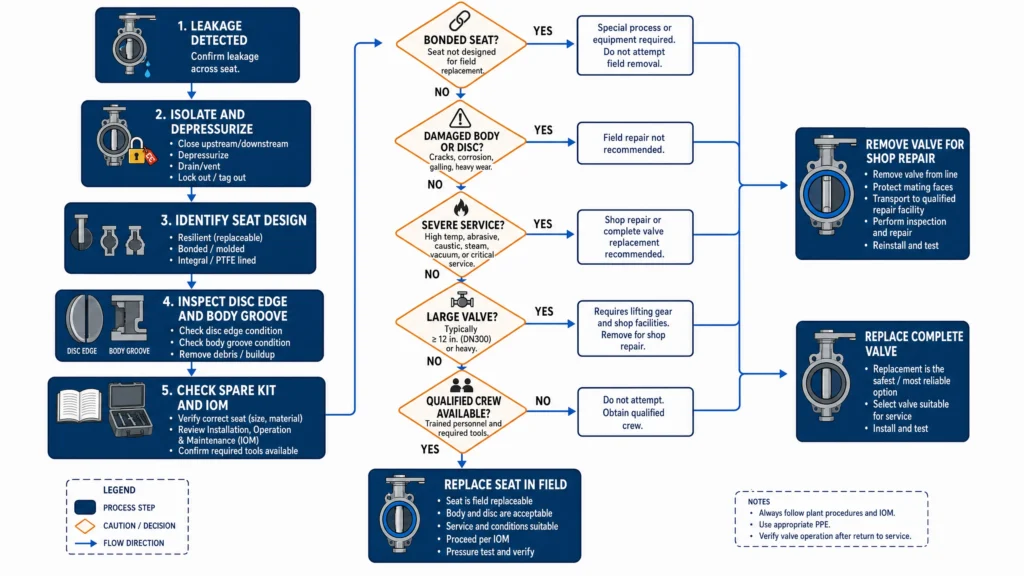
| Toestand | Aanbevolen richting |
|---|---|
| Verlijmde of gevulkaniseerde zitting | Vervang de klep of neem contact op met de OEM; ga er niet zomaar vanuit dat alleen de zitting gerepareerd hoeft te worden |
| De rand van de schijf is bekrast, heeft deukjes, is gecorrodeerd of geërodeerd | Repareer of vervang de schijf/klep voordat u een nieuwe zitting monteert |
| Groef in de behuizing beschadigd of niet rond | Een reparatie of vervanging in de winkel is meestal veiliger |
| Metalen zitting of afdichtingsring voor zware toepassingen | Volg de procedure van de OEM; mogelijk is een reparatie in de werkplaats nodig |
| Grote klep die moeilijk te bedienen is | Beoordeel de mogelijkheden op het gebied van hijsen, oriëntatie, toegang en reparaties in de werkplaats |
| Geen juiste reserveonderdelenset of IOM | Gebruik geen onderdelen die niet van de originele fabrikant zijn |
| Essentiële isolatie- of veiligheidsdienst | Een technische beoordeling en een gedocumenteerde testacceptatie zijn vereist |
Een handige regel die ik bij het opstellen van onderhoudsplannen hanteer, is deze: als de nieuwe zitting niet kan worden gemonteerd zonder de precisieafdichtingsvlakken te beschadigen, of als je achteraf niet kunt controleren of er lekkage is, is er geen sprake van een reparatie ter plaatse — dan is er sprake van een risico-overdracht.
Stoelontwerpen en hun onderhoudsvriendelijkheid
Het ontwerp van de zitting is de belangrijkste factor voor het onderhoudsgemak. Een zachte, vervangbare zitting is minder gevoelig dan een zitting van metaal-op-metaal die voor zware omstandigheden is ontworpen. Een gelijmde zitting is bij aankoop wellicht voordelig, maar ongeschikt voor onderhoud waarbij alleen de zitting wordt vervangen. Een met PTFE beklede of harde polymeerzitting kan in sommige ontwerpen worden vervangen, maar vereist zorgvuldige behandeling en uitlijning. Bij een klep met drievoudige offset of een metalen zitting is het wellicht mogelijk om zitting- en afdichtingsringensets te vervangen, maar dit werk lijkt meer op een precisieherstel dan op algemeen onderhoud.
| Ontwerp van de stoel | Vervangbaarheid ter plaatse | Opmerkingen over de onderhoudbaarheid |
|---|---|---|
| Vervangbare elastomeerzitting | Vaak goed | Het meest geschikt voor algemene service waarbij originele reserveonderdelen op voorraad zijn |
| Verlijmde of gevulkaniseerde zitting | Slecht | De zitting maakt deel uit van de binnenbekleding van de behuizing; het vervangen van de klep is vaak praktischer |
| PTFE of een zitting van hard polymeer | Voorwaardelijk | Vereist het juiste profiel, zorgvuldige behandeling en een juiste afstemming van chemicaliën en temperatuur |
| Metalen zitting of afdichtingsring | Voorwaardelijk tot beperkt | Vereist nauwkeurig bewerkte oppervlakken, een specifieke volgorde van het aandraaien en de OEM-procedure |
| Verstelbaar stoelontwerp | Goed, mits toegankelijk | De installatie moet tijdens het gebruik toegang tot de zijkant voor afstelling mogelijk maken |
In de IOM van VSI’s AWWA C504-afsluiters met vervangbare zitting wordt opgemerkt dat, indien afsluiters een verstelbare zitting hebben, de zijde voor het afstellen van de zitting zo moet worden gemonteerd dat deze tijdens het gebruik toegankelijk is en kan worden afgesteld. Die zin is een herinnering voor elke sector: het onderhoudsgemak hangt af van de oriëntatie en de toegankelijkheid, en niet alleen van het interne ontwerp.
Wat betreft de Carter Valve-platforms voor zware toepassingen, raden we lezers aan om het verschil te vergelijken tussen vlinderkleppen voor algemeen gebruik en speciaal ontworpen modellen. Carter’s Hoogwaardige vlinderklep met dubbele offset, metaal-op-metaal vlinderkleppen, en vlinderklep met zes excentrische punten versus vlinderklep met drievoudige offset In deze bronnen wordt uitgelegd waarom geometrie, belasting op de zitting en oppervlakteafwerking van cruciaal belang zijn voor de isolatie.
Een veilige werkvolgorde op grote hoogte
De volgende stappenreeks vormt geen vervanging voor de bedieningshandleiding van de fabrikant of de veiligheidsprocedures van de fabriek. Het is een algemeen planningsschema voor onderhoudsleiders en ingenieurs die moeten beoordelen of een reparatie ter plaatse haalbaar is.
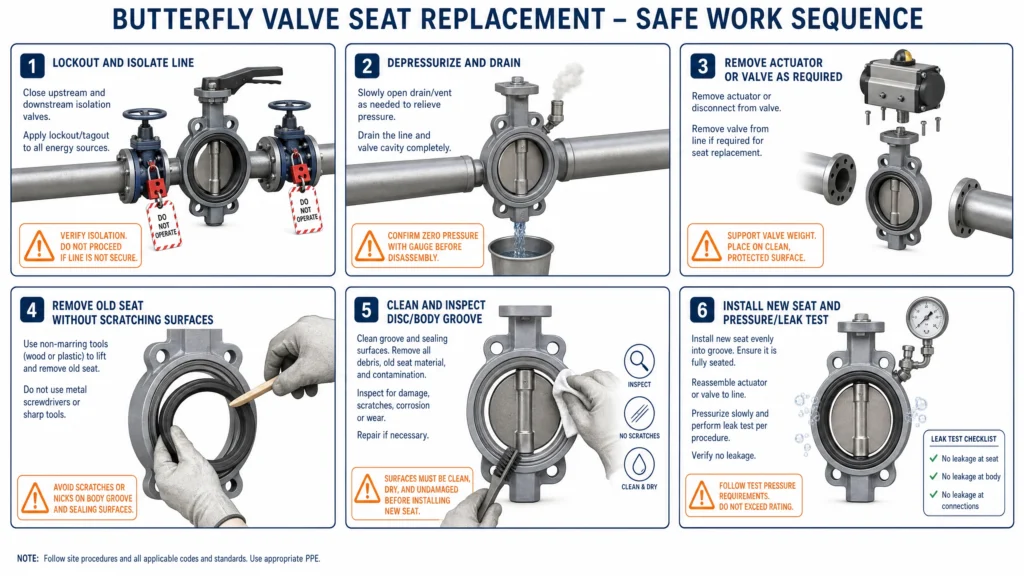
| Stap | Praktisch doel |
|---|---|
| Isoleren en afsluiten | Voorkom onbedoelde stroming, druk, energieontlading of klepbeweging |
| Druklozen en aftappen | Verwijder de opgeslagen druk en de gevaarlijke vloeistof uit de werkruimte |
| Controleer of de klep toegankelijk is | Controleer of de aandrijving is verwijderd, of deze kan worden opgetild, of de flens toegankelijk is en of de werkpositie veilig is |
| Verwijder de oude zitting voorzichtig | Zorg ervoor dat u geen krassen maakt op de groef in de behuizing, de rand van de schijf en de afdichtingsvlakken |
| Reinigen en inspecteren | Verwijder roest, vuil, resten van oude zittingen en chemische afzettingen |
| Controleer het reserveonderdeel | Controleer het materiaal, de afmetingen, het profiel, de oriëntatie en de compatibiliteit |
| Installeren en uitlijnen | De zitting moet gelijkmatig liggen, zonder verdraaiingen, uitstulpingen of vastzittend vuil |
| Weer in elkaar zetten en een ritje maken | Controleer of de beweging soepel verloopt en of de aanslag van de actuator correct is ingesteld |
| Druk-/lektest | Controleer of de afsluiting en de externe afdichting in orde zijn voordat het systeem weer in gebruik wordt genomen |
In de VSI-richtlijnen voor vlinderkleppen met vervangbare zitting wordt benadrukt dat vreemde stoffen de rubberen zittingen kunnen beschadigen, dat aangrenzende leidingen en het binnenwerk van de klep moeten worden gereinigd, en dat het testen bij een druk die hoger is dan de nominale druk kan leiden tot lekkage langs de rubberen zitting of tot schade aan de klep. Deze punten worden vaak over het hoofd gezien bij haastig uitgevoerd onderhoud.
Waarom het vervangen van stoelen mislukt
Een nieuwe zitting lost het probleem van een lekkende vlinderklep niet automatisch op. Als de oorspronkelijke lekkage werd veroorzaakt door schade aan de klepschijf, vervorming van het huis, een verkeerde uitlijning van de leidingen, te hoog aandraaimoment, een fout in de aanslag van de aandrijving of chemische onverenigbaarheid, kan de nieuwe zitting al snel defect raken.
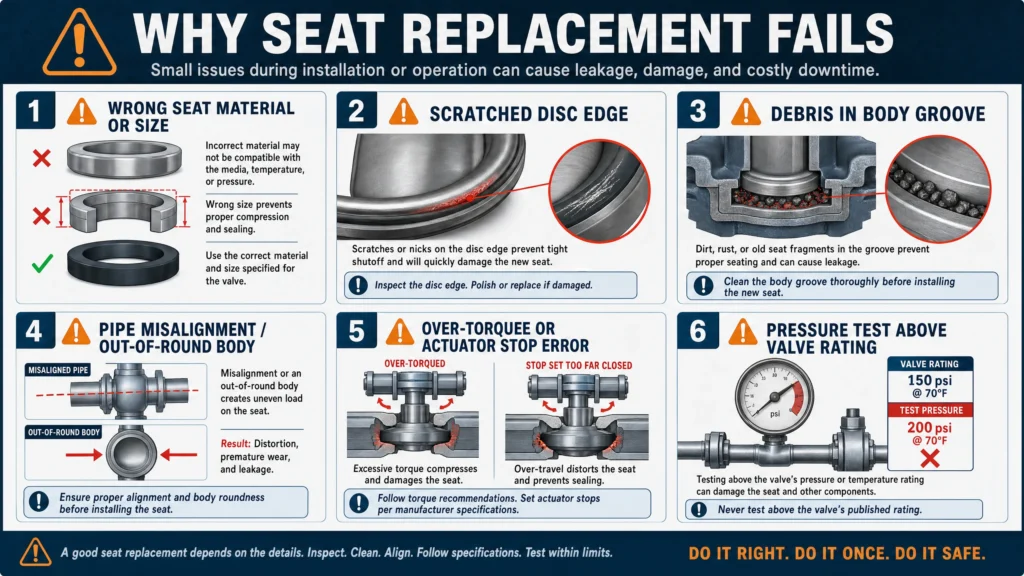
| Oorzaak van de storing | Wat dit met de nieuwe stoel doet | Preventie |
|---|---|---|
| Verkeerd materiaal | Zwelling, verharding, chemische aantasting of temperatuurschade | Stem het materiaal van de zitting af op het medium, de temperatuur en de druk |
| Verkeerde maat of profiel | Verdraaiing, extrusie, slechte compressie, lekkage | Gebruik een OEM-reserveonderdelenset en onderdelen op basis van het serienummer |
| Krassen op de rand van de schijf | Maakt tijdens het sluiten inkepingen of sneden in de nieuwe zitting | Controleer de schijf, polijst deze indien toegestaan, repareer of vervang de schijf |
| Vuil in de groef | Voorkomt een gelijkmatige verdeling en zorgt voor een lekpad | Reinig de groef in de behuizing en de oppervlakken van de klem grondig |
| Verkeerde uitlijning van leidingen | Vervormt het chassis en zorgt voor een ongelijkmatige belasting van de zitting | Juiste bevestiging van leidingen en uitlijning van flenzen |
| Te hoog koppel | Verplettert of scheurt de zitting; verhoogt het bedrijfskoppel | Stel de aanslagen en koppelgrenzen van de actuator correct in |
| Overdrukproef | Beschadigt de zitting of veroorzaakt misleidende lekkage | Test binnen de nominale waarden van de klep en de IOM-grenzen |
Daarom mag een reparatieteam niet alleen het zichtbare, flexibele onderdeel vervangen. De klep moet als een geheel worden geïnspecteerd: het huis, de klepschijf, de as, de lagers, de pakking, de aanslagen van de aandrijving, de uitlijning van de leidingen en de bedrijfsomstandigheden.
Hoe vlinderkleppen te specificeren met het oog op onderhoudsvriendelijkheid
Onderhoudsvriendelijkheid begint al in het gegevensblad. Als een koper de mogelijkheid wil hebben om onderdelen ter plaatse te vervangen, moet dat duidelijk in de specificatie worden vermeld. Daarnaast moet de leverancier worden verplicht om uit te leggen welke onderdelen ter plaatse kunnen worden vervangen, voor welke onderdelen de klep moet worden gedemonteerd, welke onderdelen in de werkplaats moeten worden gerepareerd en welke reserveonderdelen daarvoor nodig zijn.
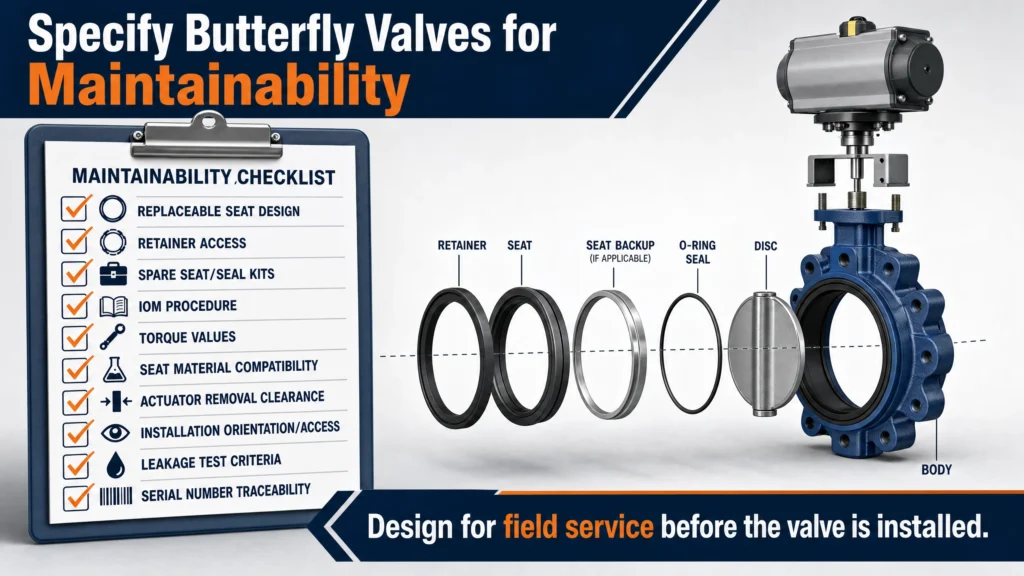
| Specificatie | Aanbevolen vereiste |
|---|---|
| Constructie van de stoel | Uitwisselbaar, gelijmd, met PTFE bekleed, met metalen zitting of een voor het project goedgekeurd ontwerp |
| Omvang van de buitendienst | Geef aan of het vervangen van de zitting in de lijn mogelijk is, na demontage van de klep, of uitsluitend in de werkplaats |
| Toegang tot de retainer | Na de installatie is toegang tot de borgring, de schroeven of de afstelzijde vereist |
| Reserveonderdelensets | Zorg voor een zitting, pakking, bevestigingsschroeven, pakkingmateriaal, afdichtingen en het aanbevolen gereedschap |
| IOM-procedure | Vraag vóór verzending de modelspecifieke onderhoudsinstructies aan |
| Materiaal van de zitting | Geef een omschrijving van de media, temperatuur, druk, reinigingsmiddelen en compatibiliteit |
| Koppelgegevens | Richtlijnen vereist voor ontkoppelingsmechanisme, zitplaatsen en het instellen van de aanslag van de aandrijving |
| Hefwerkzaamheden/toegang | Er is ruimte nodig voor het verwijderen van de aandrijving en het hanteren van de klep |
| Tests na reparatie | Stel de leknorm, druk, het medium en de acceptatiecriteria vast |
| Traceerbaarheid | Koppel reserveonderdelen aan het serienummer en de revisieversie van de klep |
Bij afsluitkleppen voor zware toepassingen of kritieke toepassingen moeten kopers navragen of de zitting en de afdichtingsring op elkaar zijn afgestemd, of beide tegelijk moeten worden vervangen, of er een inloopprocedure of speciaal gereedschap nodig is, en of de klep naar een erkend reparatiecentrum moet worden teruggestuurd. Als deze informatie vóór de aankoop niet beschikbaar is, is de onderhoudsstrategie onvolledig.
Carter kleppen gids voor lekkageklassen van kleppen helpt om “geen lekkage” om te zetten in een meetbaar acceptatiecriterium. Voor geautomatiseerde kleppen geldt dat de aandrijving voor vlinderkleppen Deze handleiding helpt voorkomen dat nieuwe zittingen beschadigd raken door een te hoog aanhaalmoment of een onjuiste afstelling van de stop.
Materiaalkeuze voor vervangende stoelen
De keuze van het materiaal voor de zitting mag nooit uitsluitend worden gebaseerd op wat er in de winkel verkrijgbaar is. EPDM, NBR, FKM, PTFE, versterkt PTFE, PEEK en metalen zittingen gedragen zich verschillend onder invloed van temperatuur, chemicaliën, druk, slijtage, reinigingsvloeistoffen en cyclische belasting. Union Valve geeft een overzicht van gangbare materialen voor zachte zittingen, zoals EPDM voor weerstand tegen water, stoom en weersinvloeden, NBR voor weerstand tegen olie en slijtage, FKM voor chemische bestendigheid bij hogere temperaturen, en PTFE voor sterke corrosiebestendigheid en lage wrijving.
| Materiaal van de zitting | Typische sterkte | Pas op |
|---|---|---|
| EPDM | Water, stoom, ozon, verwering | Niet geschikt voor veel soorten oliën en koolwaterstoffen |
| NBR | Olie- en slijtvastheid | Het temperatuur- en chemische bereik zijn beperkt |
| FKM | Hogere temperatuur- en chemische bestendigheid | De kosten en de compatibiliteit moeten nog worden gecontroleerd |
| PTFE | Chemische bestendigheid en lage wrijving | Koudevervorming, kruip en installatienauwkeurigheid zijn van belang |
| Metalen stoel | Hoge temperaturen en zware bedrijfsomstandigheden | Vereist een nauwkeurige geometrie en oppervlakteafwerking |
Als de oorspronkelijke zitting voortijdig defect is geraakt, lost het vervangen van het materiaal zonder de onderliggende oorzaak te onderzoeken het probleem mogelijk niet op. De werkelijke oorzaak kan liggen in een te grote slag van de actuator, vuil, temperatuurpieken, door stroming veroorzaakte erosie, chemische reiniging, spanning in de leiding of een onjuiste installatie.
Turnaround en planning van reserveonderdelen
Het vervangen van een zitting ter plaatse verloopt het soepelst wanneer de fabriek hier rekening mee houdt in de planning. Reservezittingen moeten op de juiste wijze worden opgeslagen, beschermd tegen ozon, UV-straling, hitte, vervorming en verontreiniging. De reservekit moet traceerbaar zijn naar het ventieletiket, de maat, de drukklasse, het materiaal, het zittingprofiel en het revisieniveau. De IOM moet op de werkplek beschikbaar zijn en mag niet verborgen zitten in een projectmap.
Voor grote kleppen moet het onderhoudsplan de hijspunten, het gewicht, de vereisten voor de flensafstand, de methode voor het verwijderen van de aandrijving, het benodigde draaimomentgereedschap, testblinden, aftap- en ontluchtingspunten vermelden, evenals of er een tijdelijke spool nodig is. VSI wijst erop dat reparatieteams ter plaatse een volledige set reserveonderdelen mee moeten nemen naar de werkplek en de onderhoudsinstructies van de fabrikant moeten doornemen voordat ze met de reparatiewerkzaamheden beginnen. Dat advies klinkt misschien voor de hand liggend, maar het voorkomt veel mislukte reparaties tijdens stilstanden.
Veelvoorkomende misvattingen
Een veelvoorkomende misvatting is dat elke zitting van een vlinderklep vervangbaar is. Dat is niet het geval. Bij gelijmde en gevulkaniseerde zittingen kan het onpraktisch zijn om alleen de zitting te vervangen.
Een andere misvatting is dat het vervangen van de zitting alle lekkages verhelpt. Als de rand van de schijf beschadigd is of het huis vervormd is, kan het ventiel onmiddellijk weer gaan lekken.
Een derde misvatting is dat vervanging ter plaatse altijd goedkoper is. Bij zware bedrijfsomstandigheden kan reparatie in de werkplaats goedkoper uitvallen dan herhaalde pogingen ter plaatse, vooral wanneer de toegestane lekkagegrens streng is.
Een vierde misvatting is dat “ter plaatse vervangbaar” automatisch hetzelfde betekent als “in-line vervangbaar”. Veel afsluiters moeten uit de leiding worden verwijderd, zelfs als de zitting vervangbaar is.
Conclusie
Het ter plaatse vervangen van de zitting van een vlinderklep is zinvol wanneer de klep hiervoor is ontworpen, de bedrijfsomstandigheden geschikt zijn, de juiste reservestel beschikbaar is en de toestand van het huis en de klepschijf een betrouwbare afdichting mogelijk maakt. Het is niet praktisch wanneer de zitting is vastgelijmd, de afdichtingsvlakken beschadigd zijn, de klep groot of ontoegankelijk is, de bedrijfsomstandigheden zwaar zijn of wanneer lekkage na reparatie niet kan worden vastgesteld.
Voor kopers en EPC-teams is de belangrijkste les dat onderhoudbaarheid al in een vroeg stadium moet worden vastgelegd. Leg vóór de installatie van de klep de constructie van de zitting, de omvang van de onderhoudswerkzaamheden ter plaatse, reservestukken, toegankelijkheid, de procedure volgens de bedieningshandleiding, aanhaalmomenten, materiaalcompatibiliteit en de lektest na reparatie vast. Carter Valve kan dit proces ondersteunen met een op de toepassing gebaseerde selectie van vlinderkleppen, advies over afsluiting bij zware bedrijfsomstandigheden, beoordeling van de lekkageklasse en op maat ontworpen klepconfiguraties voor onderhoudsvriendelijke prestaties op de lange termijn.
Veelgestelde vragen
Kan de zitting van een vlinderklep ter plaatse worden vervangen?
Ja, als de klep is ontworpen met een vervangbare zitting, kan de leiding veilig worden afgesloten en drukloos gemaakt, zijn de klepschijf en het huis niet beschadigd en zijn de juiste vervangingsset en de procedure uit de bedieningshandleiding beschikbaar. Bij vastgelijmde zittingen en veel ontwerpen voor zware toepassingen zijn reparaties ter plaatse wellicht niet haalbaar.
Hoe weet ik of de zitting van mijn vlinderklep vervangbaar is?
Raadpleeg de bedieningshandleiding, het gegevensblad en de onderdelentekening van de fabrikant. Bij vervangbare zittingen wordt vaak gebruikgemaakt van een groef in het ventielhuis, een borgring, schroeven of verwijderbare bevestigingsonderdelen. Gelijmde of gevulkaniseerde zittingen zijn doorgaans in het ventielhuis geïntegreerd en kunnen niet afzonderlijk worden vervangen.
Wanneer moet de hele klep worden vervangen in plaats van alleen de zitting?
Vervang de klep of laat deze in de werkplaats repareren als de groef in het klephuis beschadigd is, de rand van de klepschijf krassen of corrosie vertoont, de zitting vastzit, de klep ernstig versleten is, de situatie kritiek is of als na reparatie ter plaatse niet kan worden vastgesteld of er nog lekkage is.
Wat is de oorzaak van defecten aan de zittingen van vlinderkleppen?
Veelvoorkomende oorzaken zijn onder meer chemische onverenigbaarheid, blootstelling aan temperatuurschommelingen, slijtage, vuil, veroudering, drukwisselingen, te ver doorrijden van de aandrijving, verkeerde uitlijning van de leidingen, vervorming van het huis en het gebruik van de klep in een toepassing waarvoor deze niet is ontworpen.
Kunnen vlinderkleppen met metalen zitting ter plaatse worden gerepareerd?
Soms, maar dat hangt af van het ontwerp en de OEM-procedure. Metalen zittingen en afdichtringen vereisen nauwkeurig bewerkte oppervlakken en een gecontroleerde montage. Kleppen voor zware toepassingen of met drievoudige offset vereisen vaak ondersteuning door de OEM of reparatie in een werkplaats.
Welke reserveonderdelen moeten worden bewaard voor onderhoudbare vlinderkleppen?
Tot de gebruikelijke reserveonderdelen behoren zittingringen, zittingpakkingen, afdichtringen, bevestigingsschroeven, spindelpakking, O-ringen, accessoires voor de aandrijving en eventueel door de fabrikant aanbevolen speciaal gereedschap. Reserveonderdelen moeten herleidbaar zijn naar het label en het serienummer van de klep.
Wat moet er worden gecontroleerd na het vervangen van een stoel?
Bedien de klep, controleer of de aandrijving tot aanslag beweegt, controleer op vastlopen, breng langzaam druk aan, test op lekkage volgens het gespecificeerde acceptatiecriterium en leg het aanhaalmoment, de druk, de lekkage en de gebruikte onderdelen vast.
Hoe moet ik in een inkooporder vervangbare stoelen specificeren?
Geef aan dat de klep een ontwerp met vervangbare zitting moet hebben, eis van de leverancier dat hij aangeeft of de vervanging in-line plaatsvindt of nadat de klep is gedemonteerd, vraag om reservekits en procedures uit de bedieningshandleiding, en specificeer de eisen voor de lektest na reparatie.
Referenties
[1] Union Valve — Hoe vervang je de zitting van een vlinderklep?
[2] VSI Waterworks — AWWA C504 vlinderkleppen met vervangbare zitting – Gebruiksaanwijzing
[3] TG Valve — Vlinderklep reparatie voor beginners: zittingen en afdichtingen vervangen
[4] Valve World Americas — Reparatie en onderhoud van zittingen en afdichtingen van vlinderkleppen
[5] Carter Valve - Vlinderklep selectiegids voor kritische isolatie en zware toepassingen
[6] Carter Valve - Metaal-op-metaal vlinderkleppen met afdichting