





API 609 vlinderklep standaard is de aankoopspecificatie van het American Petroleum Institute die veel wordt gebruikt voor vlinderkleppen in raffinage-, petrochemische, energie-, chemische en industriële leidingprojecten. In de praktijk helpt API 609 om vast te leggen wat er moet worden gecontroleerd op het gebied van klepontwerp, materialen, inbouwafmetingen, druk- en temperatuurwaarden, keuring, inspectie en beproeving.
De belangrijkste keuze binnen de norm is of de klep Categorie A of Categorie B. Categorie A heeft doorgaans betrekking op vlinderkleppen met een door de fabrikant opgegeven drukclassificatie voor koudbedrijf, meestal in concentrische uitvoering, bestemd voor nutsvoorzieningen en algemeen gebruik. Categorie B heeft betrekking op vlinderkleppen met een druk- en temperatuurclassificatie, meestal in offset- of hoogwaardige uitvoering, die worden gebruikt wanneer drukklasse, temperatuur, afsluitintegriteit en prestaties onder zware bedrijfsomstandigheden van groter belang zijn.
Voor kopers is de conclusie simpel: “De vermelding ”voldoet aan API 609“ is onvoldoende om een vlinderklep veilig aan te schaffen. U dient de editie, categorie, maatbereik, eindverbinding, afstand tussen flenzen, CWP- of ASME-klasse, zittingclassificatie, behuizingclassificatie, materiaal, beproeving, markering en documentatie te bevestigen. API heeft in 2021 de 9e editie van API-norm 609 aangekondigd, met als ingangsdatum voor het API Monogram Program oktober 2021. In openbare normenlijsten wordt API STD 609:2021 beschreven als actief, 9e editie, en van toepassing op vlinderkleppen met dubbele flens, lug, wafer-type en stomplaataansluiting. In deze gids wordt uitgelegd wat dat betekent voor daadwerkelijke inkooporders.
Wat API 609 omvat – en wat het niet vervangt
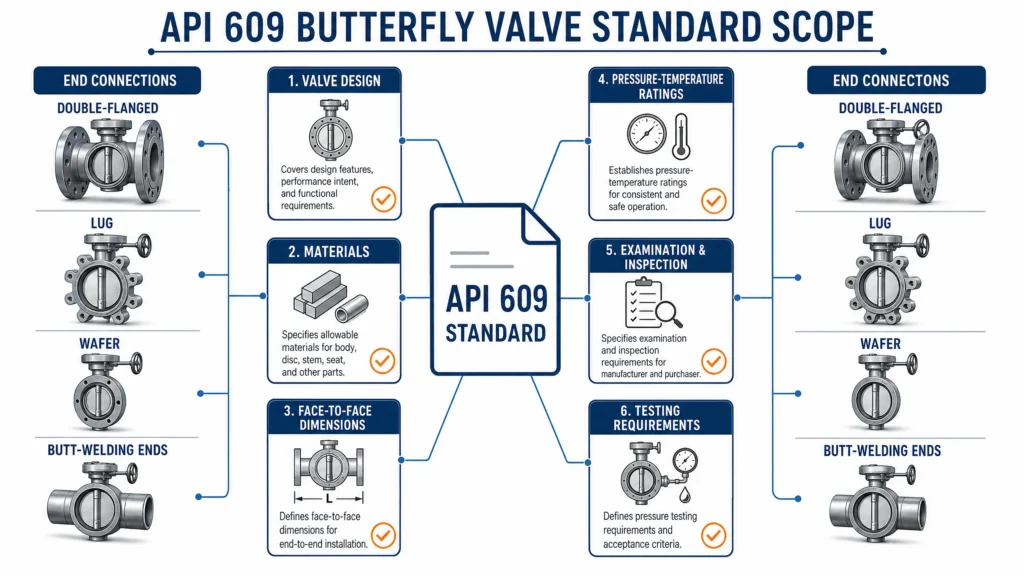
API 609 is geen marketinglabel. Het is een aankoopspecificatie die de koper en de fabrikant aangeeft welke minimale technische eisen gelden voor de betreffende vlinderkleppen. In openbare vermeldingen van API STD 609:2021 staat dat de norm betrekking heeft op ontwerp, materialen, afmetingen, druk- en temperatuurwaarden, en eisen inzake onderzoek, inspectie en beproeving voor vlinderkleppen van grijs gietijzer, nodulair gietijzer, brons, staal, legeringen op nikkelbasis of speciale legeringen.
Dat toepassingsgebied is breed, maar dat betekent niet dat elke API 609-afsluiter geschikt is voor elke toepassing. Een lagedrukafsluiter van categorie A en een afsluiter voor zware omstandigheden van categorie B vallen weliswaar beide onder API 609, maar ze zijn niet onderling uitwisselbaar. De norm werkt ook samen met andere projecteisen, zoals flensnormen, testnormen, regels voor druk- en temperatuurclassificatie, materiaalspecificaties, lekkageklassen, brandveiligheidseisen, eisen inzake diffuse emissies, normen voor aandrijvingen en specificaties van eindgebruikers.
| Vraag van een koper | Waarom het belangrijk is |
|---|---|
| Welke versie van API 609 wordt voorgeschreven? | Oude tekeningen of sjablonen van leveranciers kunnen verwijzen naar een verouderde versie. |
| Behoort de klep tot categorie A of categorie B? | De categorie bepaalt de beoordelingsgrondslag, de gebruikelijke ontwerpverwachtingen en de geschiktheid voor gebruik. |
| Welke aansluiting is nodig? | Uitvoeringen met dubbele flens, met bevestigingsogen, in wafer-uitvoering en voor stomplassen hebben verschillende implicaties voor de installatie. |
| Wat houdt de face-to-face-dimensie in? | Verkeerde afmetingen van de tegenoverliggende vlakken leiden tot problemen bij de montage in het veld. |
| Welk testcertificaat wordt meegeleverd? | Beweringen over naleving moeten worden onderbouwd met bewijs, niet alleen met de bewoordingen in de catalogus. |
| Welke stoelclassificatie is van toepassing? | De nominale waarde van de zitting of afdichting kan de klep beperken, zelfs als de nominale waarde van het huis hoger is. |
Carter kleppen soorten vlinderkleppen Deze gids is een handige inleiding voor wie API-categorieën wil vergelijken. Voor toepassingen die hoge prestaties vereisen of onder zware omstandigheden plaatsvinden, kunnen lezers ook Wat is een hoogwaardige vlinderklep? en die van Carter kritische isolatie vlinderklep selectiegids.
Categorie A versus categorie B: het praktische verschil
Categorie A en categorie B worden vaak verkeerd begrepen, omdat ze soms worden gereduceerd tot “goedkope klep” versus “goede klep”. Dat is niet de juiste technische benadering. Categorie A en B zijn verschillende specificatietrajecten voor verschillende klepontwerpen en gebruiksomstandigheden.
In openbare technische samenvattingen wordt beschreven Categorie A als vlinderkleppen met een door de fabrikant opgegeven koudwerkdruk (CWP), meestal met een concentrische schijf- en zittingconfiguratie, die doorgaans worden gebruikt in combinatie met ASME Klasse 125- of Klasse 150-flensbevestigingspatronen in de maten NPS 2 tot en met NPS 48. Categorie B worden doorgaans omschreven als vlinderkleppen met druk- en temperatuurspecificaties, voorzien van een verschoven zitting en een excentrische of concentrische schijfconfiguratie, waarbij in openbare overzichten de beschikbare maten worden vermeld, zoals NPS 3 tot en met NPS 24 voor de klassen 150, 300 en 600. Kopers dienen de exacte contractuele vereisten te verifiëren aan de hand van de officiële aangeschafte norm en de projectspecificatie.
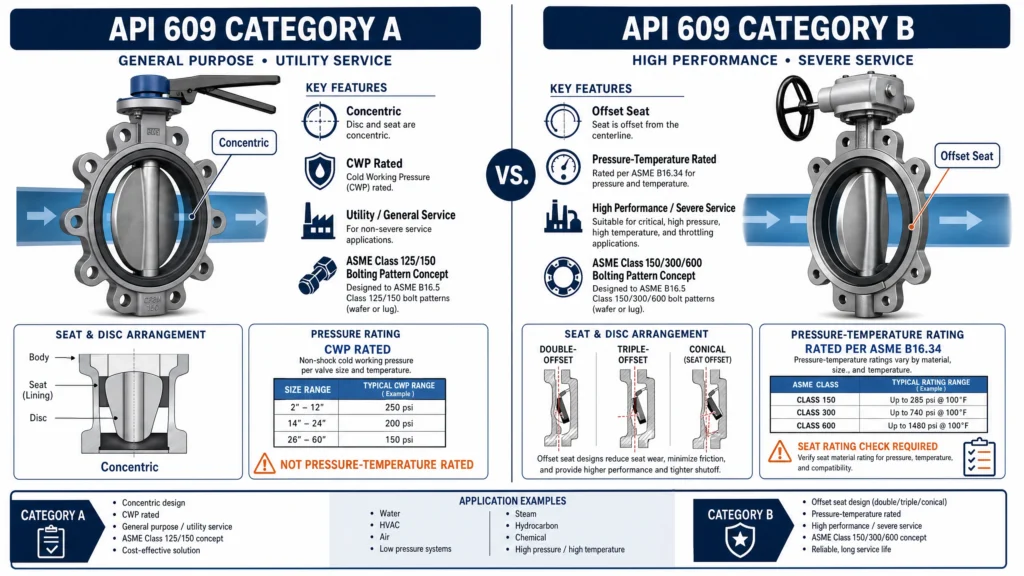
| Vergelijkingspunt | API 609 Categorie A | API 609 categorie B |
|---|---|---|
| Beoordelingsconcept | Door de fabrikant opgegeven druk bij koudvervorming | Geschikt voor bepaalde druk- en temperatuurwaarden, doorgaans op basis van drukklassen |
| Veelvoorkomende ontwerpassociatie | Concentrische schijf en zitting | Versprongen zitvlak; ontwerpen met dubbele of drievoudige verspringing of high-performance-uitvoeringen komen veel voor |
| Standaarddienst | Algemene nutsvoorzieningen, water, lucht, diensten met een laag risico | Toepassingen in raffinaderijen, de chemische industrie, stoominstallaties, koolwaterstofverwerking, bij hogere temperaturen of onder hogere druk |
| Gedrag van de stoel | Vaak van veerkrachtig materiaal of met rubber bekleed, met een schakelcontact | Vaak ontworpen om wrijving aan de zitting te verminderen en de levensduur te verlengen |
| Risico voor de koper | Niet geschikt voor zware omstandigheden | De beoordeling van de stoelen, de carrosserie en de testresultaten moeten nog worden gecontroleerd |
| Kostenoverzicht | Lagere aanschafkosten | Hogere aanschafkosten, maar vaak beter geschikt voor de levensduur bij veeleisende toepassingen |
Categorie A kan precies de juiste keuze zijn voor de juiste toepassing. Voor een waterleiding voor algemeen gebruik, een HVAC-installatie of een onschadelijk lagedruksysteem is niet dezelfde klep nodig als voor een isolatieleiding in een raffinaderij waar hoge temperaturen heersen. Categorie B wordt relevanter wanneer de koper behoefte heeft aan een strikte druk- en temperatuurclassificatie, een offset-zitting, een langere levensduur, een strakkere afsluiting, een hoger drukverschilvermogen of een basis voor de selectie van hoogwaardige vlinderkleppen.
Waarom categorie B van belang is voor HPBV, drievoudige offset en zware bedrijfsomstandigheden
Hoogwaardige vlinderkleppen en vlinderkleppen met drievoudige offset komen vaak ter sprake in de context van categorie B, omdat ze zijn ontworpen op basis van een offset-geometrie en geschikt zijn voor toepassingen met specifieke druk- en temperatuurwaarden. Een hoogwaardige dubbel-offset vlinderklep vermindert wrijving op de zitting in vergelijking met een concentrische klep. Een drievoudig-offset klep gaat nog een stap verder door gebruik te maken van een conische afdichtingsgeometrie die is ontworpen om wrijving te minimaliseren en metaal-op-metaal afdichting te ondersteunen in veeleisende toepassingen.
Carter kleppen Hoogwaardige vlinderklep met dubbele offset is geschikt wanneer compacte, krachtigere roterende afsluitingen nodig zijn. Voor hogere drukken, temperaturen en kritische afsluitvereisten biedt Carter’s drievoudige offset vlinderklep met ultrahoge druk en metaal-op-metaal vlinderklep Deze bronnen helpen verklaren waarom de vormgeving en het materiaal van de stoel van belang zijn.
Categorie B betekent niet automatisch dat de klep geschikt is voor elke zware toepassing. Kopers moeten nog steeds het materiaal van het huis, het materiaal van de afdichting, de zittingclassificatie, de lektest, de temperatuurlimiet, de corrosiemarge, de levensduur, het drukverschil bij sluiting, het koppel van de aandrijving controleren, en nagaan of projectspecifieke normen eisen stellen die verder gaan dan API 609. Bij kritische afsluiting is de term “Categorie B” een uitgangspunt, niet het definitieve acceptatiecriterium.
Versiegeschiedenis: waarom kopers moeten controleren of ze de huidige versie hebben
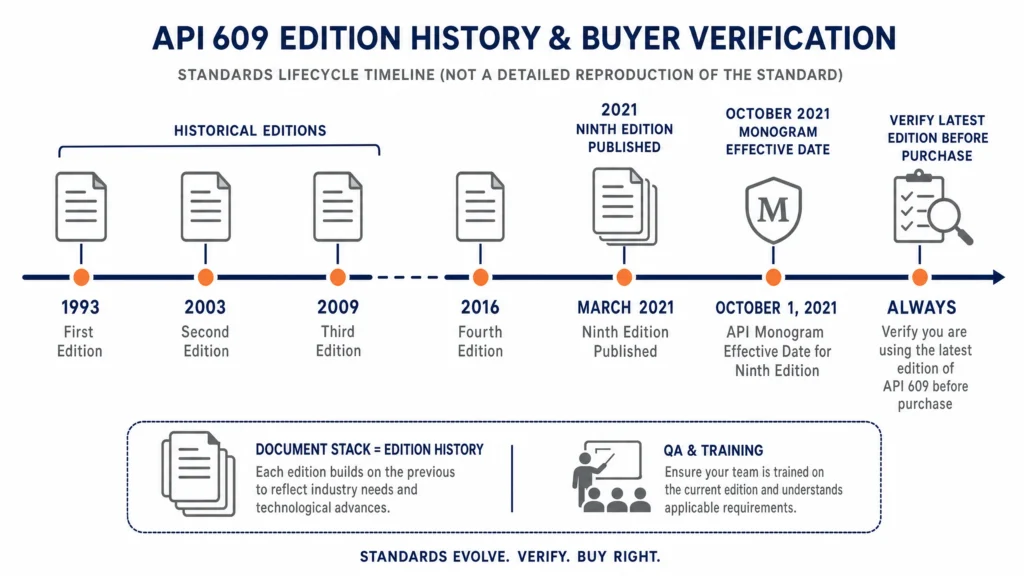
Normen veranderen. Een vijf jaar geleden opgestelde aankoopspecificatie sluit mogelijk niet meer aan bij de versie die momenteel door fabrikanten, auditors of QA/QC-teams van projecten wordt gebruikt. De API heeft op 5 mei 2021 een mededeling gepubliceerd waarin staat dat de 9e editie van API-norm 609 was verschenen en dat de Het API Monogram-programma is in oktober 2021 van kracht geworden. In een openbare lijst van normen wordt API STD 609:2021 vermeld als actieve norm, 9e editie, 34 pagina’s, en uitgavejaar 2021.
| Controlepunt van de uitgave | Actie van de koper |
|---|---|
| De projectspecificatie verwijst naar API 609 | Controleer het uitgavejaar of de vermelding “laatste uitgave” bij de projecteigenaar. |
| In de offerte van de leverancier staat “conform API 609” | Vraag welke uitgave en welke categorie er wordt aangehaald. |
| Er wordt gebruikgemaakt van tekeningen uit eerdere projecten | Controleer de afmetingen, markeringen en testreferenties ter plaatse aan de hand van de huidige projecteisen. |
| Er wordt beweerd dat er sprake is van een API-monogram of -certificering | Vraag bewijsstukken aan die betrekking hebben op de fabrikant, het productassortiment en de uitgave. |
| Het contract bevat tegenstrijdige bepalingen | Breng de hiërarchie op orde voordat de opdracht wordt gegund. |
De veiligste formulering in een inkooporder is niet “API 609-afsluiter”. Het moet specifieker zijn: “De vlinderklep moet voldoen aan API 609, [gespecificeerde editie of laatste editie zoals contractueel vastgelegd], categorie B, klasse 300, met lug- of dubbele flensuiteinden zoals vermeld, met materialen, face-to-face-afmetingen, tests, markering en documentatie volgens het projectgegevensblad.” De exacte bewoordingen kunnen variëren, maar het principe is hetzelfde: neem onduidelijkheden weg vóór de fabricage.
API 609 en aanverwante normen waar kopers rekening mee moeten houden
API 609 staat niet op zichzelf. Bij projecten met vlinderkleppen wordt vaak gebruikgemaakt van ASME B16.34, API 598, ASME B16.5, ASME B16.10, ISO 5208, MSS-documenten, brandveiligheidsnormen, normen voor diffuse emissies en specificaties van eindgebruikers. ASME B16.34 stelt dat het druk- en temperatuurclassificaties, afmetingen, toleranties, materialen, eisen voor niet-destructief onderzoek, testen en markering voor diverse nieuwe klepconstructies omvat, inclusief wafer- of flensloze kleppen die in de norm worden behandeld als kleppen met flensuiteinden. API stelt dat haar normen op consensus zijn gebaseerd, door ANSI zijn geaccrediteerd en bedoeld zijn om de veiligheid, milieubescherming en betrouwbaarheid in de olie- en gasindustrie te ondersteunen.
| Gerelateerd artikel | Waarom dit belangrijk is voor kopers |
|---|---|
| API 598 | Dit wordt vaak in verband gebracht met de verwachtingen ten aanzien van klepinspecties en druktesten bij de aankoop van API-kleppen. |
| ASME B16.34 | Specificaties inzake druk en temperatuur, materialen, constructie, beproeving en markering voor talrijke afsluiters. |
| ASME B16.5 / B16.47 | Compatibiliteit van flensverbindingen en boutverbindingen. |
| ASME B16.10 / ISO 5752 | Verwachtingen ten aanzien van de fysieke aanwezigheid, indien van toepassing. |
| ISO 5208 / EN 12266 | In internationale projectspecificaties kan er sprake zijn van termen met betrekking tot de lekkagesnelheid. |
| API 607 of ISO 10497 | Voor bepaalde toepassingen met koolwaterstoffen kan brandveiligheidstesten vereist zijn. |
| Normen voor diffuse emissies | De eigenaar kan aanvullende eisen stellen met betrekking tot de afdichting en het lekken van de stang. |
Wat betreft 'lektaal', Carters gids voor lekkageklassen voor afsluiters, waaronder API 598, FCI 70-2 en ISO 5208 helpt teams te voorkomen dat ze normen door elkaar halen die verschillende zaken onder verschillende omstandigheden meten. Carter’s klepmarkeringen, -classificatie en -normen Dit artikel is een nuttige aanvulling voor kopers die typeplaatjes en technische specificaties bekijken.
Waar kopers op moeten letten voordat ze een bestelling plaatsen
De duurste fouten met betrekking tot API 609 worden meestal gemaakt voordat de bestelling wordt geplaatst. Een inkoper ontvangt een lage offerte, ziet “API 609” in de omschrijving staan en gaat ervan uit dat aan alle technische vereisten is voldaan. Die aanname is gevaarlijk.
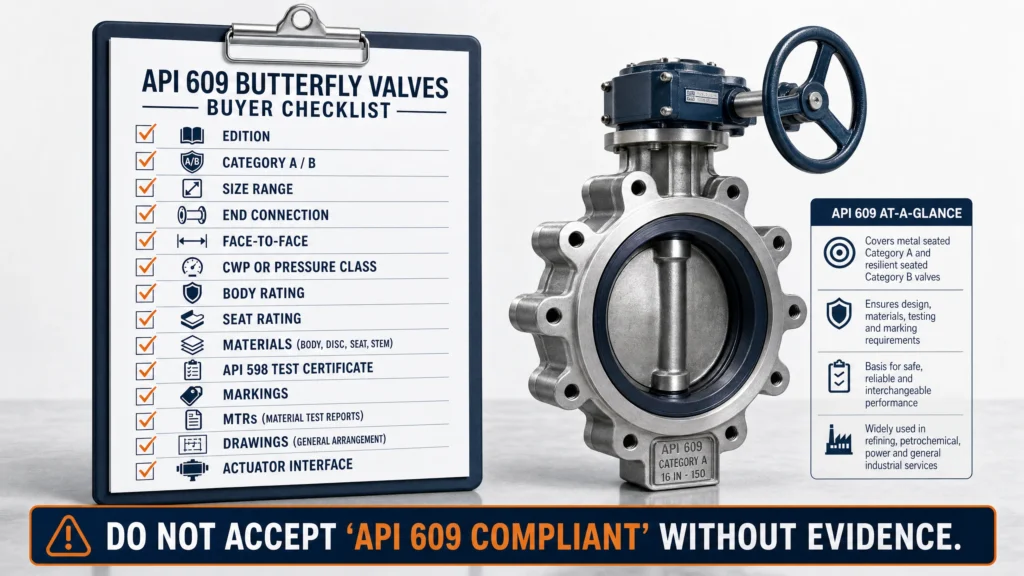
| Checklist voor kopers | Wat moet je bij de leverancier aanvragen? |
|---|---|
| Uitgave | Jaar van uitgave van API 609 en bevestiging dat deze voldoet aan de projectspecificaties |
| Categorie | Categorie A of categorie B duidelijk vermeld in de offerte en het gegevensblad |
| Grootte en klasse | NPS/DN, ASME-klasse of CWP, en flensbevestigingspatroon |
| Eindaansluiting | Plat, met nok, met dubbele flens of stompluiseinde |
| Face-to-face | Afmetingen, toleranties en normen |
| Beoordeling van het lichaam | Druk-temperatuurclassificatie voor het materiaal van de behuizing |
| Beoordeling van de stoel | Druk- en temperatuurwaarden voor de zitting/afdichting, met name indien deze lager zijn dan de waarden voor de behuizing |
| Materialen | Behuizing, schijf, spindel, zitting, pakking, bevestigingsmateriaal en coatings of hardmetalen bekleding |
| Testen | Schaltest, stoeltest, achterbank (indien van toepassing) en keurings-/testcertificaat |
| Markering | API 609-categorie, afmeting, klasse/classificatie, materiaal, stroomrichting (indien van toepassing) en traceerbaarheid |
| Documentatie | Tekening van de gasklep, MTR’s, testrapporten, IOM, koppelgegevens van de actuator en conformiteitsverklaring |
Kopers moeten ook navragen of de klep bedoeld is voor het afsluiten (aan/uit), het regelen van het debiet, ESD, intensief gebruik, toepassing in een doodlopende leiding, corrosieve vloeistoffen, schurende vloeistoffen, stoom, vacuüm of gebruik bij hoge temperaturen. De API 609-categorie alleen geeft geen antwoord op deze vragen over de toepassing.
Veelvoorkomende valkuilen bij de aankoop van API 609
De eerste valkuil is het toepassen van categorie A wanneer de toepassing eigenlijk categorie B of een speciaal ontworpen uitvoering voor zware omstandigheden vereist. Een utiliteitsklep van categorie A kan uitstekend geschikt zijn voor watertoepassingen, maar toch de verkeerde keuze zijn voor toepassingen met koolwaterstoffen, stoom, hoge temperaturen of kritische afsluitingen.
De tweede valkuil is het negeren van de afmetingen tussen de flenzen. Problemen met de montage ter plaatse zijn kostbaar omdat ze pas aan het licht komen nadat tekeningen, leidingdelen of afsluiters al zijn vervaardigd. De afmetingen tussen de flenzen moeten al in de offertefase worden gecontroleerd en nogmaals bij de goedkeuring van de tekeningen.
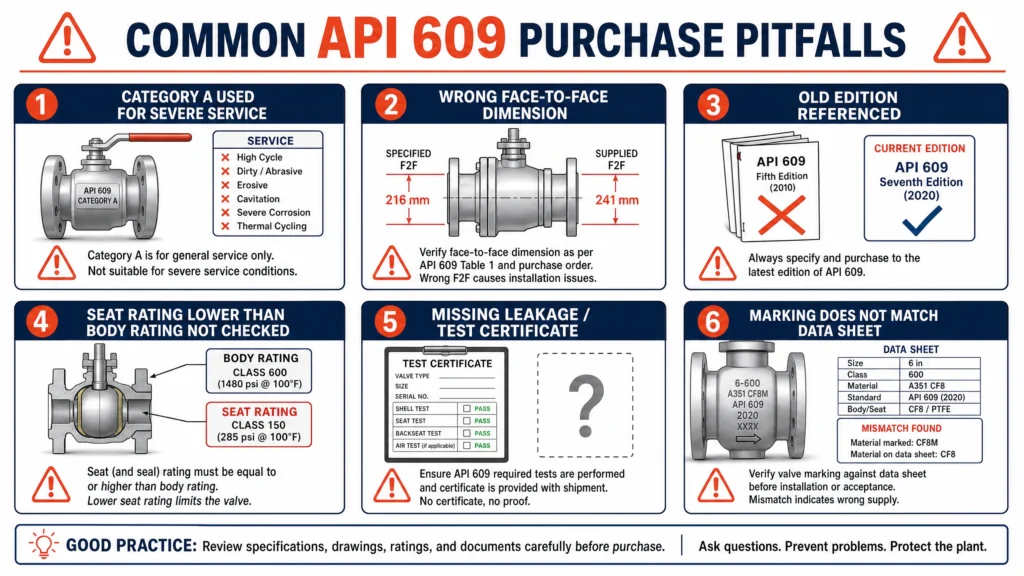
| Valkuil | Gevolg | Preventie |
|---|---|---|
| “Voldoet aan API 609” zonder categorie | Er kan een verkeerd type klep zijn aangeschaft | Vermeld categorie A of B op het gegevensblad |
| Er wordt verwezen naar een oude uitgave | Discrepantie tussen kwaliteitscontrole en inspectie | Bevestig de versie vóór de offerteaanvraag en de gunning van de inkooporder |
| Niet persoonlijk geverifieerd | Probleem bij het in elkaar zetten van leidingen | Controleer de GA-tekening en de maattoleranties |
| Beoordeling van de stoel genegeerd | Valve kan mogelijk niet omgaan met de vereiste druk- en temperatuuromstandigheden | Vraag apart naar de classificatie van de stoelen en de carrosserie |
| Testcertificaat ontbreekt | Geen bewijs van inspectie of goedkeuring van de lekproef | Vraag testdocumenten aan vóór verzending |
| Afwijking in markering | Er is mogelijk een verkeerde klep gemonteerd | Vergelijk het typeplaatje, de MTR’s, de tekeningen en de orderregels |
| Categorie B: geschikt voor zware omstandigheden | Onvoldoende gespecificeerde materialen of stoelontwerp | Voeg projectspecifieke eisen op het gebied van temperatuur, lekkage en cycli toe |
Een goede leverancier zal zich door deze vragen niet beledigd voelen. Sterker nog: gedisciplineerde leveranciers geven juist de voorkeur aan duidelijke eisen, omdat die herwerk, garantiegeschillen en klachten van klanten voorkomen.
Hoe schrijf je een betere aankoopspecificatie volgens API 609?
Een praktische specificatie moet API 609 koppelen aan de daadwerkelijke toepassing. Zo kan voor een vlinderklep in een procesinstallatie bijvoorbeeld categorie A, een CWP-classificatie, een EPDM- of NBR-zitting en basistestdocumentatie vereist zijn. Een isolatieklep voor koolwaterstoffen in een raffinaderij vereist mogelijk categorie B, ASME-klasse 300, een ontwerp met dubbele of drievoudige offset, brandveiligheidstests, een zitting van metaal of op PTFE-basis, afhankelijk van de temperatuur, een API 598-testcertificaat, MTR's en koppelgegevens van de aandrijving.
| Specificatiegedeelte | Krachtig concept |
|---|---|
| Standaardbasis | “De klep moet voldoen aan API 609, categorie B, de meest recente, voor het project goedgekeurde versie.” |
| Service | “Koolwaterstofisolatie, bedrijfstemperatuur X, ontwerpdruk Y, drukverschil Z.” |
| Beoordeling | “De druk- en temperatuurclassificatie van de behuizing moet voldoen aan de ASME-klasse en de leidingklasse van het project.” |
| Stoel | “De stoelclassificatie moet geschikt zijn voor de volledige bereik van temperaturen en drukverschillen.” |
| Testen | “De leverancier dient per project goedgekeurde testnormen te volgen bij het opstellen van rapporten over hydrostatische tests en zittinglektests.” |
| Markering | “De markering van de kleppen moet overeenkomen met het goedgekeurde gegevensblad, de MTR’s en het testcertificaat.” |
| Documentatie | “Dien de algemene tekeningen, MTR’s, nalevingsmatrix, IOM en het specificatieblad voor de aandrijving in.” |
Carter Valve ondersteunt dit soort specificatiediscipline door middel van de selectie van speciaal ontworpen vlinderkleppen, beoordeling van afsluiters voor zware toepassingen en klepsystemen die direct klaar zijn voor bediening. Voor eindgebruikers die offset-ontwerpen vergelijken, is het artikel over vlinderkleppen met zes excentrische punten versus vlinderkleppen met drievoudige excentrische punten legt uit waarom geometrie van belang is voor de afdichtings- en slijtageprestaties.
Categorie A of categorie B: een besluitvormingskader voor kopers
Bij het bepalen van de categorie moet het risico voorop staan, niet de prijs. Als de afsluiter wordt gebruikt in schoon water, HVAC-systemen, perslucht of een algemene lagedruktoepassing, is categorie A wellicht de meest praktische en economische keuze. Als de klep wordt gebruikt in een raffinaderij, de petrochemische industrie, stoomtoepassingen, chemische toepassingen, hogedruk-, hoge-temperatuur-, cyclische, corrosieve, erosieve, ESD- of kritieke isolatietoepassingen, is categorie B meestal de categorie die een gedetailleerde evaluatie verdient.
| Servicetoestand | Categorie A waarschijnlijk? | Categorie B waarschijnlijk? |
|---|---|---|
| Schoon water, lage druk | Vaak wel | Meestal niet nodig, tenzij de projectnorm dit voorschrijft |
| HVAC of algemene voorzieningen | Vaak wel | Soms, als er een hogere kwaliteit of speciale materialen nodig zijn |
| Stoom of hete olie | Meestal niet | Vaak wel, met controle van de temperatuur van de stoel en het materiaal |
| Isolatie van koolwaterstoffen | Meestal niet | Vaak wel, plus een controle op lekkage en brandveiligheid |
| Chemische dienstverlening | Hangt af van de druk en het materiaal | Vaak wel, bij corrosieve of gevaarlijke toepassingen |
| Veelvuldig gebruik | Beperkt door het ontwerp en slijtage van de zitting | Een betere keuze als het ontwerp en de materialen geschikt zijn |
| Kritische isolatie | Op zichzelf komt het zelden voor | Categorie B plus projectspecifieke eisen inzake lekkage en keuring |
Voor installaties waar lekkage onaanvaardbaar is, is het artikel van Carter over bidirectionele nul-lekkage onder zware bedrijfsomstandigheden geeft meer achtergrondinformatie over waarom beweringen over uitschakeling moeten worden onderbouwd met testomstandigheden en ontwerpgegevens.
Conclusie
API 609 is een essentiële norm voor de aankoop van vlinderkleppen, maar kopers moeten deze norm niet beschouwen als een volwaardige vervanging voor een technisch onderzoek. De cruciale vraag is of de klep Categorie A of categorie B, welke uitvoering is gespecificeerd, welke aansluitingen en inbouwafmetingen van toepassing zijn, of de klep is gecertificeerd voor CWP of voor druk-temperatuur, en of de zitting, het huis, de materialen, de markeringen en de testcertificaten geschikt zijn voor het daadwerkelijke gebruik.
Voor teams op het gebied van inkoop, EPC en installatietechniek is het het veiligst om de categorie, de uitgave, de bedrijfsvoorwaarden, de lekkage-eisen, de testvereisten en het documentatiepakket in de offerteaanvraag en de inkooporder op te nemen. Carter Valve kan ondersteuning bieden bij API 609-gerelateerde discussies met hoogwaardige vlinderkleppen, drievoudig-offset en zes-excentrische afsluitontwerpen, advies over lekklasse, beoordeling van klepmarkeringen en toepassingsgerichte selectie voor zware omstandigheden.
Veelgestelde vragen
Wat houdt API 609 in voor vlinderkleppen?
API 609 is een norm van het American Petroleum Institute die wordt gebruikt als aankoopspecificatie voor afgedekte vlinderkleppen. In openbare publicaties wordt beschreven dat deze norm betrekking heeft op het ontwerp, de materialen, de inbouwafmetingen, de druk- en temperatuurwaarden, en de eisen voor onderzoek, inspectie en beproeving van diverse constructies en materialen van vlinderkleppen.
Wat is het verschil tussen API 609 categorie A en categorie B?
Categorie A wordt doorgaans omschreven als vlinderkleppen met een door de fabrikant opgegeven drukclassificatie voor koudbedrijf, meestal in concentrische uitvoering voor nutsvoorzieningen en algemeen gebruik. Categorie B wordt doorgaans omschreven als vlinderkleppen met een druk- en temperatuurclassificatie, vaak met een excentrische zitting, die worden gebruikt voor toepassingen die hogere prestaties vereisen of zwaarder belast worden.
Is API 609 categorie B altijd beter dan categorie A?
Nee. Categorie B is niet voor elke toepassing “beter”; deze categorie is geschikter voor bepaalde toepassingen met specifieke druk- en temperatuurwaarden en voor toepassingen die hogere prestaties vereisen. Categorie A kan de juiste, voordelige keuze zijn voor schone toepassingen bij lage druk.
Welke versie van API 609 is momenteel van kracht?
In openbare lijsten wordt API STD 609:2021 aangemerkt als de geldende 9e editie, en API heeft de 9e editie in 2021 aangekondigd met een ingangsdatum voor het API Monogram Program in oktober 2021. Kopers dienen vóór aankoop altijd de meest recente editie te controleren via officiële API- of normkanalen.
Bevat API 609 testvoorschriften?
In openbare specificaties wordt API 609 omschreven als een norm die eisen op het gebied van onderzoek, inspectie en beproeving omvat. In de praktijk doen kopers er goed aan om specifieke testcertificaten op te vragen en waar nodig duidelijkheid te vragen over de bijbehorende testnormen, zoals API 598, of over projectspecifieke leknormen.
Kan een API 609-klep van categorie A worden gebruikt in raffinaderijen?
Het hangt af van de toepassing, maar categorie A wordt doorgaans geassocieerd met toepassingen in de nutsvoorzieningen, die gekenmerkt worden door een lager risico en lagere druk. Voor toepassingen in raffinaderijen met koolwaterstoffen, stoom, hoge temperaturen, ESD of kritische afsluitingen, kijken kopers meestal naar categorie B en aanvullende projecteisen.
Waar moeten kopers op letten bij een offerte voor een API 609-vlinderklep?
Vraag naar de uitvoering, categorie, afmetingen, drukklasse of CWP, aansluiting, inbouwafmetingen, nominale waarden van het huis en de zitting, materialen, testcertificaten, markeringen, materiaalspecificaties (MTR’s), GA-tekeningen, koppelgegevens van de aandrijving en een conformiteitsmatrix ten opzichte van de inkoopspecificatie.
Is “conform API 609” voldoende voor een inkooporder?
Nee. Die formulering is op zichzelf te vaag. In de inkooporder moeten de categorie, de uitvoering, de gebruiksvoorwaarden, de materialen, de druk- en temperatuurclassificatie, de eisen inzake lekkage en keuring, de documentatie en de inspectiepunten worden gespecificeerd.
Referenties
[1] API — Kennisgeving betreffende de update van API-norm 609, 9e editie, 5 mei 2021
[2] BSB Edge — API STD 609:2021 Normdetails
[3] ZECO-klep — Verschillen tussen vlinderkleppen van API 609 categorie A en categorie B
[4] ASME - B16.34 Afsluiters: Flenzen, schroefdraad en laseinden
[5] American Petroleum Institute - Normen
[6] JH Valve — API 609 categorie B versus A
[7] Carter Valve - Vlinderklep selectiegids voor kritische isolatie en zware toepassingen
[8] Carter-klep — Lekklasse van kleppen: API 598, FCI 70-2, ISO 5208