




A Metal-Seated Valve That Leaks Is Not Just a Sealing Problem — It Is a Contact Mechanics Problem
When a metal-seated butterfly valve fails to hold zero leakage after commissioning, the instinct is to blame the seat finish, the actuator torque setting, or the manufacturing tolerance. Those factors matter. But the underlying question is a physics one: is the contact stress at the disc-to-seat interface high enough, over a wide enough sealing band, to prevent fluid from finding a path through?
The answer is governed by a 140-year-old theory from solid mechanics. When two curved surfaces are pressed together under load, the contact area, contact pressure distribution, and subsurface stress field can be calculated precisely — and the result predicts whether the sealing interface will hold, deform, or fail by fatigue over time.
That theory is Hertzian contact mechanics, and understanding it is the difference between specifying a valve seat geometry that reliably achieves bubble-tight shutoff and one that looks correct on a drawing but leaks from day one.
What Is Hertzian Contact Stress?
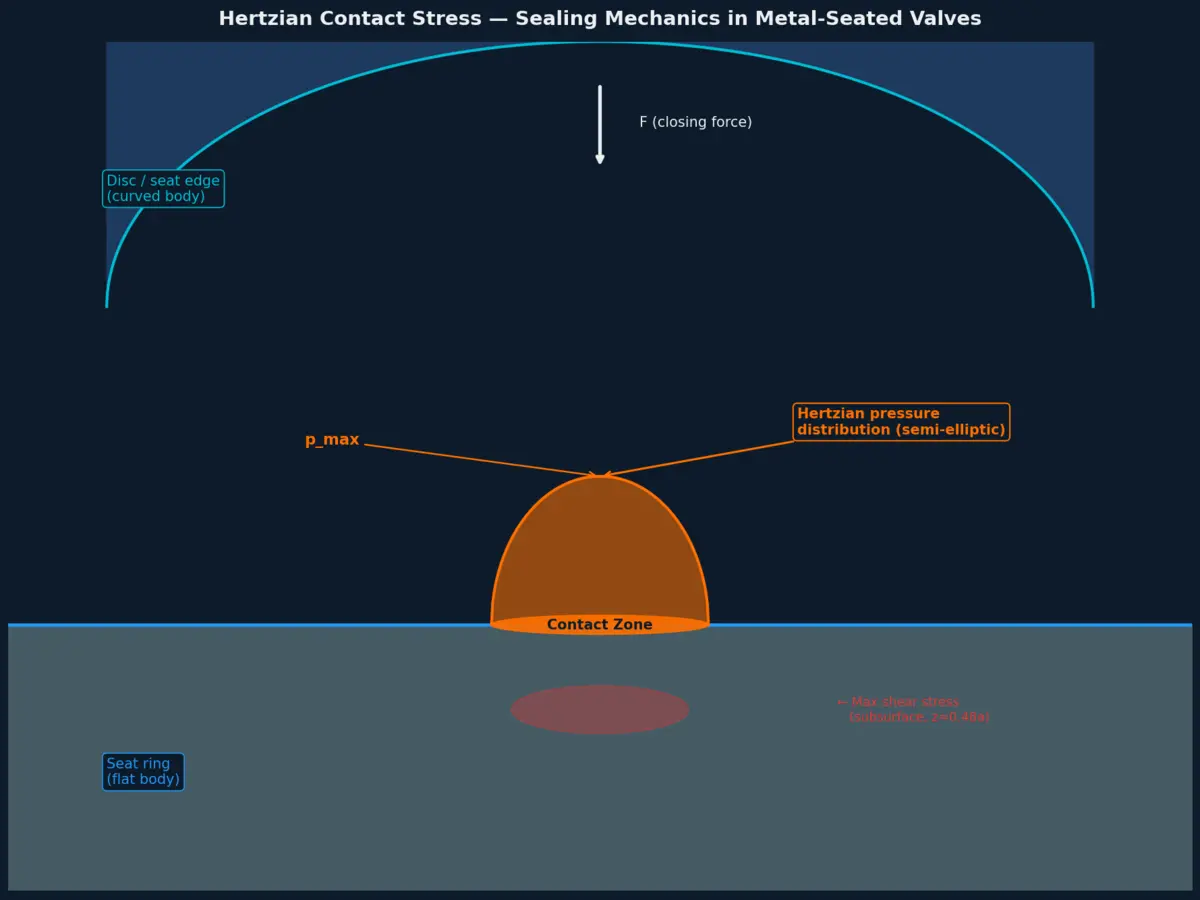
Hertzian contact stress — or simply Hertz contact stress — describes the localised stress distribution that develops when two curved, elastic bodies are pressed together.
The theory was published by the German physicist Heinrich Hertz in 1882 in his paper Über die Berührung fester elastischer Körper ("On the contact of rigid elastic solids"). Hertz observed that when two ideally rigid curved surfaces touch, the theoretical contact area is zero — a point for two spheres, a line for two cylinders. But real materials deform elastically under load, creating a finite contact patch. Hertz derived the exact shape of that patch and the pressure distribution within it.
The key results from Hertz theory are:
For two spheres in contact (or a sphere on a flat):
- The contact patch is circular with radius a ∝ F^(1/3), where F is the applied force
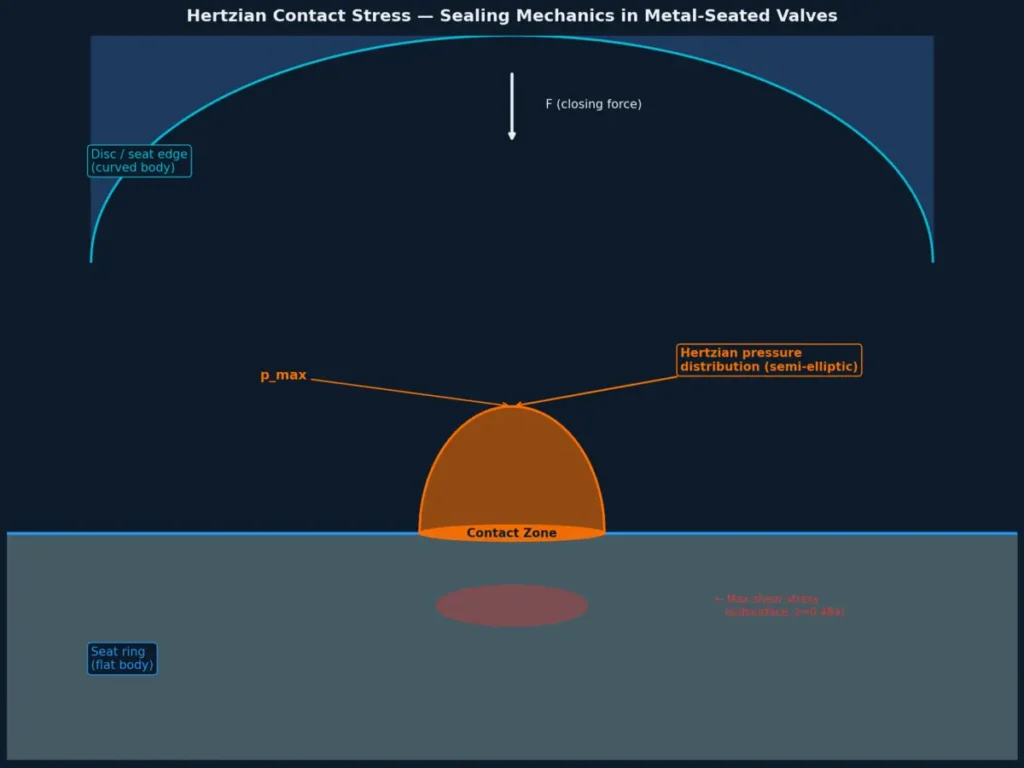
- The pressure distribution across the patch is semi-elliptic — highest at the centre, falling to zero at the edges
- Maximum contact pressure p_max = (3F) / (2πa²)
- The maximum shear stress occurs not at the surface but slightly below it — at a depth of approximately 0.48a — and governs subsurface fatigue and pitting initiation
For two cylinders with parallel axes (line contact):
- The contact patch is a narrow rectangle of width 2b
- Again semi-elliptic pressure distribution across the width
- Maximum pressure p_max = (2F) / (πbL) where L is the cylinder length
Two parameters govern the contact area and peak pressure for a given load:
- *Combined radius of curvature (R\)* — depends on the geometry of both bodies; smaller R\ means smaller contact patch and higher pressure
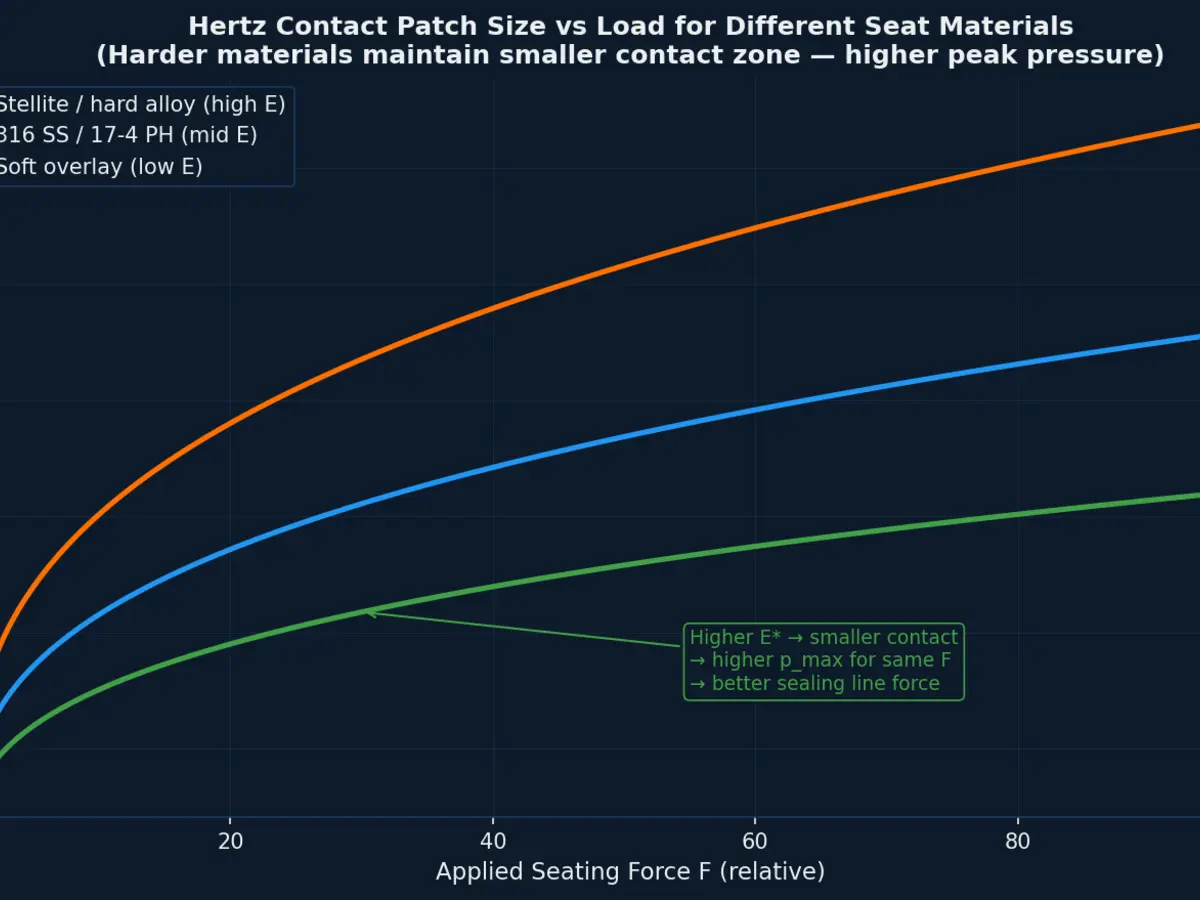
- *Combined elastic modulus (E\)** — depends on the Young's moduli and Poisson's ratios of both materials; stiffer materials produce smaller contact patches for the same load
The fundamental insight for valve engineers: for a given seating force, a stiffer, harder seat material produces a smaller contact area and a higher peak contact pressure. This is why hardness is not just about wear resistance — it directly controls the sealing line force per unit length of contact.
Where Hertzian Contact Mechanics Applies in Industrial Valves
In the context of industrial valves, Hertzian contact mechanics governs every instance where a curved surface must seal against another surface under load. The most important examples are:
Triple-offset and six-eccentric butterfly valves. In a triple-offset (or Hexa six-eccentric) design, the disc edge and seat ring form a conical contact pair. As the disc rotates to the closed position, it does not drag across the seat — it cams in at the last fraction of travel to achieve a line contact between the conical disc edge and the conical seat ring. That contact line behaves as a Hertzian line contact. The contact pressure distribution determines whether the sealing is achieved before the fluid pressure exceeds the contact stress at any point along the sealing band.
Understanding the design rationale behind this geometry is covered in Carter Valve's range of アイソレーションバルブ, which includes the Hexa six-eccentric platform engineered specifically to optimise this contact mechanic.
Ball valves (metal-seated). The ball surface contacts the seat ring along a circular contact band. The local contact geometry approximates a sphere-on-flat Hertz contact at each point around the sealing circle.
Check valves and safety relief valves. The poppet or disc contacts a flat or conical seat face. Again, the contact geometry — whether spherical, conical, or flat-on-flat — determines the Hertzian pressure distribution and the minimum seating force required.
Gate valves. Gate-to-seat contact in wedge-type designs involves conforming surface contact, which falls outside classical Hertz theory — but the transition from elastic to plastic deformation at the sealing surface is still governed by the same material property relationships that Hertz theory defines.

The Sealing Condition: When Contact Stress Must Exceed Fluid Pressure
For a metal seat to achieve shutoff, the contact stress at the sealing interface must exceed the fluid pressure at every point along the sealing line. This is the fundamental sealing criterion:
p_contact ≥ P_fluid (across the full sealing perimeter)
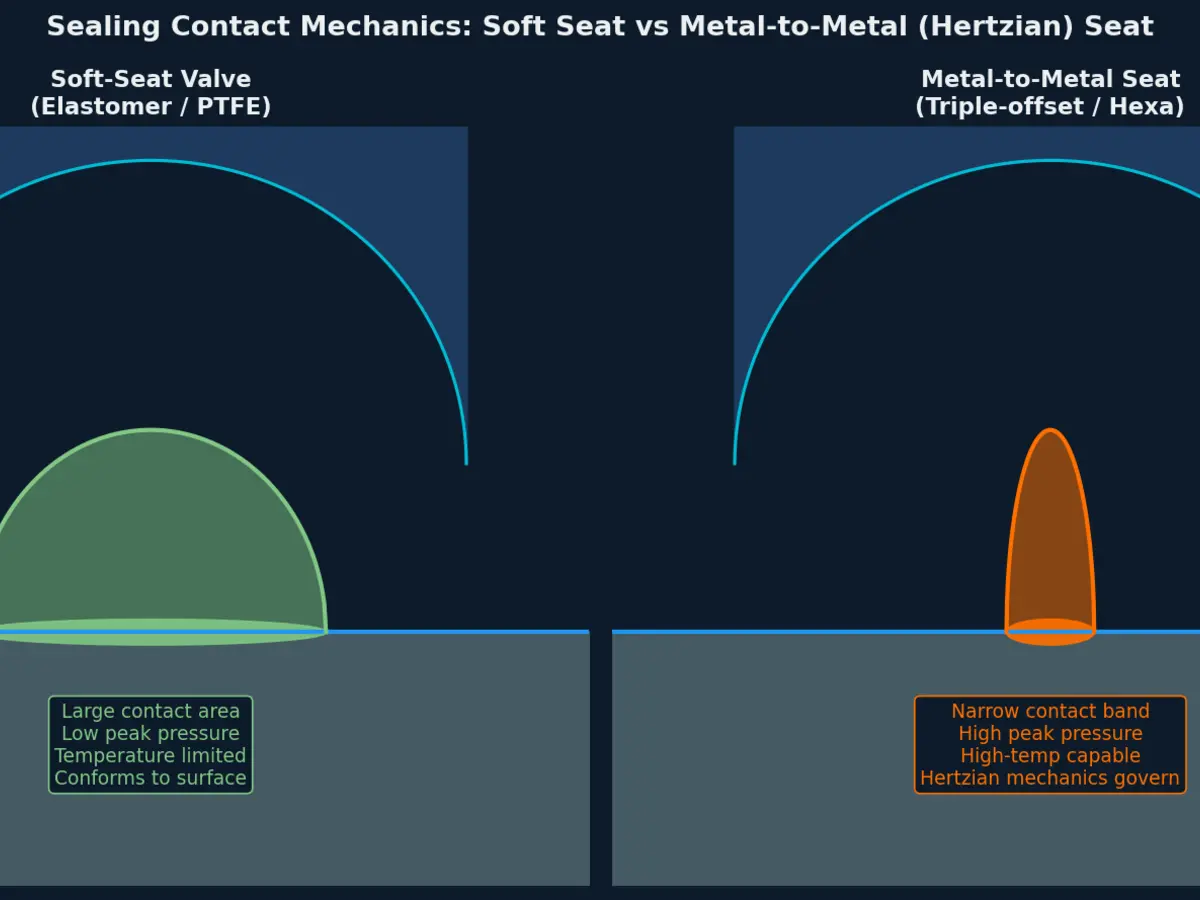
In a soft-seated valve, the elastomeric or PTFE material deforms to conform to the seat face, creating a large contact area at low contact pressure. Sealing is achieved even with modest actuator torque because the soft material accommodates surface irregularities.
In a metal-to-metal seated valve, there is no conforming elastomer. The sealing relies entirely on the Hertzian contact pressure being sufficient across the rigid conical or spherical contact geometry. This has two important consequences:
Surface finish is critical. The Hertz theory assumes perfectly smooth, continuous contact. In practice, surface asperities — microscopic peaks in the seat face finish — act as individual contact points each undergoing their own local Hertz contact stress. A surface roughness of Ra 0.156 μm (the specification used in Carter Valve's Hexa butterfly valve) ensures that the peaks are fine enough that the actual contact area closely approximates the ideal Hertz contact area, maintaining consistent sealing stress across the full contact line.
Actuator sizing is a sealing calculation, not just a torque calculation. The seating force delivered by the actuator determines the contact pressure at the sealing interface. Under-sizing the actuator — even slightly — means the contact stress may not exceed fluid pressure at rated conditions, producing a leak even in a geometrically correct valve. This is why actuator sizing for metal-seated severe-service isolation valves includes a seating force verification step, not just a breakaway torque calculation.

For control valve applications where sealing class requirements are defined under ANSI/FCI 70-2 and ISO 5208, the relationship between seat contact stress and leakage class is explored further in Carter Valve's guide to valve leakage classes and what they mean for plant specification.
Galling: When Hertzian Contact Stress Leads to Adhesive Wear
Hertzian theory assumes both bodies remain elastic. In valve service, two failure modes arise when that assumption breaks down.
Plastic deformation occurs when the contact stress exceeds the yield strength of the softer material. Under excessive seating force or repeated cycling, this can cause permanent deformation of the seat face — changing the contact geometry, widening the contact band, reducing peak pressure, and ultimately compromising the sealing condition that the design relied on.
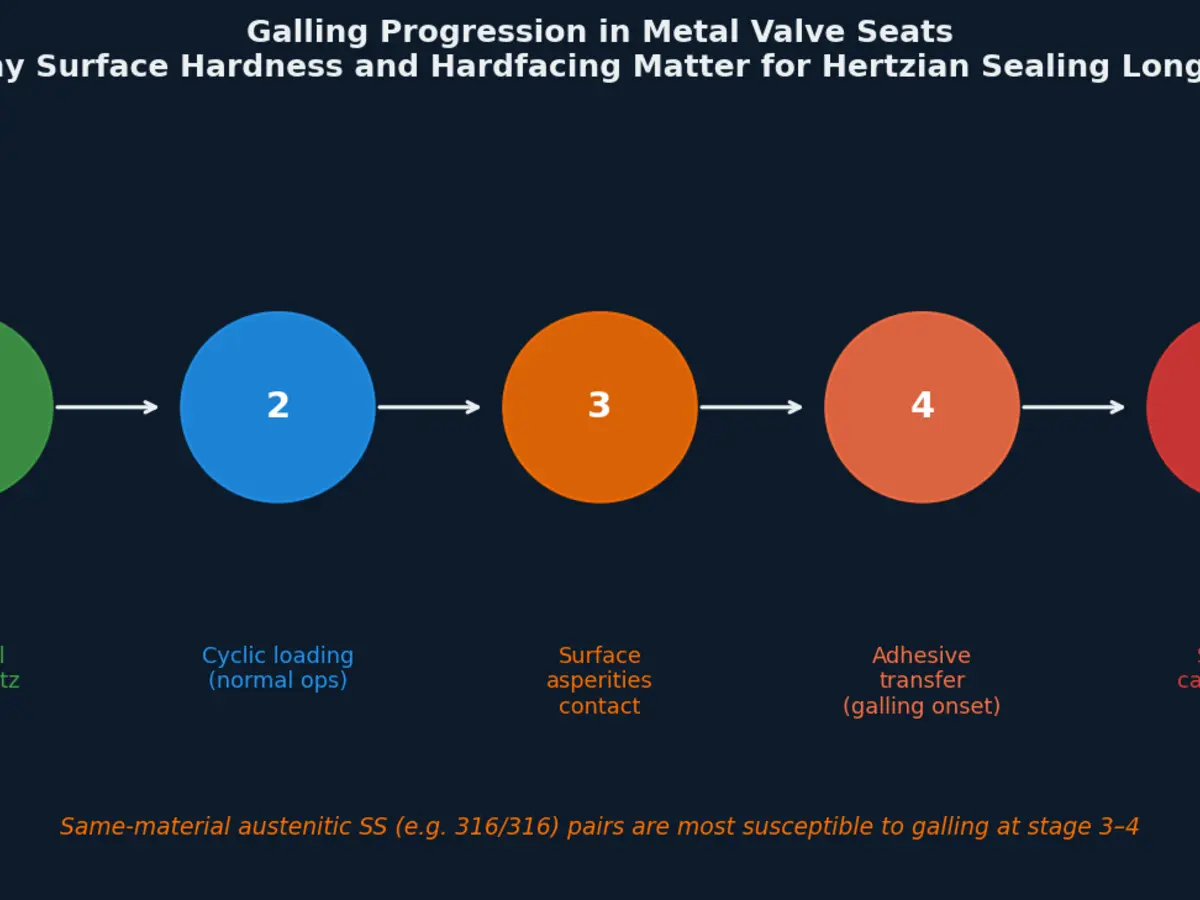
Galling is a more insidious failure. Galling is adhesive wear that occurs when two metal surfaces in contact — particularly under high contact stress and sliding motion — transfer material from one surface to the other. The result is surface tearing, material pickup, and seizure that can make a valve impossible to operate.
Austenitic stainless steels such as 316 and 304 are particularly prone to galling when used in same-material contact pairs. Their passive oxide layer, which provides general corrosion resistance, breaks down under the local contact stresses of sliding contact, exposing bare metal surfaces that adhere to each other.
This is why metal-seated valve designs for severe service specifically avoid same-grade stainless-on-stainless seat interfaces, and instead use:
Stellite hardfacing — cobalt-chromium-tungsten alloy overlaid by welding onto seat and disc contact surfaces. Stellite has high hardness (typically 40–50 HRC), a high elastic modulus, and excellent galling resistance in metal-on-metal contact.
Tungsten carbide coatings — applied by HVOF (High Velocity Oxy-Fuel) thermal spray for extreme hardness in abrasive or erosive service.
Ceramic seat inserts — for very high temperature applications where metallic hardface alloys would oxidise or lose hardness.
The selection of seat material is therefore a Hertzian mechanics decision as much as a corrosion decision. The required contact pressure to seal, the number of operating cycles, the temperature range, and the compatibility of the mating pair all flow from the same contact mechanics framework.

Carter Valve's コントロールバルブ範囲 for severe service applications specifies trim and seat materials based on this combined contact mechanics and corrosion resistance analysis.
Hertzian Contact and the Non-Rubbing Seal Design
One of the key design advances in triple-offset and six-eccentric butterfly valve geometry is directly related to Hertzian contact mechanics.
In a conventional double-eccentric butterfly valve, the disc drags across the seat during opening and closing — the contact is maintained throughout a significant portion of the disc rotation. This continuous sliding contact means the seat and disc experience repeated Hertzian contact cycles with sliding, accelerating galling and surface fatigue.
A triple-offset design eliminates rubbing contact during most of the stroke. The disc lifts away from the seat almost immediately on opening, and only makes contact during the final few degrees of closure. The sealing is accomplished by a camming action that brings the conical disc edge into line contact with the conical seat ring at the moment of final closure — applying Hertzian contact stress only at zero relative velocity between disc and seat.
The six-eccentric (Hexa) geometry takes this further still. The cone-to-cone sealing geometry means the contact line engages and disengages without rubbing, protecting the sealing surfaces from adhesive wear over hundreds of thousands of operating cycles. This is not just a geometry innovation — it is an application of contact mechanics to eliminate the conditions under which galling initiates.
よくある質問
Why does a harder seat material produce better sealing at the same actuator torque? Because a harder material has a higher elastic modulus (E\*), which reduces the contact area (a) for a given seating force. A smaller contact area means a higher peak contact pressure p_max for the same force. Higher contact pressure means the sealing condition (p_contact ≥ P_fluid) is met more easily, or is met at a lower actuator torque requirement.
What is the difference between Hertzian contact stress and nominal seating stress? Nominal seating stress divides the seating force by the geometric area of the seat face — it is an average and does not reflect the actual pressure distribution. Hertzian contact stress is the peak pressure at the centre of the actual (much smaller) contact zone, which can be orders of magnitude higher than the nominal value. For metal-seated valves, the Hertzian peak pressure is what governs sealing and determines whether galling or plastic deformation will occur.
Can Hertzian contact stress cause a valve to fail even if the seat looks undamaged? Yes. Subsurface fatigue damage initiates at the maximum shear stress point approximately 0.48a below the contact surface — which is invisible to surface inspection. This is the same mechanism that causes spalling in rolling-element bearings. In high-cycle valve applications, this subsurface fatigue can eventually surface as pitting or delamination of the seat face, particularly if the seat material has insufficient fatigue strength.
How does surface roughness affect Hertzian sealing? Surface asperities add a statistical distribution of micro-contact points on top of the macro Hertzian contact. A rougher surface means fewer, higher peaks doing the sealing work — with individual asperities experiencing much higher contact stress than the ideal smooth case. This accelerates galling and fatigue at those peaks. Tighter surface finish (lower Ra) improves the distribution of contact stress across the intended sealing band and is essential for achieving ISO 5208 Rate A leakage performance in metal-seated designs.
What is the role of Hertzian contact in fugitive emissions compliance? Fugitive emissions from valve stem packing are a separate issue from seat leakage, but the same contact mechanics principles apply. The compression of graphite or PTFE packing against the stem and stuffing box creates a Hertzian-type contact distribution. For ISO 15848-1 fugitive emissions qualification — covered in the Carter Valve guide to バタフライバルブの漏出ガス基準 — the contact sealing mechanism in the packing must maintain integrity through the defined thermal and mechanical cycling protocol.
Request a Technical Consultation on Metal-Seat Valve Selection
If you are specifying isolation or control valves for severe service where metal-to-metal seating is required — high temperature, high pressure, cryogenic, or abrasive media — the seat geometry, material pair, and actuator torque are connected through Hertzian contact mechanics, not through generic torque tables.
Carter Valve's engineering team provides application-based valve selection that includes seat contact pressure verification, material compatibility assessment, and actuator sizing for the required sealing class under your specific operating conditions.
Tell us your service — temperature, pressure class, media, and required leakage class — and we will recommend a seat design, material specification, and actuator package matched to your duty.
Explore Carter Valve's アイソレーションバルブ範囲 including the Hexa six-eccentric butterfly platform, engineered for zero-leakage metal-seated severe service.
参考文献
- Hertz, H. (1882) — Über die Berührung fester elastischer Körper — Journal für reine und angewandte Mathematik. Cited in: BayernCollab, Hertzian Theory of Contact — https://collab.dvb.bayern/spaces/TUMzfp/pages/70096858/Hertzian+Theory+of+Contact
- Engineering Notes — Hertzian Contact Stress — https://engineeringnotes.org/solid-mechanics/hertzian-contact-stress/
- TriboNet — Hertz Contact Theory: Key Concepts Explained — https://www.tribonet.org/wiki/hertz-contact-theory/
- Product Development Engineers Ltd — Hertzian Contact Explained — https://product-development-engineers.com/2024/09/24/hertzian-contact-explained/
- Zhu, X. (2012) — Tutorial on Hertz Contact Stress — OPTI 521, University of Arizona — https://wp.optics.arizona.edu/optomech/wp-content/uploads/sites/53/2016/10/OPTI-521-Tutorial-on-Hertz-contact-stress-Xiaoyin-Zhu.pdf
- MDPI Applied Sciences — Analysis and Optimization for the Sealing Performance of Ultra-High Pressure Solenoid Valves — https://www.mdpi.com/2076-3417/15/17/9608
- MDPI Applied Sciences — Design of Laminated Seal for Triple Offset Butterfly Valve (350°C) Used in Combined Cycle Power Plants — https://www.mdpi.com/2076-3417/9/15/3095
- CGIS Valves — Butterfly Valves — Triple Offset Design — https://cgis.ca/articles/butterfly-valves-triple-offset-design/
- Scientific Reports — Structural analysis and multi-objective optimization of sealing structure for cryogenic liquid hydrogen triple-offset butterfly valve — https://www.nature.com/articles/s41598-025-20095-6