






Absperrklappe vs. Durchgangsventil für Regelanwendungen ist keine einfache Entscheidung zwischen “billigem Ventil oder präzisem Ventil”. Eine Absperrklappe ist in der Regel eine kompakte, drehbare Option mit hohem Cv-Wert für große Durchflussmengen und niedrige bis mittlere Druckabfälle, während ein Durchgangsventil in der Regel die bessere Wahl ist, wenn der Kreislauf eine hohe Drosselpräzision, eine vorhersehbare Trimmcharakteristik, einen hohen Druckabfall oder einen größeren Regelbereich benötigt. Die praktische Schlussfolgerung lautet wie folgt: Wählen Sie das Ventil, das die richtige Durchflusscharakteristik und ein kontrollierbares Hubfenster bietet, nicht nur den höchsten Cv-Wert oder den niedrigsten Anschaffungspreis.
Bei der Arbeit mit Regelventilen, Cv beschreibt die Durchflusskapazität, Reichweite beschreibt den nutzbaren, regelbaren Durchflussbereich, und Fließeigenschaft beschreibt, wie der Ventilhub die Durchflusskapazität verändert. Die maßgeblichen Referenzen für Regelventile unterscheiden zwischen der inhärenten Charakteristik, die bei konstantem Druckabfall gemessen wird, und der installierten Charakteristik, die sich ändert, sobald das Ventil in ein reales Rohrleitungssystem mit Pumpen, Reibungsverlusten und variierendem Druckabfall eingebaut wird. Dieser Artikel vergleicht Absperrklappen und Durchgangsventile unter diesen drei Gesichtspunkten und gibt dann einen praktischen Auswahlablauf für Ingenieure, EPC-Teams und Wartungsgruppen.
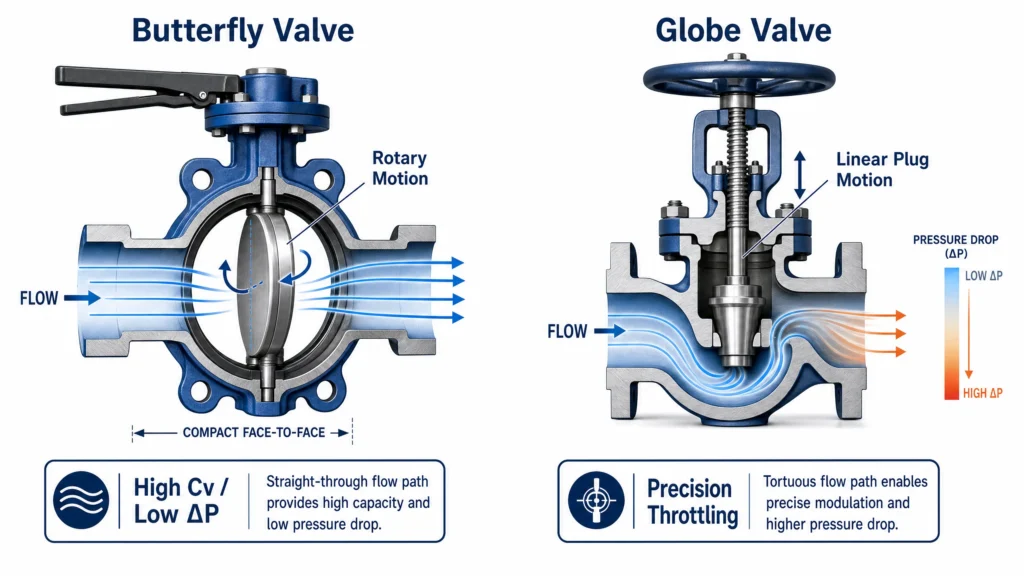
Warum die Frage “Absperrklappe vs. Durchgangsventil” zu stark vereinfacht wird
Viele Auswahlgespräche beginnen mit einer Abkürzung: “Verwenden Sie ein Durchgangsventil zum Regeln und eine Absperrklappe zum Absperren.” Dieser Rat ist in einigen Fällen sicher, aber er ist nicht vollständig. Moderne Hochleistungsabsperrklappen können in vielen Industriesystemen einen stabilen modulierenden Betrieb gewährleisten, insbesondere bei größeren Leitungsgrößen, bei denen ein Durchgangsventil schwer, teuer und druckabfallintensiv wird. Umgekehrt kann ein Durchgangsventil immer noch die beste Wahl sein, wenn der Prozess eine enge Regeltoleranz, einen hohen Druckabfall, eine kavitationshemmende Einstellung, Geräuschdämpfung oder ein wiederholbares lineares/gleichprozentiges Verhalten erfordert.
Die tatsächliche Entscheidung hängt von den Betriebsbedingungen ab. Ein Kühlwasserkreislauf, eine Niederdruckluftleitung, ein großer Erdgas-Bypass, eine Dampfablassstation und eine Chemikaliendosierleitung stellen nicht die gleichen Anforderungen an das Ventil. Sie unterscheiden sich in Bezug auf Druckabfall, Leitungsgröße, Durchflussreduzierung, zulässige Leckage, Flüssigkeitsdichte, Dampfdruck, Feststoffe, Geräuschgrenze und Ansprechverhalten des Stellantriebs.
Für Leser, die eine interne Auswahlnorm erstellen, ist der Leitfaden von Carter Valve über was ein Regelventil ist und wie seine Bestandteile funktionieren ist eine gute Grundlage. Wenn die Anwendung Flüssigkeitsblasen oder das Risiko von Kavitation beinhaltet, ist der entsprechende Artikel auf Kavitation vs. Flashen in Regelventilen sollten geprüft werden, bevor ein Ventilstil endgültig festgelegt wird.
Fließeigenschaften: Inhärentes vs. installiertes Verhalten
Ein Regelventil ist inhärente Fließeigenschaft ist die Beziehung zwischen Ventilöffnung und Durchflusskapazität, wenn der Druckabfall über dem Ventil konstant gehalten wird. Spirax Sarco definiert die inhärente Kennlinie auf diese Weise und erklärt die üblichen schnell öffnenden, linearen und gleichprozentigen Typen, die in Wasser- und Dampfanwendungen verwendet werden. Valin macht dieselbe wichtige Unterscheidung: inhärente Kennlinien stammen aus kontrollierten Testbedingungen, während installierte Kennlinien das reale System widerspiegeln, einschließlich Rohrleitungsverluste und Pumpenkennlinien.
Diese Unterscheidung ist wichtig, weil der Regelkreis nicht die Katalogkurve erfährt. Er erfährt die installierte Kurve.
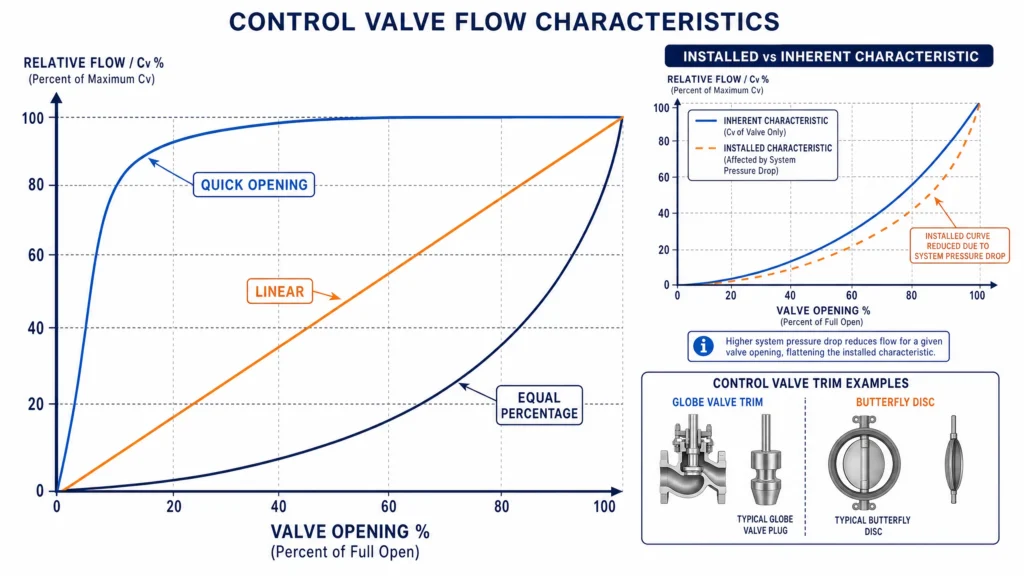
| Durchflusskennlinie | Was es bedeutet | Wo es am besten passt |
|---|---|---|
| Schnelles Öffnen | Großer Durchflussanstieg bei geringem Anfangsweg | Ein/Aus- oder reliefartiges Verhalten, keine präzise kontinuierliche Drosselung |
| Linear | Gleiche Wegabstufungen führen zu annähernd gleichen Steigerungen der Durchflusskapazität bei konstantem ΔP | Systeme, bei denen der Druckabfall im Ventil relativ stabil bleibt |
| Gleicher Prozentsatz | Gleiche Fahrstufen erzeugen gleiche prozentuale Änderungen der Durchflusskapazität | Systeme, bei denen das ΔP des Ventils stark mit dem Durchfluss variiert, oft rohrlastige Systeme |
| Modifizierte Rotation | Die Scheiben- oder Kugelgeometrie ergibt eine Kurve zwischen linear und gleichprozentig | Viele drehbare Regelventile, einschließlich Hochleistungsklappen |
Durchgangsventile haben hier einen großen Vorteil: Die Garnitur kann oft so gewählt oder geändert werden, dass sie ein lineares oder gleichprozentiges Verhalten bietet. Valin weist darauf hin, dass Durchgangsventile entweder mit linearer oder gleichprozentiger Kennlinie erhältlich sind, während Hochleistungs-Absperrklappen in der Regel etwa in der Mitte zwischen gleichprozentiger und linearer Kennlinie liegen. Das bedeutet nicht, dass Drosselklappen schlechte Regelventile sind. Es bedeutet, dass der Ingenieur überprüfen muss, ob die installierte Kennlinie eine akzeptable Regelkreisverstärkung über den erwarteten Hubbereich bietet.
Cv: Warum eine höhere Durchflusskapazität sowohl ein Vorteil als auch eine Falle ist
Cv ist ein Ventildurchflusskoeffizient, der angibt, wie viel Durchfluss ein Ventil bei einem bestimmten Druckabfall und Flüssigkeitszustand durchlassen kann. Der Leitfaden von Emerson für die Auslegung von Regelventilen nennt die erforderlichen Auslegungsdaten wie Druck vor und hinter dem Ventil, Temperatur, Durchflussmenge, Dichte, Rohrgröße, Druckklasse, Garniturentyp und Geräuschgrenze. Das ISA75.01 Komitee befasst sich mit den Normen für die Auslegung von Regelventilen in Bezug auf die Durchflussgleichungen ANSI/ISA-75.01.01 und IEC 60534-2-1.
Eine Absperrklappe bietet in der Regel einen höheren Cv-Wert pro Nennweite als ein Durchgangsventil, da ihr Durchflussweg offener und weniger gewunden ist. Dies ist bei großen Durchflussmengen von Vorteil, wo der verfügbare Druckabfall begrenzt ist. Ein Durchgangsventil hat in der Regel einen niedrigeren Cv-Wert pro Nennweite, da der Durchflussweg durch das Gehäuse und die Garnitur verläuft, aber dieselbe Geometrie ermöglicht eine bessere Drosselung, Druckabfallsteuerung und Garnituroptionen.
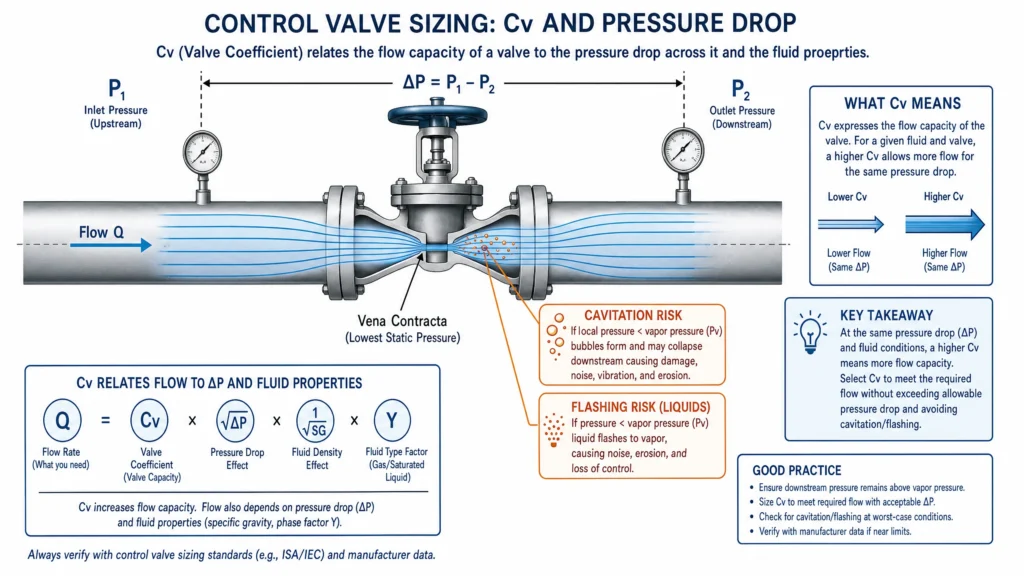
| Frage zum Lebenslauf | Auswirkung der Absperrklappe | Auswirkungen des Geradsitzventils |
|---|---|---|
| Ist das Angebot groß und der verfügbare ΔP gering? | Oft attraktiv, weil hoher Cv-Wert den permanenten Druckverlust reduziert | Erfordert möglicherweise ein größeres Gehäuse und höhere Kosten, um die gleiche Kapazität zu erreichen |
| Ist eine präzise Steuerung des niedrigen Durchflusses erforderlich? | Kann schwierig sein, wenn das Ventil überdimensioniert ist und fast geschlossen arbeitet | In der Regel stärker, da die Trimmung für die Steuerung des geringen Durchflusses charakterisiert werden kann |
| Ist Kavitation oder Blitzen möglich? | Höhere Druckrückgewinnung kann das Risiko bei einigen Flüssigkeitsdienstleistungen erhöhen | Trimmungen für den harten Einsatz können Druckabfall und Rückgewinnung besser steuern |
| Ist Energieverlust ein Problem? | Geringerer Druckabfall kann Pump- oder Kompressionskosten reduzieren | Ein höherer Druckabfall kann akzeptabel sein, wenn die Kontrollqualität entscheidend ist. |
| Ist das Ventil im Normalbetrieb überwiegend geöffnet? | Möglicherweise geringe Kontrollmöglichkeiten, wenn fast weit geöffnet | Kann bei richtiger Größe noch einen brauchbaren Federweg bieten |
Ein hoher Cv-Wert ist nicht automatisch gut. Wenn das Ventil zu groß ist, kann die Steuerung es dazu zwingen, in der Nähe des Sitzes zu arbeiten, wo kleine Hubänderungen zu großen Durchflussänderungen und schlechter Auflösung führen. Bray warnt davor, dass überdimensionierte Regelventile die Regelauflösung beeinträchtigen, während unterdimensionierte Ventile den Durchfluss einschränken und zu Drosselung, Kavitation oder Flashen beitragen können. Das beste Ventil ist nicht das mit dem größten Cv-Wert, sondern das mit dem richtigen Cv-Wert bei normalen, minimalen und maximalen Betriebspunkten.
Erreichbarkeit und das nützliche Kontrollfenster
Erreichbarkeit ist das Verhältnis zwischen dem maximal steuerbaren Durchfluss und dem minimal steuerbaren Durchfluss, bei dem das Ventil noch akzeptabel regeln kann. In realen Projekten wird die Regelbarkeit oft mit dem vollen Kataloghubbereich verwechselt. Ein Ventil kann sich physikalisch von 0% bis 100% bewegen, aber der nützliche Regelbereich ist normalerweise kleiner.
In den Auslegungsrichtlinien von Bray heißt es, dass ein ideales Regelventil häufig in folgenden Bereichen arbeitet 60%-80% offen, mit 20%-80% als normaler Betriebsbereich verwendet werden, um die Regelungstreue und Auflösung zu verbessern. Diese Faustregel ist wertvoll, weil sie das Auswahlteam zwingt, darüber nachzudenken, wo das Ventil nach der Installation tatsächlich arbeiten wird.
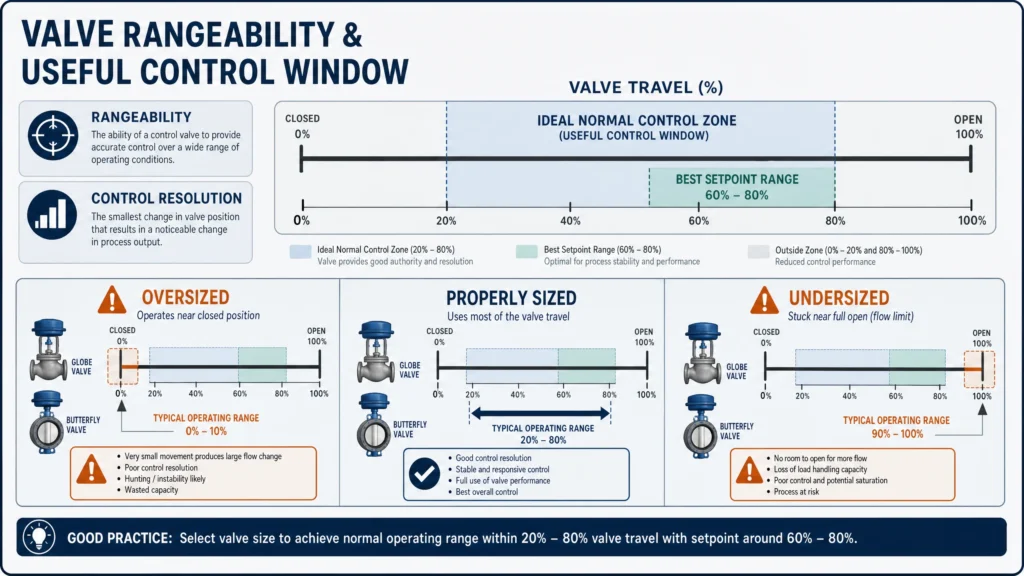
| Ergebnis der Größenbestimmung | Betriebssymptom | Kontrolle der Folgen |
|---|---|---|
| Überdimensioniertes Ventil | Normaler Durchfluss erfolgt bei sehr geringer Öffnung | Schlechte Auflösung, Hunting, Sitzverschleiß, instabile Steuerung |
| Richtig dimensioniertes Ventil | Der normale Fluss liegt in der Mitte des Weges | Besseres Schleifenverhalten, stabile Auflösung, Raum für Störungen |
| Unterdimensioniertes Ventil | Das Ventil bleibt bei normalem oder hohem Durchfluss fast ganz geöffnet | Durchflussbegrenzung, hoher Druckabfall, Unfähigkeit, den Bedarf zu decken |
Durchgangsventile bieten im Allgemeinen eine bessere Regelbarkeit über einen größeren Bereich, da die Geometrie von Kegel und Sitz angepasst werden kann. Absperrklappen lassen sich sehr gut regeln, wenn das Betriebsfenster nicht zu groß ist und die Klappe so dimensioniert ist, dass die Scheibe nicht die meiste Zeit ihres Lebens fast geschlossen oder fast vollständig geöffnet ist. In großen Versorgungs-, Kühl-, HLK-, Wasser-, Niederdruckgas- und einigen Prozessanwendungen kann eine Absperrklappe daher eine sehr praktische Regelungslösung darstellen.
Für die Auslegung von Absperrklappen und deren Betätigung bietet Carter Valve's Leitfaden für die Auslegung von Stellantrieben für Absperrklappen und Übersicht Hochleistungsabsperrklappen sind nützliche weiterführende Ressourcen.
Wenn eine Absperrklappe mehr Sinn macht
Eine Absperrklappe ist oft sinnvoll, wenn die Leitung groß ist, der Druckabfall mäßig ist, der Prozess eine weniger spezielle Durchflusscharakteristik vertragen kann und der Wert der Kompaktheit hoch ist. Die Vorteile werden mit zunehmender Leitungsgröße immer größer. Ein großes Durchgangsventil kann schwer, teuer und schwer zu tragen sein. Eine leistungsstarke Absperrklappe kann bei vielen Anwendungen eine hohe Kapazität, eine kürzere Baulänge, ein geringeres Gewicht und geringere Anforderungen an den Antrieb bieten.
Absperrklappen eignen sich auch für Anwendungen, bei denen die Armatur eher für eine grobe oder mittlere Regelung als für eine extrem feine Drosselung eingesetzt wird. Beispiele hierfür sind Kühlwasser, Prozesswasser, Niederdruckluft, Versorgungsgas, Verdampferversorgungsleitungen, viele Wärmetauscher-Bypässe und große Absperr-/Modulieraufgaben, bei denen ein enger Raum von Bedeutung ist.
| Vorteil Absperrklappe | Praktischer Wert |
|---|---|
| Hoher Cv-Wert pro Größe | Geringerer Druckabfall und möglicherweise kleineres Ventilgehäuse |
| Kompakt von Angesicht zu Angesicht | Leichtere Installation in überfüllten Rohrregalen oder Skids |
| Geringeres Gewicht | Geringere Stützlast und einfachere Handhabung |
| Drehbetätigung | Einfache Automatisierung und schnelle Reaktionsmöglichkeiten |
| Gute Wirtschaftlichkeit für große Linien | Niedrigere installierte Gesamtkosten bei vielen Großbohrungen |
Der Schlüssel liegt in der Auswahl der richtigen Absperrklappe. Ein universell einsetzbares, elastisch gelagertes Ventil ist nicht dasselbe wie ein Hochleistungsventil mit doppeltem Versatz oder eine Absperrklappe für schwere Betriebsbedingungen. Informationen zu den Optionen von Carter Valve und zum technischen Hintergrund finden Sie in der Produktkategorie Absperrklappen, die Hochleistungs-Absperrklappe mit doppelter Verstellung, und den Leitfaden über Arten von Absperrklappen.
Wann ein Durchgangsventil das bessere Regelventil ist
Ein Geradsitzventil ist in der Regel die bessere Wahl, wenn hohe Regelgenauigkeit, ein großer Regelbereich, ein starkes Druckabfallmanagement, eine kavitationsdämpfende Einstellung, eine geräuscharme Einstellung oder ein vorhersehbares charakteristisches Verhalten erforderlich sind. Da der Durchfluss durch einen Kegel und einen Sitz fließt, hat der Konstrukteur mehr Freiheit bei der Gestaltung der Einstellung und der stufenweisen Steuerung des Druckabfalls.
Dies ist von Bedeutung bei Dampf, Kesselspeisewasser, chemischer Einspritzung, Kompressorrückführung, Hochdruckflüssigkeitsablass und anderen Dienstleistungen, bei denen eine schlechte Regelungsqualität Auswirkungen auf Sicherheit, Qualität oder Energie hat. Ein Durchgangsventil kann teurer und schwerer sein, aber es kann die Prozessvariabilität verringern, nachgeschaltete Anlagen schützen und wiederkehrende Wartungsarbeiten aufgrund von Lärm, Kavitation oder instabiler Regelung verhindern.
| Vorteil Geradsitzventil | Praktischer Wert |
|---|---|
| Gekennzeichnete Trimmung | Lineares oder gleichprozentiges Verhalten kann gewählt werden |
| Bessere Präzision bei der Drosselung | Stärkere Option für strenge Prozesskontrolle |
| Ausstattungsoptionen für den harten Einsatz | Bessere Handhabung von hohem ΔP, Kavitation, Blitzen oder Lärm |
| Gute Low-Flow-Auflösung | Nützlich, wenn ein minimaler kontrollierbarer Durchfluss wichtig ist |
| Etablierte Dokumentation zu Steuerventilen | Einfacher zu spezifizieren für viele Prozessregelkreise |
Carter-Ventile Regelventil-Kategorie, Universal-Durchgangsregelventil, und ANSI-Regelventil mit strengem Service sind natürliche interne Links für die Leser, die zu dem Schluss kommen, dass die Kontrolle nach dem Globusprinzip die richtige Richtung ist.
Installierte Merkmale: Das System entscheidet über die endgültige Antwort
Ein Ventil kann nicht losgelöst vom System ausgewählt werden. In einem rohrlastigen System kann sich der dem Ventil zur Verfügung stehende Druckabfall bei Änderungen des Durchflusses erheblich ändern. Valin erklärt, dass ein Ventil mit gleichem Prozentsatz, das in einem System mit erheblichen Rohr- und Armaturenverlusten installiert ist, eine nahezu lineare installierte Kennlinie aufweisen kann. Spirax Sarco betont außerdem, dass die Ventileigenschaften an die Installationscharakteristik angepasst und nicht nur als Katalogkurven bewertet werden sollten.
Hier gehen viele Debatten über Klappen und Ventile schief. Die Frage lautet nicht: “Welches Ventil hat die bessere Kennlinie?” Die Frage lautet: “Welches Ventil bietet die brauchbarste installierte Kennlinie, nachdem der Druckabfall im System, die Pumpenkennlinie, die Rohrleitungsverluste und das Regelungsziel berücksichtigt wurden?”
Eine Absperrklappe mit hohem Cv-Wert kann beispielsweise sehr gut in einem großen Kühlwasser-Bypass funktionieren, wo der Druckabfall gering und die Regelungstoleranz moderat ist. Dasselbe Ventil kann in einem Hochdruck-Flüssigkeitsablass schlecht funktionieren, weil Druckrückgewinnung und Kavitationsrisiko die Entscheidung dominieren. Ein Durchgangsventil kann ideal für Kesselspeisewasser sein, aber unnötig teuer für eine große Niederdruck-Lüftungs- oder Versorgungsleitung.
Matrix für Auswahlentscheidungen
Die nachstehende Entscheidungsmatrix ist ein praktischer Ausgangspunkt. Sie soll weder eine Auslegungssoftware noch eine technische Überprüfung ersetzen, aber sie zeigt schnell, wo die einzelnen Ventilarten in der Regel passen.
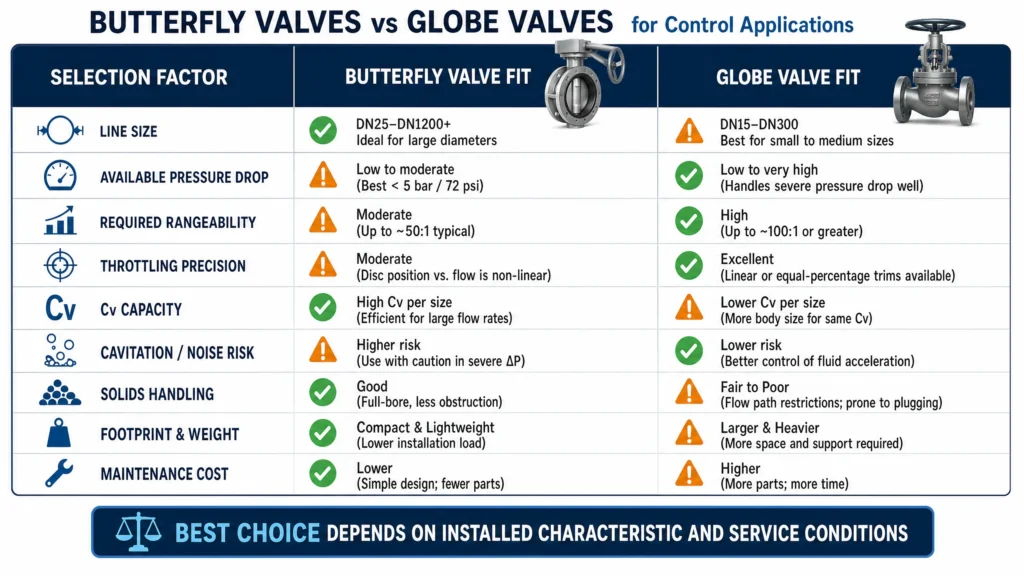
| Auswahlfaktor | Die Absperrklappe passt normalerweise, wenn... | Das Durchgangsventil passt normalerweise, wenn... |
|---|---|---|
| Größe der Linie | Mittlere bis sehr große Linien machen Gewicht und Kosten wichtig | Kleine bis mittlere Linien machen Präzision wertvoller als Körpergröße |
| Verfügbarer Druckabfall | Geringes bis mäßiges ΔP ist verfügbar | Mäßiges bis hohes ΔP muss kontrolliert werden |
| Erforderliche Reichweite | Mäßig kontrollierbarer Bereich ist akzeptabel | Ein großer kontrollierbarer Bereich ist erforderlich |
| Durchflusskennlinie | Geändertes Drehverhalten ist nach installierter Analyse akzeptabel | Lineare oder gleichprozentige Beschneidung ist erforderlich |
| Lebenslauf-Anforderung | Hoher Cv-Wert pro Größe ist vorteilhaft | Ein niedrigerer Cv-Wert pro Größe ist für die Behörde akzeptabel oder erwünscht |
| Kavitation/Geräusch | Das Risiko ist gering oder überschaubar | Starke Beeinträchtigungen sind erforderlich |
| Tendenz zu Feststoffen oder Schlämmen | Offener Fließweg kann bei einigen Diensten helfen | Verschlungener Pfad kann je nach Verkleidung verstopft sein |
| Platzbedarf und Gewicht | Kompakte, leichte Installation ist wertvoll | Größere Körper und Stützen sind für die Kontrollqualität akzeptabel |
| Lebenszykluskosten | Geringere Installationskosten und einfachere Betätigung | Geringere Variabilität, längere Lebensdauer und Genauigkeit rechtfertigen die Kosten |
Ein nützlicher interner Übergang ist hier Carter Valve's Leitfaden für Ventilleckageklassen, Denn die Leckageerwartungen beeinflussen oft, ob ein Regelventil auch eine Absperrung bieten muss oder ob ein separates Absperrventil installiert werden sollte.
Häufige Fehler bei der Auswahl von Absperrklappen und Durchgangsventilen
Der erste häufige Fehler ist die Dimensionierung nur für den maximalen Durchfluss. Wenn der normale Durchfluss viel niedriger ist als der maximale, kann das Ventil die meiste Zeit in der Nähe der geschlossenen Position verbringen. Dies führt zu einer schlechten Regelungsauflösung und kann dazu führen, dass der Regelkreis wie ein Abstimmungsproblem aussieht, obwohl das eigentliche Problem die Ventildimensionierung ist.
Der zweite Fehler ist der Vergleich von Cv-Werten ohne Vergleich von Druckrückgewinnung und Kavitationsverhalten. Eine Zellenradschleuse mit hohem Cv-Wert kann die richtige Wahl für einen Service mit geringem Druckabfall sein, aber sie kann die falsche Wahl sein, wenn der Flüssigkeitsdruck unter den Dampfdruck an der Vena contracta fällt. Emerson weist in seinen Auslegungsrichtlinien ausdrücklich darauf hin, dass bei einem Druckabfall, der hoch genug für die Verdampfung der Flüssigkeit ist, der Druckabfall bei gedrosselter Strömung berücksichtigt werden muss, anstatt einfach den tatsächlichen Druckabfall zu verwenden.
Der dritte Fehler ist die Vernachlässigung der Leistung von Antrieb und Stellungsregler. Eine Armatur mit dem richtigen Gehäuse, aber schlechter Antriebsauflösung, übermäßigem Totband oder schwacher Stellungsrückmeldung lässt sich nicht gut regeln. Drehventile und Gleitschieberventile haben unterschiedliche Reibungs-, Drehmoment-, Schub- und Gestängeeigenschaften, so dass die Dimensionierung des Stellantriebs als Teil der Ventilauswahl betrachtet werden muss.
Der vierte Fehler besteht darin, für jede Regelungsaufgabe ein Durchgangsventil zu erzwingen. Das kann bei großen Anwendungen mit geringem Druckabfall zu Energie- und Budgetverschwendung führen, wo eine Absperrklappe bei geringerem Druckverlust und kleinerem Platzbedarf eine angemessene Regelung bieten würde.
Spezifikations-Checkliste für EPC- und Beschaffungsteams
Bei einer aussagekräftigen Anforderung von Steuerventilen sollte der Anbieter die Leistung bei minimalen, normalen und maximalen Bedingungen nachweisen. Es sollte auch nach dem installierten Verhalten gefragt werden, nicht nur nach dem Katalog-Cv.
| Punkt der Checkliste | Was zu beantragen ist |
|---|---|
| Servicebedingungen | Flüssigkeit, Phase, Dichte, Viskosität, Dampfdruck, Temperatur, P1, P2, Durchflussbereich |
| Cv in den Betriebspunkten | Erforderlicher Cv-Wert bei minimalem, normalem und maximalem Durchfluss |
| Ventilöffnung | Voraussichtlicher Verfahrweg in jedem Betriebspunkt, vorzugsweise in der Mitte des Verfahrweges |
| Charakteristisch | Lineare, gleichprozentige, modifizierte gleichprozentige oder herstellerspezifische Kurve |
| Erreichbarkeit | Erforderliches kontrollierbares Durchflussverhältnis und erwartete installierte Reichweite |
| Kavitation/Blitzen/Geräusch | Berechnung und ggf. Minderungsmethode |
| Stellantrieb/Stellungsregler | Drehmoment- oder Schubspanne, Auflösung, Totzone, Ausfallverhalten, Rückmeldung |
| Absperrung und Leckage | Leckageklasse des Sitzes und ob eine separate Isolierung erforderlich ist |
| Dokumentation | Auslegungsblatt, Kurven, Zeichnungen, Materialien, Prüfberichte, IOM, Ersatzteile |
Hier ist Carter Valve's breitere Ventil Produkte Seite und Kategorie modulierende Regelventile kann den Lesern helfen, vom Vergleich zur Produktauswahl überzugehen.
Überlegungen zu Kosten und Lebenszyklus
Eine Absperrklappe ist oft günstiger in Bezug auf Anschaffungspreis, Gewicht und Installationskosten in größeren Größen. Ein Durchgangsventil ist oft die bessere Wahl, wenn die Prozessvariabilität teuer ist, der Druckabfall hoch ist oder eine schlechte Steuerung ein Qualitäts- oder Sicherheitsrisiko darstellt. Bei der Entscheidung über die beste Lebensdauer werden Energieverluste, Wartungshäufigkeit, Antriebskosten, Ersatzteile, Ausfallzeiten und Prozessstabilität abgewogen.
In einem praktischen Beispiel kann der Ersatz eines Durchgangsventils durch eine Absperrklappe in einer großen Wasserversorgungsanlage den Druckverlust und das Gewicht der Anlage verringern, ohne die Regelung zu beeinträchtigen. In einem anderen Beispiel kann das Ersetzen eines Durchgangsventils durch eine Absperrklappe bei einer Hochdruck-Flüssigkeitsentnahme zu Kavitation, Sitzschäden und instabiler Regelung führen. Beide Aussagen können zutreffend sein, da das System entscheidet.
Schlussfolgerung
Die richtige Wahl zwischen einer Absperrklappe und einem Durchgangsventil für Regelanwendungen hängt ab von Durchflusseigenschaften, Messbereich, Cv, installierter Druckabfall, Regelgenauigkeit und Lebenszyklusrisiko. Absperrklappen sind oft die bessere Wahl für kompakte Anlagen mit großem Durchfluss und geringem bis mittlerem Druckabfall, bei denen ein hoher Cv-Wert und niedrige Installationskosten wichtig sind. Durchgangsventile sind in der Regel die bessere Wahl, wenn Präzisionsdrosselung, großer Regelbereich, charakteristischer Abgleich, Kavitationskontrolle, Geräuschkontrolle oder starker Druckabfall wichtiger sind.
Ein zuverlässiger Auswahlprozess beginnt mit den Betriebsdaten, berechnet den Cv-Wert an mehreren Betriebspunkten, prüft die installierte Kennlinie, verifiziert das nützliche Regelfenster, untersucht Kavitation und Geräusche und vergleicht erst dann die Ventilbauart und die Kosten. Carter Valve kann diesen Prozess mit Drosselklappenplattformen, Regelventilen für Durchgangsventile und Ventile für schwere Betriebsbedingungen, Antriebsführung und anwendungsbezogener technischer Prüfung unterstützen.
Häufig gestellte Fragen
Ist eine Absperrklappe oder ein Durchgangsventil für Regelanwendungen besser geeignet?
Ein Durchgangsventil eignet sich im Allgemeinen besser für eine präzise Drosselung, einen großen Regelbereich und eine starke Druckabfallregelung. Eine Absperrklappe eignet sich oft besser für große Durchflussmengen mit geringem bis mittlerem Druckabfall, wenn kompakte Abmessungen, ein hoher Cv-Wert und niedrigere Installationskosten wichtig sind.
Kann eine Absperrklappe als Regelventil verwendet werden?
Ja. Eine Hochleistungsklappe kann für eine modulierende Regelung verwendet werden, wenn die Betriebsbedingungen, der Betriebshub, der Druckabfall, die Leckageanforderung und die Antriebsauflösung geeignet sind. Sie sollte nicht ausgewählt werden, nur weil sie billiger ist oder einen hohen Cv-Wert hat.
Warum werden Durchgangsventile als besser für die Drosselung angesehen?
Durchgangsventile verwenden eine Sitzgarnitur, die für eine lineare oder gleichprozentige Durchflusskennlinie geformt werden kann. Dies ermöglicht eine vorhersehbarere Steuerung, eine bessere Auflösung bei niedrigem Durchfluss und mehr Optionen für Kavitations-, Flashing- und Lärmschutz.
Was bedeutet Cv bei der Ventilauslegung?
Cv ist ein Durchflusskoeffizient, der die Durchflusskapazität des Ventils bei einem bestimmten Druckabfall und Flüssigkeitszustand angibt. Ein höherer Cv-Wert bedeutet mehr Durchflusskapazität bei gleichem Druckabfall, aber ein zu hoher Cv-Wert kann dazu führen, dass das Ventil überdimensioniert und schwer zu steuern ist.
Was versteht man unter Regelbarkeit bei einem Regelventil?
Die Regelbarkeit ist das Verhältnis zwischen dem maximalen und dem minimalen regelbaren Durchfluss, bei dem das Ventil noch wirksam regeln kann. Sie ist nicht dasselbe wie der volle mechanische Hub von geschlossen bis offen.
Warum kann ein überdimensioniertes Ventil eine schlechte Steuerung verursachen?
Ein überdimensioniertes Ventil kann bei normalem Durchfluss nahe der Schließstellung arbeiten. In diesem Bereich kann eine kleine Bewegung der Spindel oder des Ventiltellers zu einer großen Durchflussänderung führen, was zu Schwankungen, Instabilität und schlechter Auflösung führt.
Welches Ventil hat einen höheren Cv-Wert, Drosselklappe oder Durchgangsventil?
Bei gleicher Nennweite hat eine Absperrklappe in der Regel einen höheren Cv-Wert, da ihr Durchflussweg offener ist. Ein Durchgangsventil hat in der Regel einen niedrigeren Cv-Wert, aber eine bessere Drosselungsregelung und ein besseres Druckabfallmanagement.
Sollte ein Steuerventil auch eine dichte Absperrung gewährleisten?
Manchmal, aber nicht immer. Wenn ein dichtes Absperren sicherheitskritisch ist, kann es besser sein, ein spezielles Absperrventil in Reihe zu verwenden, als das Regelventil zu zwingen, sowohl eine präzise Modulation als auch eine Absperrung vorzunehmen.
Referenzen
[1] Spirax Sarco - Merkmale der Regelventile
[2] Valin - Regelventil Durchflusskennlinien
[3] Emerson - Regelventil-Dimensionierung
[4] ISA - ISA75.01, Gleichungen für die Auslegung von Regelventilen
[5] Bray - Regelventil-Dimensionierung
[6] Emerson - Handbuch für Regelventile
[7] Carter-Ventil - Was ist ein Regelventil? Typen und Komponenten