





You’re mid-job — pressure washer running at 3,500 PSI — and you need to swap a spray nozzle. So you shut the whole machine down, fumble with a hot fitting, restart, and repeat this three more times before lunch. Meanwhile, the valve you grabbed from a hardware store bin starts weeping at the stem after 20 minutes of use.
Most pressure washing downtime traces back to one of two things: the pump or the valve. Pumps get all the attention. Valves don’t — until they fail.
The right ball valve lets you change attachments without stopping the engine, protect your pump from pressure spikes, meter chemical dosing precisely, and isolate hose lines on multi-gun rigs. The wrong one leaks, limits flow, or fails at pressure in ways that are both expensive and dangerous.
This guide covers everything you need to know to choose correctly — material, pressure rating, thread standard, valve position, and the mistakes that show up repeatedly in the field.
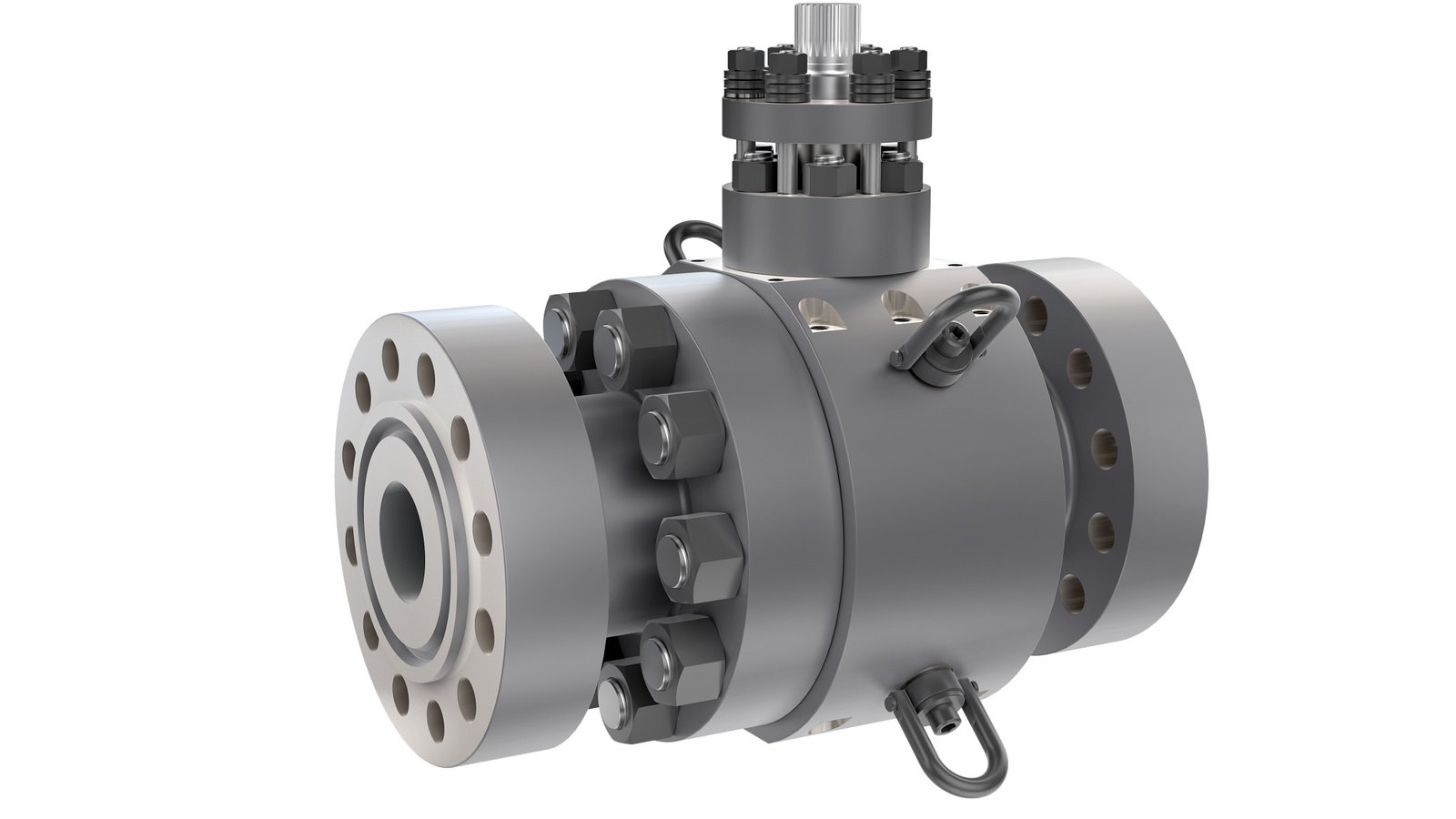
A ball valve for a pressure washer is a quarter-turn shutoff device installed at the discharge side of the pump or at the spray gun base. The best options are rated for 3,000–5,000 PSI minimum, built from plated brass or 304/316 stainless steel, and fitted with PTFE seats for reliable sealing under repeated high-pressure cycling. Size is almost always 3/8″ NPT for residential and light commercial systems, with 1/2″ used in professional trailer rigs.
Table of Contents
What Is a Ball Valve — and Why Does Pressure Washing Demand a Specific Type?
A ball valve controls fluid flow through a hollow, perforated sphere seated inside a valve body. Rotate the handle 90 degrees, the bore aligns with the pipe, and flow is fully open. Rotate it back, and the solid wall of the ball blocks flow completely. Full open or full shut — no partially-open middle state.
That binary behavior is precisely what pressure washing demands. Unlike globe valves, which throttle flow gradually, ball valves offer:
- Instant shutoff — a quarter-turn stops high-velocity flow without pressure surge or cavitation
- Zero restriction when open — a full-bore ball valve preserves the PSI your pump generates, with no pressure drop through the valve body
- Cycle durability — ball valves maintain their seal integrity after thousands of open/close cycles, critical in daily-use commercial systems
Standard gate valves and globe valves are not suitable for high-pressure washing applications. They are designed for low-cycle, low-velocity service. Ball valves — specifically those rated for the PSI of your system — are the correct choice.
Where Ball Valves Fit in a Pressure Washing System
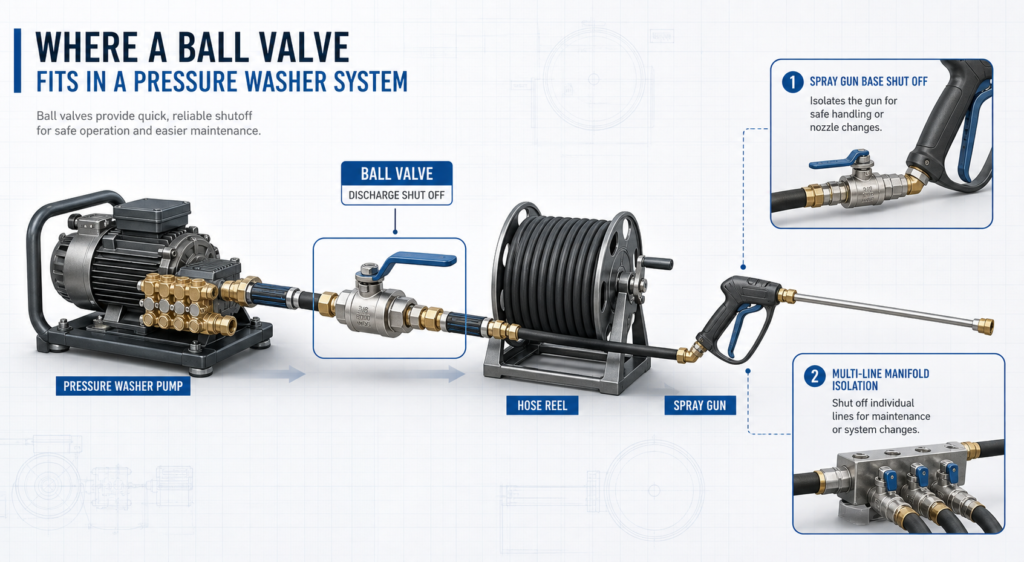
Ball valves appear in at least four positions in a professional pressure washing setup, and each location has different sizing and rating requirements.
1. Discharge-Side Shutoff
The most common position. Installed between the pump outlet and the hose reel, this valve isolates the high-pressure hose without stopping the engine. Essential for swapping guns, connecting chemical injectors, or pausing between tasks on large sites.
2. Spray Gun Base (Field Shutoff)
A compact DN10 (3/8″) or DN15 (1/2″) valve threaded directly at the base of the spray gun. The operator cuts flow while staying in position — no walking back to the machine between passes. Commonly used in professional soft wash and surface cleaning rigs →
3. Chemical Injection / Metering
Three-way ball valves control chemical dosing into the injector port, allowing precise on/off flow of surfactants or bleach without disrupting main water pressure. PVC ball valves are appropriate here — on the downstream, low-pressure chemical side only.
4. Multi-Outlet Manifold Control
On trailer rigs running multiple hose drops, individual ball valves isolate each line. One operator can work while another swaps a nozzle, without affecting system pressure elsewhere. This is where stainless steel body valves earn their keep.
Brass vs. Stainless Steel: Picking the Right Material
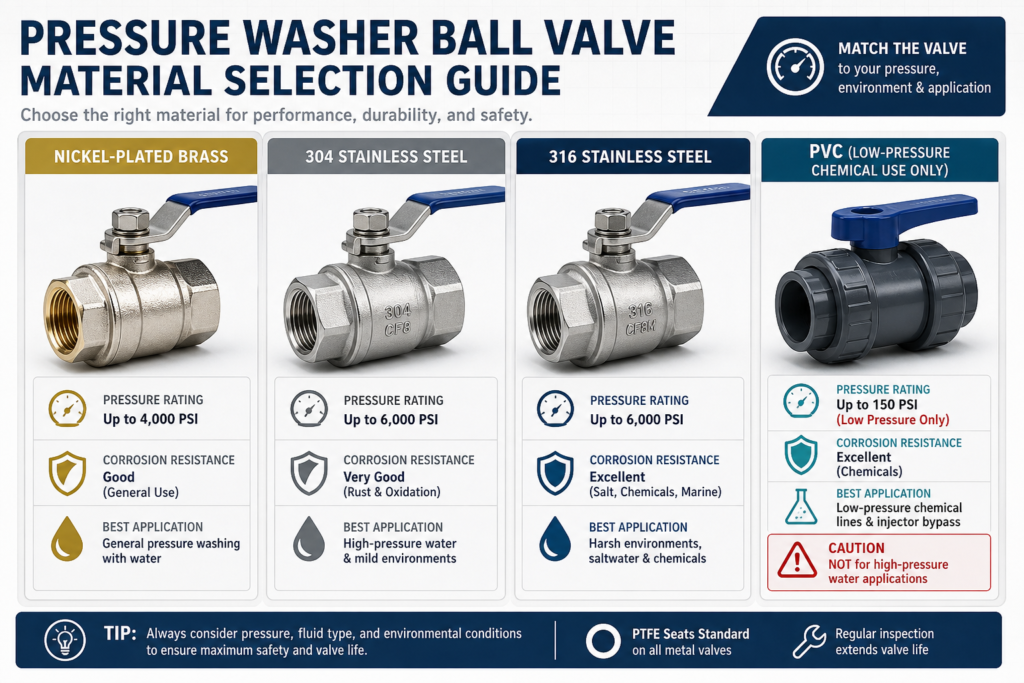
Material is not a preference — it’s a specification. The wrong body material fails under corrosion, chemical exposure, or pressure that exceeds its rating.
| Material | Typical Max PSI | Best Application | Limitations |
|---|---|---|---|
| Nickel-Plated Brass | 3,000–5,000 PSI | Residential, light commercial, spray gun base | Plating degrades with prolonged chemical exposure |
| Stainless 304 | 5,000–6,000 PSI | Commercial rigs, outdoor systems, moderate chemical contact | Not ideal in coastal/salt environments |
| Stainless 316 | 6,000–7,400 PSI | Marine, chemical-heavy soft wash, continuous operation | Higher cost; verify thread compatibility with brass fittings |
| PVC | Under 300 PSI | Chemical tanks, gravity-fed injectors, downstream soft wash | Never use on the high-pressure discharge side |
The practical rule: For most residential and light commercial pressure washers (1,500–3,500 PSI), a quality nickel-plated brass ball valve rated to 4,500–5,000 PSI covers your needs with margin to spare. For continuous-use commercial or industrial systems — especially those using hot water or cleaning chemicals — step up to 304 or 316 stainless.
Industry standard: Operate at no more than 80% of the valve’s rated pressure at working temperature. A valve rated for 5,000 PSI should be used in systems running at 4,000 PSI or below. Pressure spikes from pump startup and water hammer briefly exceed working pressure — that margin is what keeps fittings intact.
The Four Specs You Must Verify Before Buying
Don’t select a ball valve by price or appearance alone. Four numbers define whether a valve is safe and effective in your system:
1. PSI Rating
Must exceed your pump’s maximum output. Check the valve’s rated working pressure — not burst pressure. A 4,500 PSI pump needs a valve rated to at least 5,000–6,000 PSI to operate safely within the 80% margin.
2. Temperature Rating
Hot-water pressure washers typically heat water to 125–158°F (50–70°C). Your valve must be rated above this range. Most quality brass and stainless ball valves with PTFE seats are rated to 158°F minimum — always confirm before purchasing for hot-water applications.
3. Thread Size and Standard
The most common pressure washer size is 3/8″ for residential and light commercial, and 1/2″ for professional trailer rigs. More critically: verify whether you need NPT (American) or BSP (British/European) threads. Many Italian-made brass ball valves — which dominate the professional pressure washing market — use BSP threads. Mixing NPT and BSP causes immediate leaks, no matter how much thread tape you apply.
4. Seat Material
PTFE (polytetrafluoroethylene) seats are standard and required for most pressure washing applications. PTFE provides chemical resistance, low friction, and reliable sealing under high-pressure cycling. Avoid valves with nylon or rubber seats in high-pressure or hot-water applications.
NPT vs. BSP Threads: The Silent Cause of Leaks in the Field
This is the single most overlooked compatibility issue in pressure washing — and the one that generates the most field frustration.
- NPT (National Pipe Taper): American standard. Threads taper, so the connection tightens as you thread in. Dominant in North American-made guns, hose assemblies, and machines.
- BSP (British Standard Pipe): European standard. Parallel threads sealed with a washer or O-ring (BSPP) or tapered threads (BSPT). Common in Italian and European-manufactured ball valves, which are widely sold in the professional pressure washing industry.
NPT and BSP threads have the same pitch at 3/8″ and 1/2″, which means they will start threading together — but they will never seal properly. If you’re sourcing valves from European suppliers or using Italian brass valves at your gun base, confirm the thread standard and use appropriate adapters or thread-seal methods.
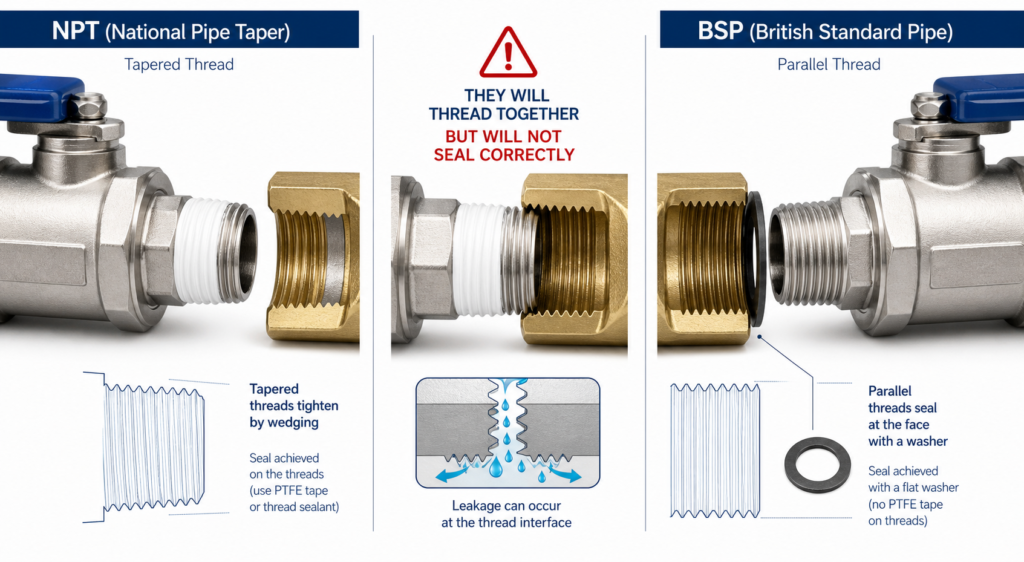
NPT uses tapered threads; BSP typically seals at the face with a washer or O-ring. They may thread together, but they do not seal the same way
How to Install a Ball Valve on a Pressure Washer
Installation is straightforward, but four details determine whether the connection holds under pressure.
Step 1 — Thread Preparation
For NPT connections, apply 6–7 wraps of PTFE thread tape, or 2–3 drops of thread-locking compound. For BSP parallel threads, use a bonded washer or O-ring at the face seal — thread tape alone is insufficient.
Step 2 — Hand-Tighten First
Thread the valve in by hand until snug. Cross-threading at high torque is the most common installation error and the hardest to recover from.
Step 3 — Wrench-Tighten to Spec
Tighten 1–2 additional turns with a wrench. Brass fittings are softer than steel — over-tightening cracks the body or distorts the seat. Firm and secure is the target, not maximum torque.
Step 4 — Pressure Test Before Full Operation
Run the system at low pressure first, check for weeping at the threads and stem, then bring it to operating pressure. A fitting that leaks at 500 PSI will fail at 3,500 PSI.
Step 5 — Orient the Handle Correctly
Make sure the handle position (parallel = open, perpendicular = closed) is visible and accessible in the installed position. A valve that’s hard to reach defeats its purpose.
Common Mistakes — and How to Avoid Them
Using a standard plumbing ball valve rated for 125–250 PSI. Hardware store valves are designed for household water supply at 60–80 PSI. They will fail — sometimes catastrophically — in a pressure washing circuit.
Mixing NPT and BSP threads without adapters. As noted above: they engage, but they won’t seal. This is responsible for a large percentage of “unexplained” leaks in field installations.
Installing a ball valve on a machine and never exercising it. Ball valves that sit in one position for extended periods can develop sticking or seizing — especially in outdoor environments with water mineral deposits. Cycle your valves briefly during each use.
Using PVC valves on the discharge side. PVC is an excellent choice for low-pressure chemical delivery. It is not a pressure-rated valve for any part of the high-pressure circuit, regardless of how a product may be labeled.
Selecting valve size by hose size alone. Your hose inner diameter and your valve bore should match for full-flow performance, but always cross-reference the valve’s Cv (flow coefficient) against your system’s GPM requirement. An undersized bore creates pressure drop that costs you cleaning performance.
Ball Valve Maintenance: Keeping Valves Functional Under Heavy Use
A quality ball valve in a pressure washing system should last years without issue — if maintained properly.
- Flush with clean water after chemical use. Surfactants and bleach solutions left in valve bodies accelerate seat degradation and body corrosion.
- Exercise valves weekly in continuous-use systems. Open and close each valve fully to prevent seat adhesion and keep the stem seal pliable.
- Inspect stem seals annually. A weeping stem is an early warning. Replace the packing before it becomes a full leak under pressure.
- Replace, don’t repair, ball valves that have been overtorqued or impacted. A visibly deformed valve body is a pressure failure waiting to happen. Ball valves are not expensive relative to the cost of pump repair or a safety incident — replace promptly.
Quick Reference: Choosing the Right Ball Valve
| Application | Recommended Spec |
|---|---|
| Residential pressure washer (up to 2,500 PSI) | 3/8″ Nickel-Plated Brass, 3,000+ PSI rated, PTFE seat |
| Light commercial washer (2,500–3,500 PSI) | 3/8″ Brass or 304 SS, 5,000 PSI rated, PTFE seat |
| Professional/contractor rig (3,500–5,000 PSI) | 3/8″–1/2″ 304 Stainless, 6,000 PSI rated, PTFE seat |
| Hot-water system (above 140°F) | Stainless steel body, rated to 175°F+ minimum |
| Chemical injection / soft wash | PVC or 316 SS, downstream side only |
| Marine / coastal environment | 316 Stainless, EPDM or PTFE seals |
Final Word: Spec It Right Once
A ball valve for a pressure washer is a $15–$80 component that protects a $500–$5,000 machine and the people operating it. The failure modes — blown stems, cracked bodies, thread separation under load — are not gradual. They are sudden, messy, and sometimes dangerous.
Spec for your system’s maximum PSI with a safety margin. Match the thread standard to your existing fittings. Choose body material based on your chemical exposure and operating environment. And never use a standard plumbing valve where a pressure-rated one is required.
Get those four decisions right, and the valve will outlast everything else on your rig.

Nickel-plated brass, 304 stainless, 316 stainless, and PVC each belong in different operating conditions. Match the material to pressure, corrosion exposure, and fluid type.
Need Help Specifying a Ball Valve for Your System?
Carter Valves supplies industrial-grade isolation and shutoff valves to contractors, fleet operators, and OEM equipment builders across North America. Whether you’re specifying a single spray gun shutoff or a full manifold assembly for a multi-gun trailer rig, our engineering team will help you match the right valve to your system’s PSI, temperature, and chemical requirements.
→ Browse Carter Valves’ Valve Products
→ Contact Our Specification Team
→ Related: High-Performance Butterfly Valves for Industrial Systems