





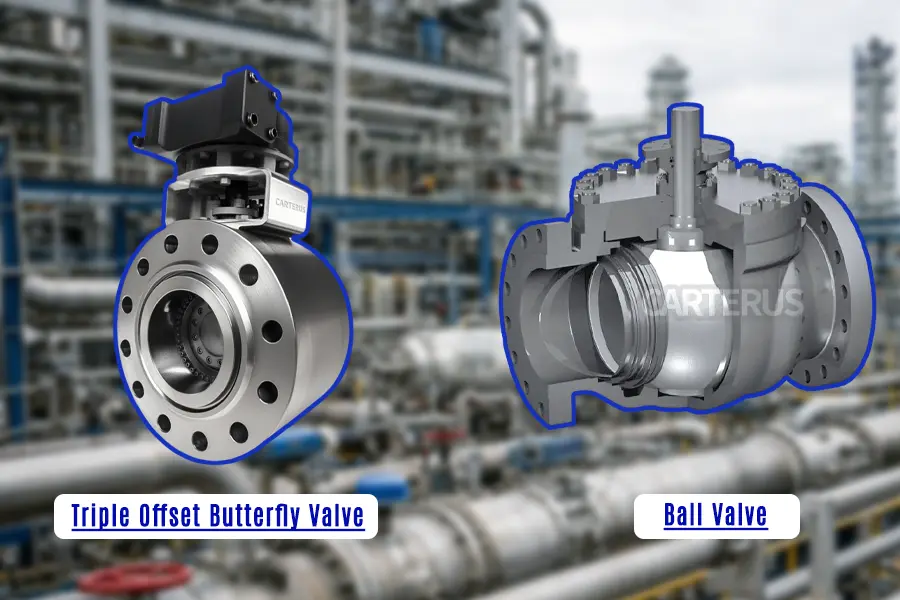
When specifying isolation valves for high-pressure, high-temperature, or critical services, engineers have traditionally defaulted to trunnion-mounted ball valves. The ball valve has long been the industry standard for robust, full-bore isolation. However, over the past two decades, the Triple Offset Butterfly Valve (TOV)—also known as the triple eccentric butterfly valve—has emerged as a formidable alternative, capable of matching the zero-leakage performance of a ball valve while offering significant advantages in weight, footprint, and total cost of ownership.
The decision between a TOV and a ball valve is not a matter of one design being universally superior to the other. Rather, it requires a nuanced understanding of process conditions, space constraints, actuation requirements, and maintenance strategies. This comprehensive engineering guide challenges the assumption that ball valves are always the default choice, providing a rigorous technical comparison to help specifiers select the optimal isolation valve for demanding applications.
Fundamental Design Principles of Triple Offset butterfly Valve vs Ball Valve
To understand where each valve excels, we must first examine their core operating mechanics. While both are quarter-turn rotary valves, their sealing principles are fundamentally different.
The Metal-Seated Trunnion Ball Valve
A trunnion-mounted ball valve relies on a spherical closure element supported by upper and lower shafts (trunnions). This design absorbs the line pressure, preventing the ball from being pushed into the downstream seat, which is a common limitation of floating ball designs [1].
The sealing mechanism in a metal-seated ball valve is friction-based. Spring-loaded seats are constantly pushed against the ball. As the valve opens and closes, the hard-faced ball (often coated with Stellite or Tungsten Carbide) rubs against the seats. This continuous contact provides a self-wiping action that is highly effective at clearing abrasive particulates or slurries from the sealing surface [2].
The Triple Offset Butterfly Valve (TOV)
The TOV represents a radical departure from traditional resilient-seated or double-offset butterfly valves. Its design incorporates three distinct offsets:
- Shaft Offset 1: The shaft is located behind the sealing plane.
- Shaft Offset 2: The shaft is offset from the centerline of the pipe.
- Cone Axis Offset (The Third Offset): The axis of the seat cone is angled away from the valve centerline.
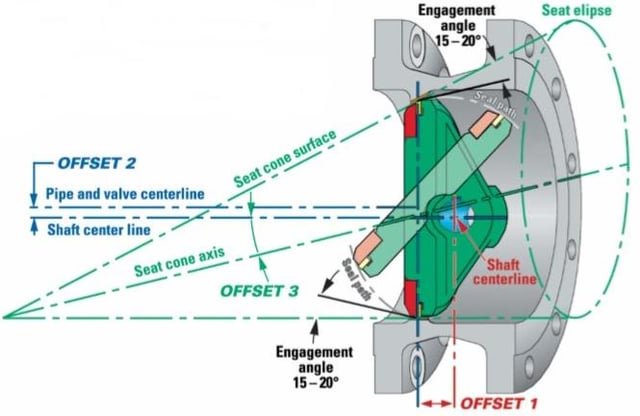
This specific geometry creates a “cone-in-cone” seating profile. As the disc closes, it cams into the seat without any rubbing or friction. Contact between the disc seal ring and the body seat occurs only at the final fraction of a degree of closure [3].
Unlike the ball valve, the TOV is a torque-seated valve. The seal is not achieved by line pressure or spring force, but by the uniform compression of a laminated metal seal ring against the body seat, driven by the torque of the actuator. This friction-free operation eliminates seat wear and galling, ensuring repeatable zero-leakage performance over a prolonged cycle life [4].
Head-to-Head Technical Comparison
When evaluating these two valve types for a specific project, engineers must weigh several critical parameters. The following table summarizes the primary differences.
| Specification Parameter | Trunnion-Mounted Ball Valve (MSBV) | Triple Offset Butterfly Valve (TOV) |
|---|---|---|
| Sealing Principle | Position-seated, friction-based | Torque-seated, friction-free |
| Leakage Class | ANSI/FCI 70-2 Class V or VI | API 598 Zero Leakage (Bidirectional) |
| Flow Path | Full bore (piggable) | Reduced bore (disc in flow stream) |
| Abrasive Media Handling | Excellent (self-wiping action) | Poor (risk of seal ring damage) |
| Throttling Capability | Poor (quick opening characteristic) | Excellent (equal percentage characteristic) |
| Face-to-Face Standard | API 6D / ASME B16.10 (Long) | API 609 (Short / Compact) |
| Weight & Footprint | Heavy and bulky | Lightweight and compact |
1. Weight and Face-to-Face Dimensions
The most striking difference between a TOV and a ball valve is physical size. Ball valves, especially in larger diameters and higher pressure classes (Class 300, 600, and above), require massive cast or forged bodies to contain the ball and withstand pipeline stresses.
According to API 609 (Butterfly Valves) and API 6D (Pipeline Valves) face-to-face dimension standards, a TOV is significantly more compact [5]. For example, a 12-inch Class 300 TOV typically weighs around 80-100 kg. A comparable 12-inch Class 300 trunnion ball valve can weigh upwards of 400 kg [6].
This massive weight reduction translates directly into lower structural support requirements, easier installation, and reduced shipping costs. In offshore platforms, FPSOs, or congested refinery pipe racks where space and weight are at an absolute premium, the TOV is often the only viable choice.
2.Sealing Performance and Leakage Rates
For critical isolation, zero leakage is the ultimate goal. A well-designed TOV, utilizing a laminated stainless steel and graphite seal ring, achieves true bidirectional zero leakage in accordance with API 598 [7]. Because the seal is torque-energized and friction-free, this zero-leakage capability is maintained even after thousands of cycles.
Metal-seated ball valves (MSBVs), due to their friction-based design, are typically rated to ANSI/FCI 70-2 Class V or Class VI [8]. While Class VI is highly stringent, it still permits a measurable, albeit microscopic, allowable leakage rate. For hazardous gases, high-pressure steam, or toxic chemicals where absolute shutoff is mandated, the TOV provides a superior and more reliable seal.
3. Media Suitability: Clean vs. Abrasive
This is the primary dividing line in the selection process. The TOV is a precision instrument. Its laminated seal ring relies on a perfectly smooth, lapped body seat. If the process media contains high levels of abrasive particulates, catalyst fines, or solid slurries, these particles can become trapped between the disc and the seat during closure, scoring the sealing surfaces and destroying the zero-leakage capability.
In contrast, the trunnion ball valve thrives in harsh, abrasive environments. The constant wiping action of the spring-loaded seats against the ball pushes particulates away. Furthermore, the ball and seats are often coated with extremely hard materials like Tungsten Carbide, making them highly resistant to erosion. For fluid catalytic cracking (FCC) slurries, mining tailings, or heavy crude, the MSBV is mandatory.
4. Flow Characteristics and Throttling
Ball valves are primarily on/off isolation devices. They exhibit a “quick-opening” flow characteristic, meaning that a small amount of rotation results in a massive change in flow rate. Attempting to use a standard ball valve for throttling control often leads to severe cavitation, vibration, and rapid seat wear [9].
The TOV, however, offers a semi-linear to equal-percentage flow characteristic. The disc design allows for precise flow control between 20° and 70° of opening. This dual functionality—capable of both precise throttling and zero-leakage isolation—allows engineers to replace two separate valves (a control valve and an isolation block valve) with a single TOV, dramatically reducing piping complexity and costs.
5. Actuation and Torque Requirements
Actuator sizing is a critical component of valve specification. Ball valves suffer from high “breakaway torque.” Because the seats are constantly pressed against the ball, and because the valve may sit in the closed position for months, static friction builds up. When the actuator receives the signal to open, it must overcome this massive initial resistance.
TOVs have significantly lower dynamic torque requirements because they are friction-free during travel. However, because they are torque-seated, they require a high “seating torque” at the very end of the stroke to compress the seal ring and achieve zero leakage [10]. As a rule of thumb, while a TOV generally requires a smaller actuator than a comparable ball valve, the actuator must be carefully sized to deliver maximum torque at the fully closed position (typically utilizing a scotch-yoke pneumatic actuator).
Total Cost of Ownership (TCO)
When evaluating capital expenditure (CAPEX) and operational expenditure (OPEX), the TOV generally presents a compelling financial case, provided the process media is suitable.
- Initial Purchase Cost: A TOV is structurally simpler, uses less raw material, and requires less machining than a trunnion ball valve. In sizes 8-inch and larger, a TOV can be 30% to 50% less expensive than an equivalent MSBV.
- Installation Cost: The lighter weight of the TOV eliminates the need for heavy lifting equipment, extensive pipe supports, and large installation crews.
- Maintenance Cost: Many modern TOVs feature field-replaceable seal rings and seats. If a seal is damaged, it can often be replaced in-line without removing the entire valve body from the piping system. A welded-body or heavily flanged ball valve often requires complete removal and specialized shop repair.
Conclusion: When to Specify Which?
The engineering consensus is clear: the choice between a Triple Offset Butterfly Valve and a Trunnion-Mounted Ball Valve dictates the reliability and safety of the piping system.
Specify a Trunnion-Mounted Ball Valve when:
- The process media contains abrasive solids, slurries, or catalyst fines.
- The pipeline requires regular “pigging” (cleaning devices sent through the pipe), necessitating a full-bore, unobstructed flow path.
- The application involves extremely high pressures (Class 900, 1500, or 2500) where the massive structural integrity of a ball valve is required.
Specify a Triple Offset Butterfly Valve (TOV) when:
- The process media is clean gas, high-pressure steam, refined hydrocarbons, or cryogenic fluids (LNG).
- Absolute, repeatable zero-leakage isolation (API 598) is mandatory.
- Weight and space constraints are critical (e.g., offshore platforms, tight pipe racks).
- The valve must perform both throttling control and tight shutoff duties.
- The pipeline size is 8 inches or larger, where the cost and weight savings of a TOV become exponential.
By understanding the distinct mechanical advantages of each design, piping engineers can move beyond the “ball valve default” and specify the exact isolation technology required to protect uptime, ensure safety, and optimize project budgets.
Reference
[1] Weldon Valves. (2024). Floating Ball Valve vs. Trunnion Ball Valve: A Comprehensive Comparison.
[2] JH Valve. (2025). Triple Offset Butterfly Valve vs. Metal-Seated Ball Valve: A Selection Guide.
[3] QRC Valves. Triple Offset Butterfly Valve – Benefits, Drawing, vs Other Offsets.
[4] Emerson. Virgo Triple Offset Valve Applications Guide.
[5] Global Supply Line. EN 558-1-2017 Valve Face to Face End to End Dimension Comparison.
[6] TOT Valve. Ball Valve vs Butterfly Valve: Engineering Selection Guide.
[7] Value Valves. (2019). Why Choose Triple Offset Valve Over Ball Valves?
[8] Athena Valve. (2025). Why Triple Eccentric Butterfly Valves Stand Out in Fluid Control.
[9] FS Welsford. (2025). Ball Valve vs. Butterfly Valve – A Deeper Look At Pros & Cons.
[10] Eng-Tips Engineering Forums. (2009). Ball Valves versus Triple Offset Butterfly.