





In many projects, the butterfly valve is chosen because it is compact and fast, yet teams still see issues such as unstable shutoff, premature seat wear, or torque that does not match the actuator. Those problems usually come from a mismatch between how the valve works and the actual service conditions—pressure, temperature, media, cycling rate, and required tightness.
Short answer (featured snippet):
A butterfly valve controls flow with a circular disc mounted on a shaft inside the pipe. Turning the shaft 90 degrees rotates the disc from fully open (parallel to the flow) to fully closed (perpendicular). In the open position, the disc offers low resistance; in the closed position, the disc presses against a seat to block flow. Different geometries—concentric, double offset (high performance), triple offset, and multi-eccentric designs—change how the disc approaches the seat, which affects sealing behavior, wear, torque, and suitability for severe services.
The Basic Principle of Operation
Een vlinderklep is een quarter-turn valve. Rotation of the stem moves a disc that sits in the flow path:
- Open: Disc is aligned with the pipe axis; flow passes with minimal obstruction.
- Throttling: Partial rotation reduces the open area and controls flow.
- Closed: Disc rotates to press against a seat, forming a seal.
Because the travel is only 90 degrees, response is fast and the actuator can be compact compared with multi-turn valves.
Key Components (What Each Part Does)
- Body: The pressure-containing shell installed between flanges or as a lug/wafer design.
- Disc: The rotating closure element that modulates or stops flow.
- Stem/Shaft: Transmits torque from the actuator or handle to the disc.
- Seat: Provides the sealing surface (resilient or metal-to-metal, depending on design).
- Actuator/Operator: Manual gear, electric, or pneumatic device that rotates the stem.
Further discussion of flow-induced wear mechanisms can be found here.
Disc Angle, Flow Pattern, and Local Erosion Risk
In throttling or part-open operation, the disc angle strongly influences local flow patterns. At small opening angles, butterfly valves can generate high-velocity jets, asymmetric vortices, and localized turbulence. In services with solids, droplets, or flashing media, these effects may accelerate erosion on the disc edge, seat area, or downstream pipe wall.
What to verify in real projects:
- Whether the valve will operate frequently in a partially open position rather than fully open/closed
- The presence of catalyst fines, molecular sieve dust, or other abrasive particles
- Acceptable noise and vibration limits for the piping system
- Whether a characterized disc or alternative control valve type is required for continuous throttling duty
Why Geometry Matters: Concentric vs. Offset Designs
The way the disc approaches the seat determines friction, wear, and sealing behavior.
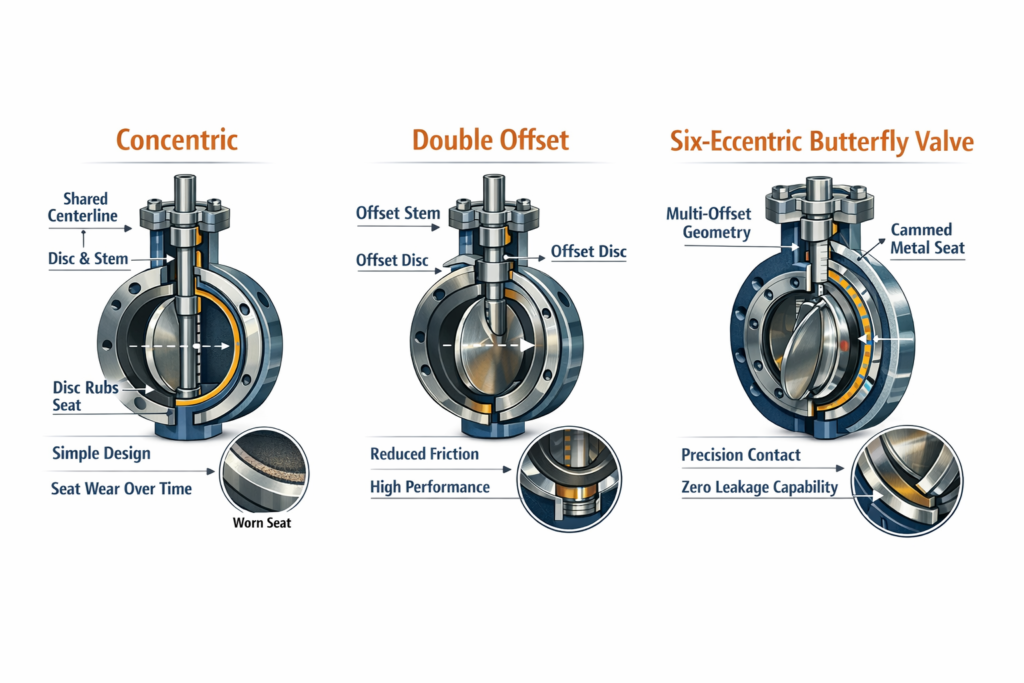
Concentric (Resilient-Seated)
- Disc and stem share the same centerline as the pipe.
- The disc rubs the seat during most of the closing stroke.
- Simple and economical for clean, moderate conditions.
- Seat life and tightness depend heavily on material compatibility and cycling.
Double Offset (High Performance Butterfly Valve)
- The stem is offset from the disc centerline and from the pipe centerline.
- The disc cams away from the seat early in the opening stroke, reducing rubbing.
- Commonly used with reinforced seats for higher pressure/temperature than concentric designs.
Drievoudige offset
- Adds a third offset via a conical sealing geometry.
- The disc engages the seat in a cam-like, torque-seated motion at the very end of travel.
- Enables metal-to-metal sealing with minimal sliding, suitable for higher temperatures and demanding isolation duties.
Multi-Eccentric (e.g., Zes-excentrisch)
- Extends the same cam-seated principle with additional geometric offsets.
- The intent is to further control contact stress, engagement angle, and sealing stability under severe service.
- Often considered where predictable shutoff behavior, controlled sealing contact, and mechanical stability are required (for example, in high-temperature FCCU service or cryogenic LNG isolation—subject to project verification).
How the Valve Seals: Two Common Concepts
- Resilient Seat: Elastomer or polymer provides line contact and tight shutoff at low torque. Verify chemical compatibility and temperature limits for the specific media.
- Metal-to-Metal Seat: Sealing relies on controlled contact between metal surfaces. Tightness depends on machining, alignment, and closing torque; performance must be verified by the applicable test method and acceptance criteria for the project.
Note on “zero leakage”: Claims of zero leakage are meaningful only when tied to a defined test standard, pressure class, temperature, and acceptance criterion. Always confirm the required test conditions and documentation.More reading about zero leakage.
Decision Table: Choosing the Right Butterfly Valve Type
| Service Need / Constraint | Concentric (Resilient) | High Performance (Double Offset) | Drievoudige offset | Six-Eccentric / Multi-Eccentric |
|---|---|---|---|---|
| Typical duty | On/off, light throttling | Higher pressure/temperature isolation and control | Severe isolation, higher temperature | Severe service with controlled sealing behavior |
| Seat interaction | Continuous rubbing | Reduced rubbing | Cam-seated, minimal sliding | Cam-seated with enhanced control of engagement |
| Sealing type | Soft seat | Soft or composite seat | Usually metal-to-metal | Often metal-to-metal or engineered sealing |
| Wear management | Seat wear depends on cycles/media | Improved vs. concentric | Lower sliding wear | Designed to stabilize contact and wear |
| What to verify | Media compatibility, temp limits | Pressure/temperature rating, torque | Test standard, acceptance class, torque | Test method, acceptance class, service stability |
This table is a selection aid. Final suitability must be confirmed against project pressure, temperature, media, cycling, and required test criteria.Temperature and pressure test requirements are typically defined in project specifications and industry standards published by organizations such as ASME en API.
Actuation and Control: What Actually Turns the Disc
- Manual gear or lever: Simple and reliable for infrequent operation.
- Pneumatic actuator: Common for fast, fail-safe on/off duties.
- Electric actuator: Used where precise positioning or integration with control systems is required.
What to verify: required operating torque across the full pressure/temperature range, safety factors, and whether the actuator sizing accounts for worst-case conditions (e.g., cold start, fouled seat).
Installation and Operation Considerations
- Orientation: Some services benefit from installing the shaft horizontal to reduce sediment load on the seat; confirm with the process conditions.
- Piping alignment: Misalignment increases stem and seat stress and degrades sealing.
- Commissioning: Stroke limits and position feedback must be set so the disc fully clears the seat in open position and achieves full seating torque in closed position.
Commissioning Checklist (Practical)
- [ ] Verify valve type matches service (pressure, temperature, media, cycling).
- [ ] Confirm actuator sizing and fail position against worst-case torque.
- [ ] Check flange alignment and gasket selection.
- [ ] Set and test open/close travel stops.
- [ ] Perform the specified seat leakage test per project requirement.
When Specifications Depend on the Project: What to Verify
- Test method and acceptance criteria for seat leakage (do not rely on generic claims).
- Pressure and temperature envelope across all operating and upset conditions.
- Media characteristics: solids, coking tendency, cryogenic service, or corrosiveness.
- Cycle life expectations and maintenance strategy.
- Documentation and service support needed for the site (drawings, ITPs, spare parts, response time).
Where Engineered Designs Fit
Engineered butterfly valves—such as high performance, triple offset, and six-eccentric designs—are typically specified where predictable shutoff behavior, controlled sealing contact, and mechanical stability are required. Examples can include molecular sieve service, high-temperature FCCU isolation, or cryogenic LNG duties, provided the final selection is verified against the project’s defined test and operating conditions. Local manufacturing and service capability can reduce lead time and improve response for commissioning and maintenance, which is a practical risk-reduction factor for many projects.
Conclusion and Next Steps
If you want a selection check, share your service conditions—media, pressure, temperature, cycle rate, and required leakage criteria. An engineering review can quickly confirm whether a concentric, high-performance, triple-offset, or six-eccentric configuration is the right fit for your application.
For project-specific questions, technical clarification, or documentation requirements, you can contact our engineering team to discuss your operating conditions and specification needs. A brief discussion at the early stage often helps avoid mismatches in sealing performance, torque margins, and long-term reliability.