





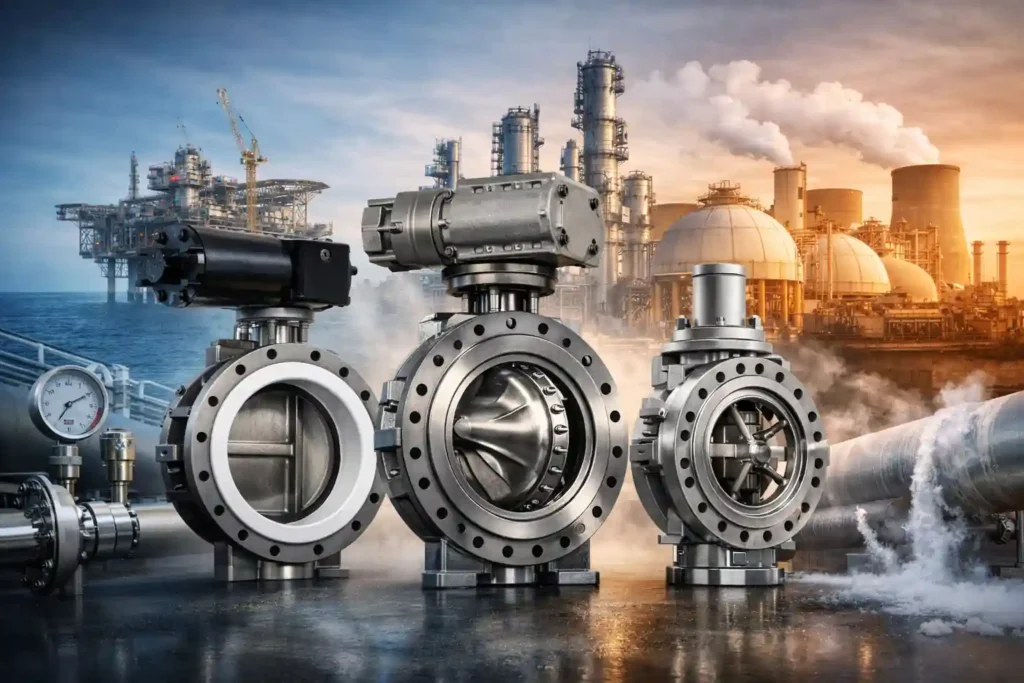
Vlinderkleppen zijn te vinden in vrijwel elke sector van de industriële verwerking, van HVAC-systemen in gebouwen tot offshore olieplatforms. Toch dekt de term “vlinderklep” een breed scala aan technische concepten die aanzienlijk verschillen in afdichtingsmechanisme, druk- en temperatuurcapaciteit en slijtagegedrag op lange termijn. Binnen deze brede familie zijn de vlinderklep met hoge prestaties (HPBV) neemt een kritieke middenpositie in: hij levert een strakkere afsluiting en een langere levensduur dan standaard ontwerpen met een veerkrachtige zitting, terwijl hij compacter en kosteneffectiever blijft dan een kogelafsluiter met volledige doorlaat voor veel isolatietaken.
Dit artikel legt uit wat een vlinderklep “high performance” maakt, hoe de belangrijkste types verschillen in ontwerp en toepassing, welke industrienormen hun specificatie bepalen en hoe je beslist wanneer een HPBV - of een meer geavanceerde variant - de juiste keuze is voor jouw project. Voor een breder overzicht van vlinderklepcategorieën, zie onze gids voor soorten vlinderkleppen.
1. Wat definieert een “High Performance” vlinderklep?
De term vlinderklep met hoge prestaties verwijst niet naar één product, maar naar een categorie vlinderklepontwerpen die verder gaan dan de mogelijkheden van standaard concentrische kleppen met een veerkrachtige zitting. In de industrie wordt algemeen aangenomen dat een HPBV het volgende biedt:
- Hogere druk mogelijk - gewoonlijk berekend op ASME-klasse 150 of klasse 300 (PN25/PN40), vergeleken met klasse 125/150 voor standaardontwerpen
- Hogere temperatuurtolerantie - tot 260°C (500°F) voor varianten met PTFE-afdichting en veel verder voor configuraties met metalen afdichting
- Minder slijtage van de stoel - Bereikt door offset schijfgeometrie die continu wrijvingscontact tussen schijf en zitting elimineert
- Strengere, herhaalbare afsluiting - met geverifieerde lekkage volgens API 598- of ISO 5208-normen
- Geschikt voor veeleisende media - waaronder stoom, koolwaterstoffen, bijtende chemicaliën en schurende slurries
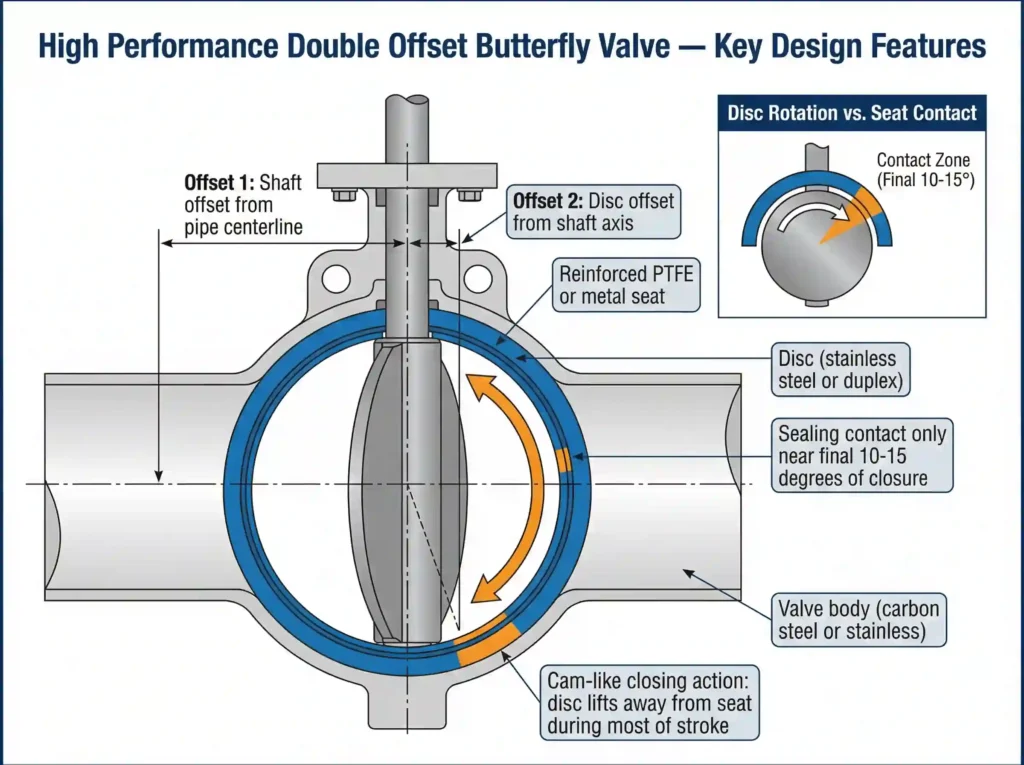
Het belangrijkste technische onderscheid is offsetgeometrie. In een standaard concentrische klep draait de schijf om een as die door het midden loopt en schuurt de schijfrand tegen de zitting gedurende de volledige slag van 90°. Deze voortdurende wrijving is aanvaardbaar in water- of HVAC-services met lage druk en lage cycli, maar wordt een voorspelbaar storingsmechanisme in meer veeleisende omstandigheden. Hoogwaardige ontwerpen maken gebruik van een of meer geometrische offsets om een nokachtige sluitbeweging te creëren, zodat de schijf alleen bij de laatste sluitgraden in contact komt met de zitting.
Om te begrijpen hoe dit in de praktijk werkt, lees je ons artikel over hoe een vlinderklep werkt biedt een nuttige basis voordat we in de onderstaande concepten van offsetgeometrie duiken.
2. De vier hoofdtypen vlinderkleppen
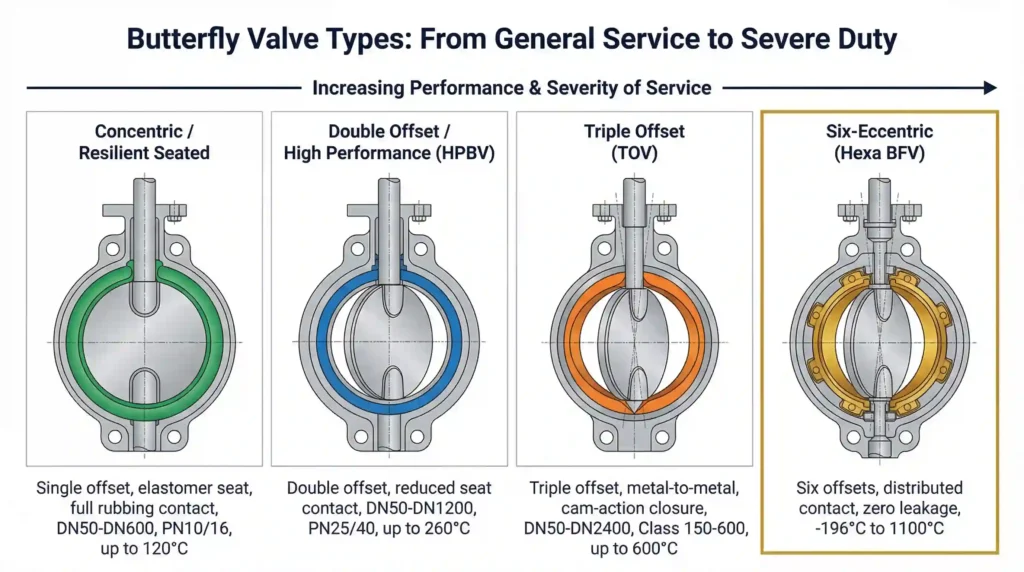
De vlinderklepfamilie kan worden gezien als een opeenvolging van steeds geavanceerdere offsetgeometrieën, die elk de beperkingen van het vorige ontwerp aanpakken. Het diagram in figuur 1 illustreert deze progressie visueel.
2.1 Vlinderklep met concentrische / veerkrachtige zitting
Het eenvoudigste en meest voorkomende type. De as van de schijf loopt precies door het midden van de schijf en de hartlijn van de pijp. Een rubberen of EPDM elastomeer zitting zorgt voor de afdichting door elastische compressie. Deze kleppen zijn goedkoop, compact en worden veel gebruikt in waterbehandeling, HVAC en algemene nutsvoorzieningen. De continue wrijving tussen de schijf en de zitting beperkt het gebruik echter tot matige drukken (PN10/16), temperaturen onder ongeveer 120°C en media die compatibel zijn met elastomeren.
2.2 Dubbele offset / vlinderklep met hoge prestaties (HPBV)
De dubbele offset ontwerp introduceert twee geometrische offsets: de as is verschoven ten opzichte van de middellijn van de schijf en de middellijn van de schijf is verschoven ten opzichte van de middellijn van de buis. Samen zorgen deze offsets voor een cam-achtige werking tijdens het sluiten - de schijf komt tijdens het grootste deel van de slag los van de zitting en maakt alleen contact in de laatste 10-15° rotatie. Dit vermindert drastisch de slijtage van de zitting, verlaagt het bedrijfskoppel en verlengt de levensduur.
HPBV's met dubbele offset gebruiken meestal versterkte PTFE-, RPTFE- of gelamineerde zittingen en zijn geschikt voor temperaturen tot 260 °C en drukken tot klasse 300. Ze zijn de standaardkeuze voor chemische processen, hulpsystemen voor energieopwekking en olie- en gasleidingen. Carter kleppen’ Hoge prestatie dubbele offset vlinderklep (CVS-250) dekt DN80-DN800 (3″-32″), klasse 150/300, met een API 607 brandveilige optie beschikbaar voor koolwaterstofdiensten.
2.3 Drievoudige offset vlinderklep (TOV)
De drievoudige offset Het ontwerp voegt een derde offset toe: de kegelas van de zitting is gekanteld ten opzichte van de asas, waardoor een conische zittinggeometrie ontstaat. Hierdoor nadert de schijf de zitting langs een echt nokpad zonder enig glijcontact - afdichting vindt puur plaats door compressie bij de uiteindelijke sluitingshoek. Triple offset kleppen zijn inherent geschikt voor metaal-op-metaal passing, waardoor ze kunnen werken bij temperaturen tot 600°C en drukken tot Klasse 600 of hoger.
Het nadeel is dat het afdichtingscontact geconcentreerd is in een smalle strook op het conische oppervlak van de zitting. Dit zorgt weliswaar voor een uitstekende initiële afsluiting, maar de slijtage concentreert zich ook in dezelfde zone, wat kan leiden tot een relatief abrupte verslechtering van de afdichtingsprestaties na langdurig gebruik. Voor een gedetailleerde technische vergelijking van drievoudige offset en meer geavanceerde ontwerpen, zie ons artikel over zes-excentrische vs drievoudige offset vlinderklep: wat is het echte verschil in afdichting en slijtage?
2.4 Zes-excentrische vlinderklep
De zes-excentrisch Het ontwerp - het gepatenteerde Hexa-platform van Carter Valves - bouwt voort op het principe van de drievoudige offset door extra geometrische excentriciteiten te introduceren die het contactpad tussen schijf en zitting een nieuwe vorm geven. In plaats van de afdichtingsbelasting te concentreren in één smalle band, verdeelt de zes excentrische geometrie de contactspanning gelijkmatiger over het zittingoppervlak, wat resulteert in een stabieler afdichtingsgedrag op lange termijn en een langzamer slijtageproces.
De Carter Hexa reeks bestrijkt een uitzonderlijk werkgebied: -196 °C tot 1.100 °C, met toleranties op het afdichtingsoppervlak van 0,01 mm en een oppervlakteruwheid van Ra 0,156 µm. Dit maakt de klep geschikt voor toepassingen waar triple offset kleppen hun limieten bereiken, waaronder FCCU isolatie bij hoge temperaturen, cryogene LNG-services en moleculaire zeefschakeling. De Volgende generatie zes-excentrische vlinderklep (CVS-290) en de Cryogene vlinderklep met zes excenters (CVS-290C) vertegenwoordigen de huidige stand van de techniek in deze categorie.
3. Belangrijkste industrienormen voor HPBV's
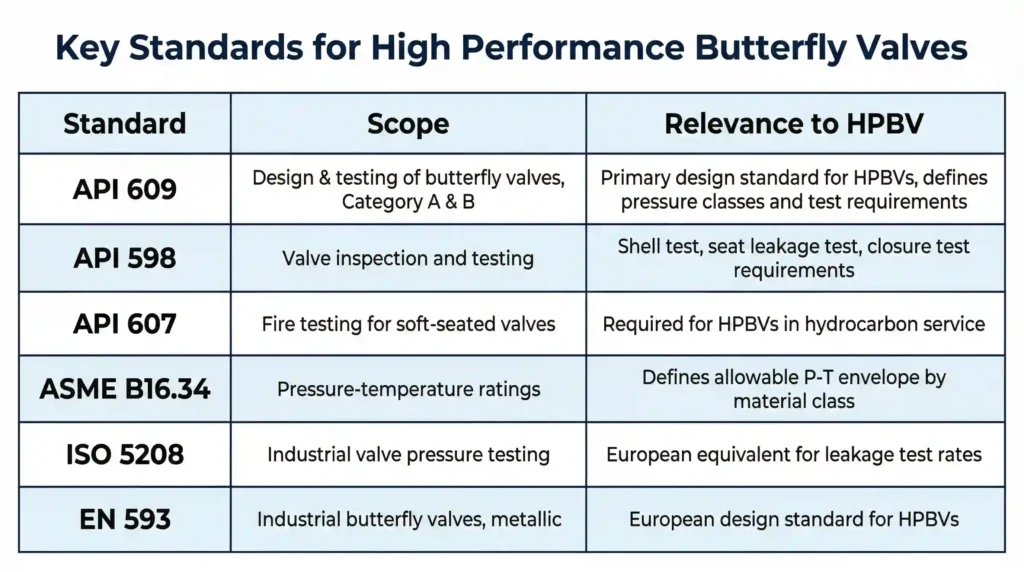
Om een HPBV correct te kunnen specificeren, moet je bekend zijn met de normen die ontwerpvereisten, druk-temperatuurwaarden en acceptatietests definiëren. De tabel in Figuur 3 vat de belangrijkste normen samen; de paragrafen hieronder leggen hun praktische betekenis uit.
| Standaard | Volledige titel | Belangrijkste relevantie |
|---|---|---|
| API 609 | Vlinderkleppen: Dubbele flens, Lug- en Wafer-type | Primaire ontwerp- en testnorm voor HPBV's; definieert Categorie A (concentrisch) en Categorie B (offset) ontwerpen |
| API 598 | Inspectie en testen van kleppen | Definieert vereisten voor de shell-test, de lektest van de zitting en de sluitingstest voor alle afsluitertypes. |
| API 607 | Brandtest voor kwartslagkleppen en kleppen uitgerust met niet-metalen zittingen | Vereist voor HPBV's geïnstalleerd in koolwaterstofleidingen waar brandveiligheid verplicht is |
| ASME B16.34 | Kleppen - flens, schroefdraad en laseinden | Definieert toegestane druk-temperatuurwaarden per materiaalklasse |
| ISO 5208 | Industriële afsluiters - Druktests van metalen afsluiters | Europees equivalent voor lekkagetests; definieert lekkageklassen van Rate A tot Rate D |
| NL 593 | Industriële kleppen - Metalen vlinderkleppen | Europese ontwerpnorm voor vlinderkleppen, inclusief hoogwaardige types |
3.1 API 609: de primaire ontwerpnorm
API 609 is de meest gebruikte norm voor vlinderkleppen in industriële toepassingen. Er wordt onderscheid gemaakt tussen Categorie A kleppen (concentrisch, met veerkrachtige zitting, voor algemeen gebruik bij lagere druk) en Categorie B afsluiters (offset ontwerpen, voor hogere druk en hogere temperatuur). De meeste HPBV's zijn Categorie B ventielen onder API 609.
De norm definieert ontwerpvereisten voor de wanddikte van de behuizing, de grootte van de schacht, de retentie van de zitting en de afmetingen van het uiteinde. De norm specificeert ook de testvereisten waaraan moet worden voldaan voordat een klep als conform kan worden gecertificeerd, inclusief hydrostatische tests van de behuizing en lektesten van de zitting op gedefinieerde drukniveaus.
3.2 API 607: Brandveiligheidscertificering
Voor HPBV's geïnstalleerd in olie- en gasinstallaties, raffinaderijen of elke locatie waar koolwaterstofbranden een geloofwaardig risico vormen, API 607 Een brandveilige certificering wordt meestal vereist door projectspecificaties. Deze norm test of een afsluiter na blootstelling aan een gedefinieerde brandconditie acceptabele leksnelheden kan handhaven, zodat wordt gegarandeerd dat de afsluiter geen bron wordt van ongecontroleerde lekkage van koolwaterstoffen tijdens een brand.
De CVS-250 HPBV met dubbele offset van Carter Valves is verkrijgbaar met een API 607 brandveilige configuratie. Voor ontwerpen met metalen afdichtingen, zoals de Hexa serie, biedt de inherente metaal-op-metaalafdichting een extra laag van brandwerendheid.
3.3 Lekkageklassen: ISO 5208 en API 598
Beide ISO 5208 en API 598 definiëren acceptabele lekkagesnelheden voor het testen van klepzittingen, maar ze gebruiken verschillende classificatiesystemen. ISO 5208 definieert leksnelheden van Rate A (nul meetbare lekkage) tot Rate D en verder, terwijl API 598 lekwaarden in druppels per minuut of bellen per minuut specificeert, afhankelijk van de grootte van de klep en het type zitting.
Voor kritieke isolatietaken, zoals moleculaire zeefschakeling, LNG-blokkleppen of FCCU-isolatie. lekvrij (ISO 5208 klasse A of gelijkwaardig aan API 598 klasse VI) wordt meestal gespecificeerd. Dit is een van de belangrijkste redenen om HPBV's met metalen afdichting te verkiezen boven ontwerpen met zachte afdichting. Het Hexa-platform van Carter Valves is ontworpen en getest om verifieerbare nullekkage te bereiken, ondersteund door de 0,01 mm tolerantie van het afdichtingsoppervlak en Ra 0,156 µm oppervlakteafwerking. Voor meer informatie over wat nullekkage in de praktijk betekent, zie ons artikel over bidirectionele nullekkage: wat het betekent en waarom het belangrijk is bij zware service.
4. Typische toepassingen voor vlinderkleppen met hoge prestaties
HPBV's zijn de werkpaarden van de middelzware tot zware isolatie in een groot aantal industrieën. De keuze van het juiste type HPBV - dubbel offset, drievoudig offset of zes excentrisch - hangt af van de specifieke bedrijfsomstandigheden van elke toepassing.
4.1 Olie en gas
In upstream en midstream olie- en gasfaciliteiten worden HPBV's gebruikt voor pijplijnisolatie, pigvalkleppen, spruitstukblokkleppen en isolatie van nutsvoorzieningen. De combinatie van compacte face-to-face afmetingen, hoge drukwaarden en brandveilige certificering maakt ze tot een geprefereerd alternatief voor full-bore kogelkleppen in vele niet-pigging toepassingen. Ontdek de oplossingen van Carter Valves voor de olie- en gassector.
4.2 Raffinage en petrochemie
Raffinaderijtoepassingen stellen enkele van de meest veeleisende eisen aan isolatiekleppen. Diensten bij hoge temperaturen zoals FCCU (Fluid Catalytic Cracking Unit) regeneratorisolatie, moleculaire zeef schakelkleppen, en blokkeerkleppen voor verkooksers vereisen HPBV's met metalen afdichting die na duizenden thermische cycli nog steeds geen lekkage vertonen. Het Hexa-platform met zes centra is speciaal ontwikkeld om aan deze zware eisen te voldoen. Voor toepassingen in chemische processen, zie onze oplossingen voor chemische procesbeheersing.
4.3 Energieopwekking
Stoomisolatie, turbine bypass en ketelvoedingswatersystemen in elektriciteitscentrales vereisen HPBV's die geschikt zijn voor stoom onder hoge druk. De combinatie van een hoge temperatuurcapaciteit, een laag bedrijfskoppel (belangrijk voor de dimensionering van de actuator) en een betrouwbare afsluiting na lange perioden van inactiviteit maakt HPBV's met metalen zitting de keuze bij uitstek voor kritische isolatietaken in energiecentrales. Bekijk onze energie- en energietoepassingen pagina voor meer informatie.
4.4 LNG en cryogene service
Cryogene toepassingen brengen unieke uitdagingen met zich mee: materialen krimpen bij lage temperaturen, spelingen verschuiven en afdichtingsgeometrieën die ontworpen zijn voor omgevingstemperatuur presteren mogelijk niet zoals bedoeld bij -196°C. De Carter Cryogenic zes-excentrische vlinderklep (CVS-290C) is speciaal ontworpen voor LNG, vloeibare stikstof en andere cryogene toepassingen, met uitgebreide bovendeel-/stangopties om de pakking in een beheersbare temperatuurzone te houden en materiaalkeuzes die zijn geoptimaliseerd voor bestandheid tegen cryogene slijtage.
4.5 Scheepvaart en scheepsbouw
Offshore platforms, FPSO's en LNG-tankers vereisen afsluiters die compacte afmetingen, hoge betrouwbaarheid en weerstand tegen corrosie combineren. HPBV's in duplex roestvast staal of super duplex, met de juiste oppervlaktebehandelingen, worden op grote schaal gespecificeerd voor zeewaterkoeling, ballast en procesisolatie op scheepsinstallaties. Meer informatie over Carter Valves’ mariene en scheepsbouwoplossingen.
5. Wanneer een HPBV specificeren: een praktisch selectiekader
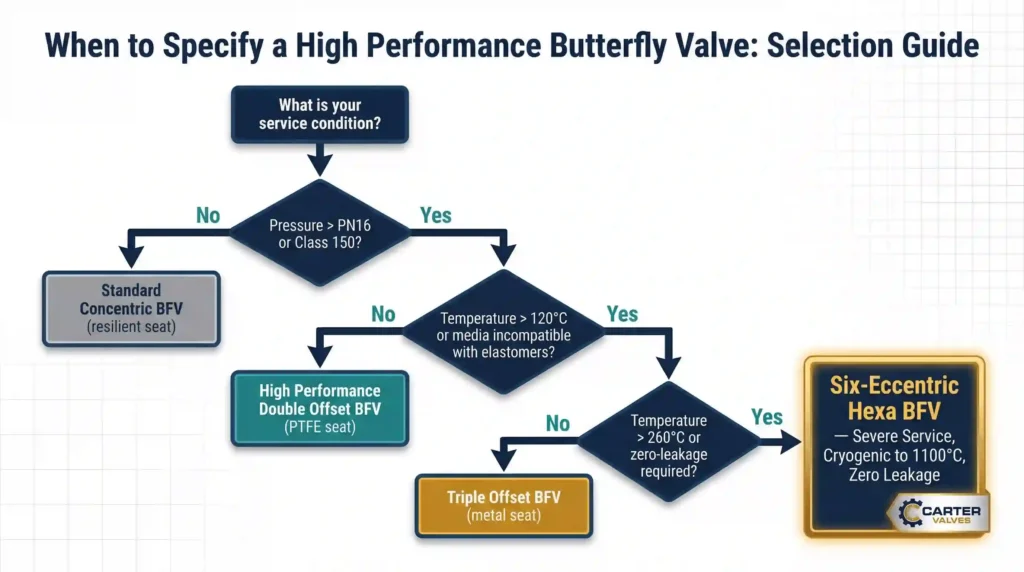
Het stroomschema in Afbeelding 4 biedt een praktisch startpunt voor de keuze van het type afsluiter. De volgende vragen helpen om de keuze verder te verfijnen.
Is de werkdruk hoger dan PN16 / Klasse 125?
Zo ja, dan is een standaard concentrische klep met veerzitting waarschijnlijk niet geschikt. Kies voor een HPBV met dubbele offset als minimumspecificatie.
Is de temperatuur hoger dan 120°C of is het medium onverenigbaar met elastomeren?
Elastomeer zittingen (EPDM, NBR, BUNA-N) degraderen snel boven ongeveer 120°C en zijn ongeschikt voor koolwaterstoffen, oplosmiddelen en veel chemische media. Een HPBV met dubbele offset en een versterkte PTFE of gelamineerde zitting breidt het werkingsgebied uit tot ongeveer 260°C en dekt een veel breder scala aan media.
Is er geen lekkage vereist of is de temperatuur hoger dan 260°C?
Op dit punt is een ontwerp met een metaal-op-metaal zitting nodig. Drievoudige offsetafsluiters dekken het grootste deel van dit bereik effectief af. Voor toepassingen boven 600°C of toepassingen waarbij een lekvrij ontwerp gedurende duizenden cycli met minimaal onderhoud moet worden gehandhaafd, biedt het Hexa-platform met zes excenters de meest robuuste oplossing.
Is de service cyclisch, schurend of onderhevig aan thermische schokken?
Deze omstandigheden versnellen de slijtage in elk klepontwerp. Het gedistribueerde contactpad van de zes-excentrische geometrie is specifiek ontworpen om slijtage te vertragen bij cyclische en thermisch veeleisende services, waardoor de onderhoudsintervallen worden verlengd en de levenscycluskosten worden verlaagd.
Voor een gedetailleerde vergelijking van hoe deze overwegingen van toepassing zijn op de keuze van vlinderkleppen voor kritische isolatietaken, zie ons artikel over vlinderklepselectie voor kritische isolatie.
6. HPBV vs. kogelkraan: Wanneer wint de vlinder?
Een veel voorkomende vraag bij de keuze van afsluiters is of er een vlinderklep met hoge prestaties of een kogelkraan gebruikt moet worden voor een bepaalde isolatietaak. Het antwoord hangt af van verschillende factoren:
| Factor | HPBV Voordeel | Voordeel kogelkraan |
|---|---|---|
| Lengte face-to-face | Veel korter (wafer of lug type) | Langer, vooral in grotere maten |
| Gewicht | Aanzienlijk lichter in grote maten | Zwaarder in grote maten |
| Kosten (grote diameters) | Zuiniger boven DN300 | Zuiniger onder DN150 |
| Varkenscompatibiliteit | Niet geschikt (schijf belemmert het boorgat) | Kogelkraan met volledige doorlaat vereist |
| Throttling mogelijkheid | Beperkt (niet aanbevolen voor controle) | Niet geschikt voor smoren |
| Brandveiligheidscertificering | Beschikbaar (API 607) | Beschikbaar |
| Cryogene service | Geschikt (met correct ontwerp) | Geschikt |
| Koppel bij grote maten | Lager dan gelijkwaardige kogelkraan | Hoger bij grote maten |
In het algemeen gaan HPBV's steeds meer concurreren met kogelkleppen naarmate de pijpdiameter toeneemt. Boven DN300 (12″) zijn het gewicht en de kostenvoordelen van een vlinderklep vaak doorslaggevend, op voorwaarde dat de toepassing geen piggertoegang of smoorklepregeling vereist.
7. Overwegingen voor de dimensionering van de actuator voor HPBV's
Een van de praktische voordelen van offset vlinderkleppen is hun relatief lage bedieningskoppel in vergelijking met zowel concentrische vlinderkleppen als kogelkleppen van gelijke grootte. De nokachtige sluitactie vermindert wrijving en de afwezigheid van continue wrijving over de zitting betekent dat het losbreekkoppel - het koppel dat nodig is om beweging vanuit de gesloten positie te initiëren - voorspelbaarder en lager is dan bij veerkrachtige ontwerpen.
Het dimensioneren van de actuator voor HPBV's is echter niet simpelweg een kwestie van het aflezen van een koppeltabel. Belangrijke factoren zijn onder andere drukverschil bij sluiting, de stroomrichting ten opzichte van de schijforiëntatie, temperatuureffecten op de wrijving van de zitting en de vereiste veiligheidsfactor voor de actuator. Zie voor een gedetailleerde behandeling van deze overwegingen ons technische artikel over dimensionering van de actuator voor vlinderkleppen: losbreekkoppel, veiligheidsfactoren en veelgemaakte fouten.
Carter Valves levert een volledig assortiment bedieningsopties voor zijn HPBV-producten, waaronder pneumatische membraanaandrijvingen, elektrische actuators van industriële kwaliteit, en slimme elektrische actuators met geïntegreerde klepstandsteller en diagnosefunctie.
8. Het HPBV-productassortiment van Carter Valves
Carter Valves produceert een compleet assortiment vlinderkleppen met hoge prestaties, van standaard ontwerpen met dubbele offset voor algemene industriële toepassingen tot het gepatenteerde Hexa-platform met zes excentrische vlinderkleppen voor de meest veeleisende toepassingen voor zware toepassingen.
| Product | Model | Type | Grootte Bereik | Drukklasse | Temperatuurbereik | Belangrijkste toepassing |
|---|---|---|---|---|---|---|
| Hoogwaardige BFV met dubbele offset | CVS-250 | Dubbele offset | DN80-DN800 | Klasse 150/300 | -40 °C tot 260 °C | Chemische, energie, O&G nutsbedrijven |
| Drievoudige BFV met ultrahoge druk | CVS-288 | Drievoudige offset | DN50-DN2400 | Klasse 150-600 | -29 °C tot 600 °C | Raffinaderij, energie, zware service |
| Volgende generatie zes-excentrische BFV | CVS-290 | Zes-excentrisch | DN50-DN2400 | Klasse 150-2500 | -196 °C tot 1100 °C | FCCU, moleculaire zeef, zware service |
| Cryogene zes-excentrische BFV | CVS-290C | Zes-excentrisch (Cryo) | DN50-DN1200 | Klasse 150-600 | -196 °C tot +200 °C | LNG, vloeibare stikstof, cryogeen |
Alle producten worden vervaardigd onder ISO 9001 kwaliteitsbeheer, met ontwerp- en testondersteuning voor API 609, API 607, API 598, ASME B16.34, en PED 2014/68/EU zoals vereist door de projectspecificaties.
Blader door de volledige vlinderklep productreeks of de speciale Categorie zes-excentrische vlinderkleppen voor gedetailleerde specificaties en configuratieopties.
9. Samenvatting: De juiste HPBV kiezen
Een vlinderklep met hoge prestaties is niet één enkel product - het is een familie van ontwerpen die de beperkingen van standaard concentrische kleppen aanpakken door middel van progressief meer verfijnde offsetgeometrie. De juiste keuze hangt af van de specifieke combinatie van druk, temperatuur, media, cyclische frequentie en lekkagevereisten voor elke toepassing.
Als algemene richtlijn:
- Dubbele offset HPBV (bijv. CVS-250): de standaardkeuze voor middel- tot hogedruk toepassingen tot 260°C, waar minder slijtage van de zitting en betrouwbare afsluiting vereist zijn zonder de kosten van een ontwerp met metalen afdichting.
- Drievoudige offset HPBV (bijv. CVS-288): de gevestigde oplossing voor metaal-op-metaalisolatie tot 600°C en Klasse 600, waar geen lekkage en brandveilige prestaties vereist zijn.
- Hexa BFV met zes excentrieken (bijv. CVS-290 / CVS-290C): de keuze voor de meest veeleisende toepassingen - extreme temperaturen, cyclische belasting, geen lekkage gedurende duizenden cycli - waar de gedistribueerde contactgeometrie van het Hexa platform meetbaar betere stabiliteit op lange termijn biedt dan conventionele drievoudige offset ontwerpen.
Klaar om uw HPBV te specificeren?
De ingenieurs van Carter Valves werken rechtstreeks samen met inkoopteams, projectingenieurs en EPC-aannemers om voor elke toepassing de juiste afsluiter te vinden. Of u nu een standaard HPBV met dubbele offset specificeert voor een utiliteitslijn van een chemische fabriek of een zes-excentrische Hexa-afsluiter voor een hoge temperatuur FCCU-isolatietoepassing, wij bieden volledige technische ondersteuning vanaf de eerste selectie tot en met de inbedrijfstelling.
Een offerte aanvragen - Geef uw bedrijfsomstandigheden op (druk, temperatuur, media, grootte, cyclische frequentie en lekkageklasse) en ons technische team zal binnen één werkdag reageren met een specifieke productaanbeveling en een gegevensblad.
Praat met een ingenieur - Voor complexe of ongebruikelijke toepassingen staan onze toepassingstechnici klaar om uw vereisten in detail te bespreken en een schriftelijk technisch advies te geven.
Bekijk onze servicemogelijkheden - Carter Valves levert niet alleen afsluiters, maar ook bedieningspakketten, het testen van afsluiters en technische documentatie voor grote projecten.
Verwante artikelen
- Soorten vlinderkleppen: Een praktische gids voor industriële toepassingen
- Zes-excentrische vs drievoudige offset vlinderklep: Wat is het echte verschil in afdichting en slijtage?
- Hoe bereikt een zes-excentrische vlinderklep een metaal-op-metaalafdichting?
- Bi-directionele nullekkage: Wat het betekent en waarom het van belang is bij zware toepassingen
- Vlinderklepselectie voor kritische isolatie
- Actuator dimensionering voor vlinderkleppen: Uitbreekmoment, veiligheidsfactoren en veelgemaakte fouten
- Vlinderkleppen voor algemene toepassingen vs. hoogwaardige vlinderkleppen: Wat is het verschil?
Carter Valves is een gespecialiseerde afsluiterfabrikant die hoogwaardige vlinderkleppen, drievoudige offsetkleppen en zes-excentrische Hexa vlinderkleppen levert aan de olie- en gasindustrie, raffinage, energieopwekking, LNG en chemische verwerking. De productiefaciliteiten bevinden zich in Hangzhou, China, met verkoop- en technische ondersteuningskantoren in de VS. Neem voor vragen contact op met info@cartervalves.com of bezoek cartervalves.nl/contact.
Referenties
American Petroleum Institute (API). API Standaard 609: Vlinderkleppen-dubbelflens, Lug- en Wafer-type.
American Petroleum Institute (API). API-norm 598: Inspectie en testen van afsluiters.
American Petroleum Institute (API). API Standaard 607: Brandtest voor kwartslagafsluiters en afsluiters uitgerust met niet-metalen afdichtingen.
Internationale Organisatie voor Standaardisatie (ISO). ISO 5208:2015-Industriële afsluiters - Drukbeproeving van metalen afsluiters. ISO.
Bray International. Tri Lok drievoudige offset vlinderklep. Bray.
Emerson. Drievoudige offsetventieltechnologie.
Bray International. Vlinderklep met hoge prestaties: Dubbele offset 4-Cx.
KLINGER Die Erste. Vlinderklep - dubbele offset (zachte zitting).