




The Fluid Catalytic Cracking Unit (FCCU) is often considered the heart of a modern petroleum refinery, responsible for converting heavy, high-boiling hydrocarbon fractions into valuable products like high-octane gasoline and diesel. However, the very process that makes the FCCU so profitable also creates one of the most hostile environments for industrial valves. Valve erosion in FCCU service is a pervasive challenge that threatens process control, plant safety, and overall profitability.
As refineries push for longer turnaround intervals—often extending from three years to five or even six years—the mechanical integrity of critical isolation and control valves becomes paramount. This article explores the mechanics of catalyst-induced valve erosion, the severe consequences of component failure, and why advanced hardface seat designs, particularly in triple offset butterfly valves, are essential for reliable FCCU operation.
Understanding the FCCU Environment: Why Valves Face Extreme Conditions
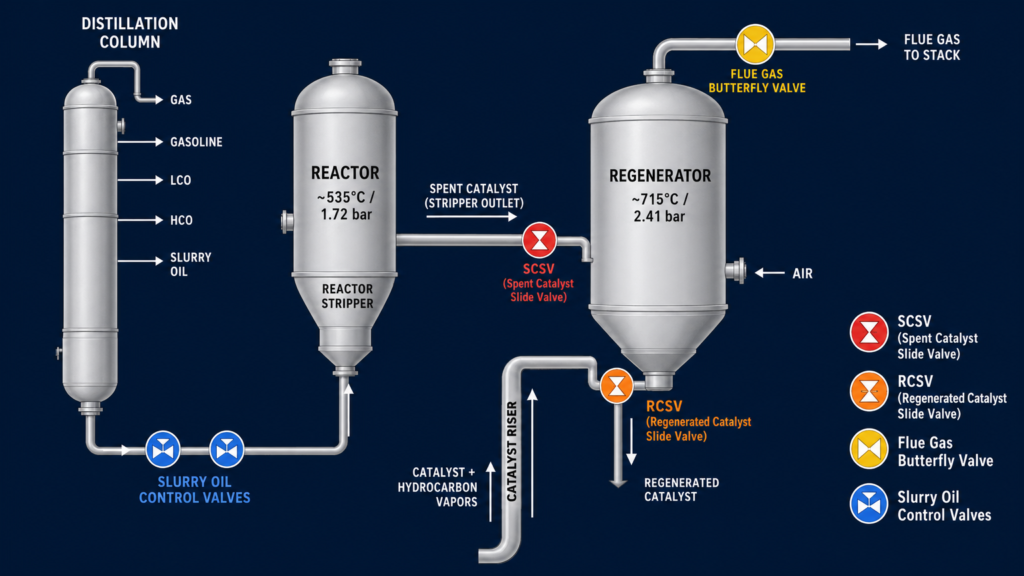
To understand why valve erosion is so severe in an FCCU, one must examine the operating conditions and the nature of the catalyst itself. The FCC process relies on the continuous circulation of a powdered catalyst between two main vessels: the reactor and the regenerator.
In the reactor, long-chain hydrocarbons vaporize and crack upon contact with the hot catalyst at temperatures around 535°C (995°F) and pressures of approximately 1.72 bar. The cracking process deposits carbonaceous coke on the catalyst, deactivating it. This “spent” catalyst is then transferred to the regenerator, where the coke is burned off in an oxygen-rich environment at temperatures reaching 715°C (1320°F) and pressures around 2.41 bar.

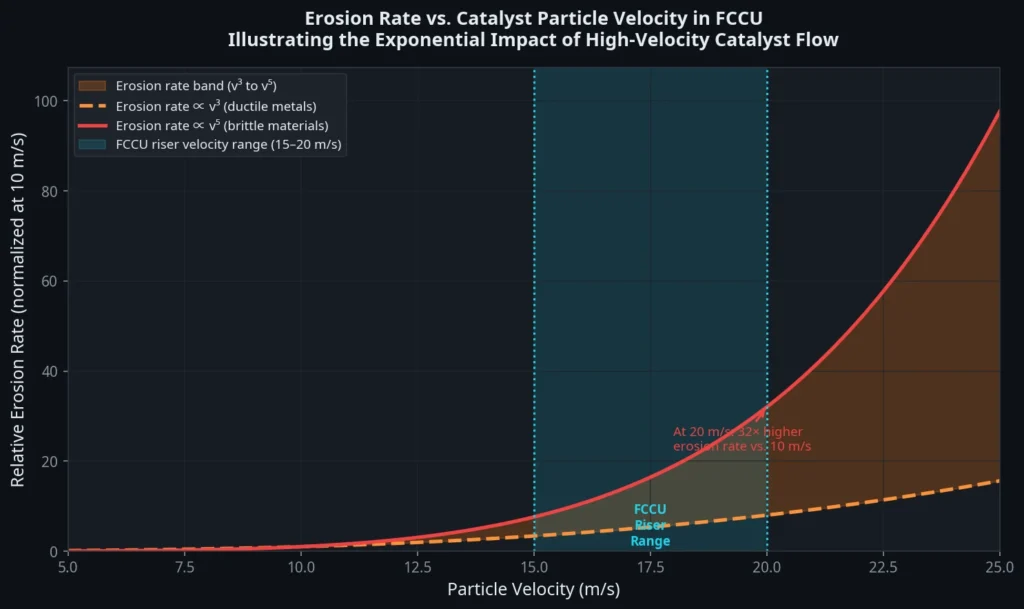
The catalyst itself is highly abrasive. Typically composed of zeolite (Y-type faujasite) within a silica-alumina matrix, the particles average 60 to 100 micrometers in size. The alumina and silica components possess a hardness of 6 to 7 on the Mohs scale, comparable to quartz. When millions of these hard particles are propelled through the system at velocities of 15 to 20 meters per second, they act as a continuous, high-temperature sandblasting medium against any exposed valve surfaces.
Key valve positions exposed to this severe service include the Spent Catalyst Slide Valve (SCSV), the Regenerated Catalyst Slide Valve (RCSV), flue gas butterfly valves, and slurry oil control valves. Each of these valves must maintain precise control and tight shutoff despite the relentless erosive attack.
The Mechanics of Valve Erosion in FCCU Service
Valve erosion in an FCCU is primarily driven by solid particle impact and abrasion. When hard catalyst particles strike the metallic surfaces of a valve at high velocity, they remove microscopic amounts of material. Over time, this cumulative material loss compromises the valve’s structural integrity and sealing capability.
The rate of erosion is not linear; it is exponentially related to the velocity of the particles. For ductile metals, the erosion rate is typically proportional to the velocity cubed ($v^3$), while for brittle materials, it can be proportional to the velocity to the fifth power ($v^5$). This means that even a slight increase in flow velocity—perhaps due to a localized pressure drop across a partially open valve disc—can dramatically accelerate the erosion rate.

Furthermore, the erosion process is often exacerbated by the high-temperature environment. At temperatures exceeding 500°C, many standard valve materials experience a significant reduction in hardness and yield strength. This high-temperature softening makes the metal more susceptible to cutting and plowing by the catalyst particles. Additionally, the presence of sulfur compounds and naphthenic acids can lead to erosion-corrosion, where the protective oxide layer on the metal is continuously stripped away by the catalyst, exposing fresh metal to rapid chemical attack.
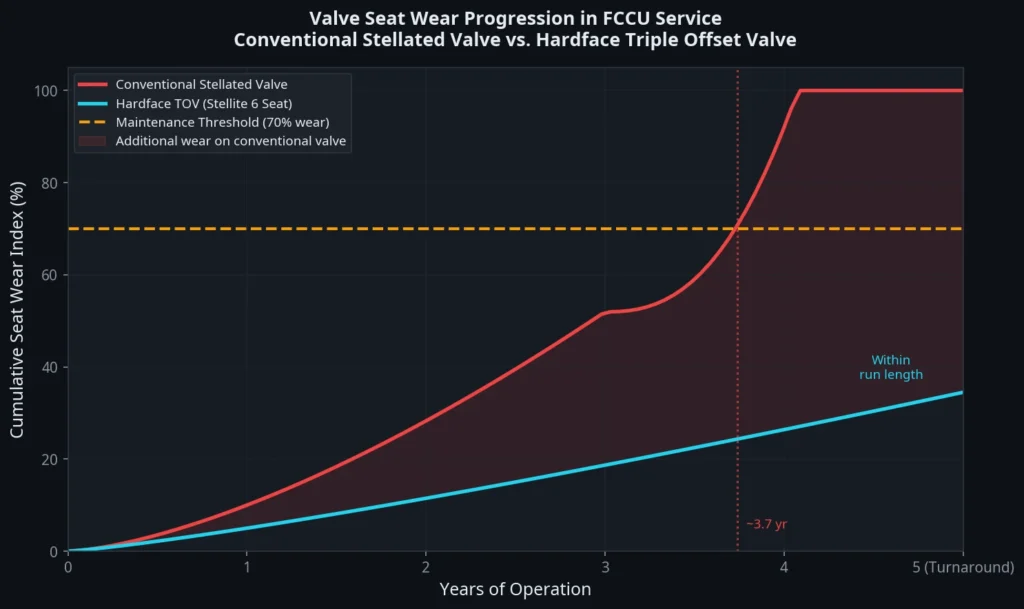
Another critical factor is the accumulation of catalyst “fines.” As the catalyst circulates, the particles grind against each other and the equipment walls, breaking down into smaller fragments (less than 20 micrometers) known as fines. These fines tend to accumulate in the slurry oil circuit at the bottom of the main fractionator. As a turnaround cycle progresses, the concentration of these highly abrasive fines increases, leading to a sharp spike in erosion rates during the final years of the run.
Consequences of Unchecked Valve Erosion
The consequences of failing to mitigate valve erosion in an FCCU extend far beyond the cost of replacing a damaged component. Unchecked erosion impacts operational efficiency, plant safety, and the bottom line.
Operational and Economic Impacts
When the seating surfaces or the disc edge of a valve erode, the valve loses its ability to provide tight shutoff. This internal leakage allows catalyst and hydrocarbons to bypass the intended control points. In the case of slide valves, severe erosion of the orifice plate or guides can lead to a loss of differential pressure control, making it difficult to maintain the proper catalyst level in the reactor or regenerator.
To compensate for compromised valves, operators are often forced to derate the unit, reducing throughput to maintain safe operating parameters. If a valve fails completely before the scheduled turnaround, the refinery faces an unplanned shutdown. The economic impact of an unplanned FCCU outage is staggering, often costing between $1 million and $2 million per day in lost production, not including the direct costs of emergency maintenance and replacement parts.
Safety Implications
The most severe consequence of valve erosion is the potential for catastrophic safety incidents. The FCCU relies on a delicate pressure balance and physical catalyst barriers to keep the hydrocarbon-rich environment of the reactor separated from the oxygen-rich environment of the regenerator.
If the Spent Catalyst Slide Valve (SCSV) suffers severe erosion and fails to maintain the catalyst seal, hydrocarbons can flow backward into the regenerator. When these hydrocarbons mix with the air in the regenerator, the result is often a massive explosion.
“The U.S. Chemical Safety and Hazard Investigation Board (CSB) has investigated multiple refinery incidents where the erosion of FCCU slide valves played a critical role. In the 2018 Husky Superior Refinery explosion, the CSB found that the refinery had ‘normalized’ the severe erosion rate of the SCSV over a five-year turnaround cycle, leading to a loss of the catalyst barrier and a subsequent explosion that injured 36 workers.”
These incidents underscore the critical importance of selecting valves engineered specifically to withstand the erosive forces of the FCCU environment.
The Limitations of Conventional Valve Designs
Standard valve designs and materials are wholly inadequate for FCCU catalyst service. Carbon steel and standard austenitic stainless steels (like 316L) possess hardness levels in the range of HRC 20 to 25, which offer virtually no resistance to the abrasive silica-alumina catalyst. Soft-seated valves utilizing PTFE or elastomers are immediately destroyed by the extreme temperatures, which far exceed their thermal limits.
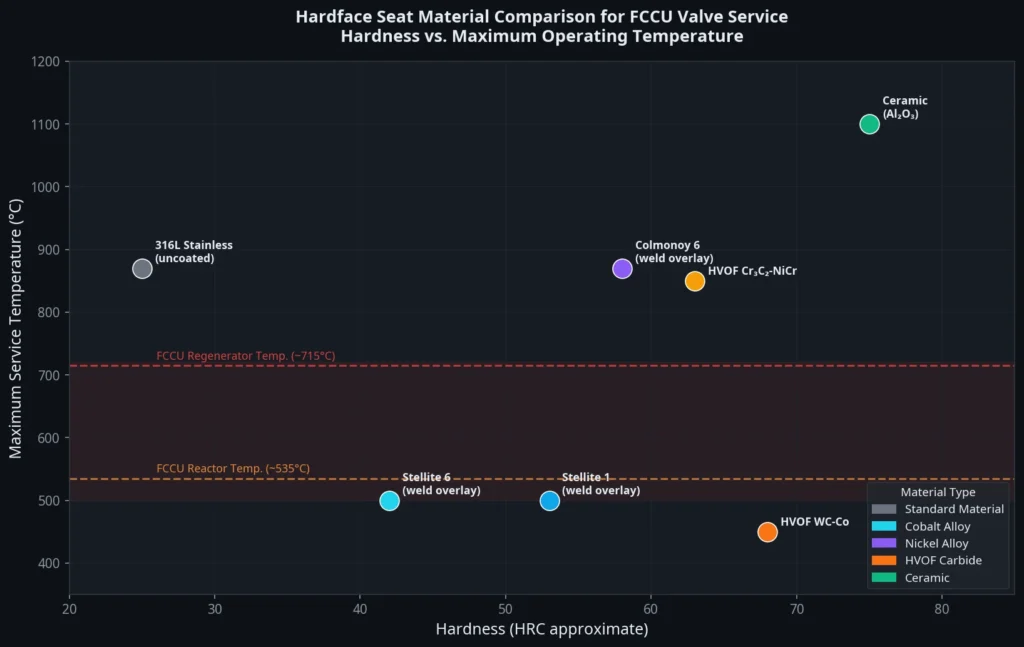
Historically, the industry standard for improving wear resistance has been the application of Stellite weld overlays on the seating surfaces of conventional valves. Stellite 6, a cobalt-chromium-tungsten alloy, provides a hardness of HRC 38 to 44 and retains its mechanical properties up to 500°C. While a “stellated valve” performs adequately during the early years of a turnaround cycle, it often falls short as the run progresses.
The primary limitation of conventional butterfly valves—even those with Stellite overlays—is their reliance on friction for sealing. In concentric or double-offset designs, the disc rubs against the seat during the final degrees of closure. In an environment laden with abrasive catalyst dust, this rubbing action grinds the particles into the seating surfaces, accelerating wear. As the Stellite layer is worn away, the softer base metal is exposed, leading to rapid failure.

The Case for Hardface Seat Design and Triple Offset Geometry
To achieve the extended run lengths demanded by modern refineries, valves in FCCU service require a combination of advanced hardfacing materials and friction-free mechanical design.
Advanced Hardfacing Materials
Hardfacing involves applying a layer of wear-resistant material to a softer, tougher base metal. This provides the necessary surface hardness to resist erosion while maintaining the structural ductility required for pressure containment.
While Stellite 6 remains a popular choice for weld overlays due to its excellent balance of erosion, corrosion, and galling resistance, other materials are gaining traction for specific severe service applications. High-Velocity Oxygen Fuel (HVOF) thermal spray coatings, such as Tungsten Carbide-Cobalt (WC-Co) and Chromium Carbide-Nickel Chromium (Cr₃C₂-NiCr), offer extreme hardness levels exceeding HRC 65. These coatings create a dense, mechanically bonded layer that provides superior protection against sliding abrasion and particle impact.
The table below summarizes the key properties of the most common hardface seat materials used in FCCU valve service, allowing engineers to match the material to the specific demands of each valve position.
| 素材 | Hardness (HRC approx.) | Max. Service Temp. | Application Method | 最適 |
|---|---|---|---|---|
| 316L Stainless (uncoated) | 25 | 870°C | — | General service (not recommended for catalyst) |
| Stellite 6 (Co-Cr-W) | 38–44 | 500°C | Weld overlay, laser cladding | Reactor/regenerator slide valves, butterfly valve discs |
| Stellite 1 (Co-Cr-W, high C) | 50–55 | 500°C | Weld overlay | High-wear butterfly valve hardfacing |
| Colmonoy 6 (Ni-Cr-B-Si) | 55–60 | 870°C | Weld overlay | High-temp, high-abrasion butterfly valves |
| HVOF Cr₃C₂-NiCr | 60–65 | 850°C | HVOF thermal spray | High-temperature erosive service |
| HVOF WC-Co | 65–70+ | 450°C | HVOF thermal spray | Lower-temp, extreme abrasion (slurry service) |
| Ceramic (Al₂O₃) | ~75 (Mohs 9) | >1000°C | Sintered insert | Most severe slurry oil service |

For the most extreme slurry oil applications, where catalyst fines concentration is highest, advanced ceramic materials like aluminum oxide ($Al_2O_3$) or zirconia ($ZrO_2$) are sometimes employed. These ceramics offer a hardness of 9 on the Mohs scale and exceptional thermal shock resistance, though they are more brittle than metallic hardfacing.
The Triple Offset Advantage
The true potential of hardfacing is realized when it is combined with the non-rubbing geometry of a トリプルオフセットバタフライバルブ(TOV).
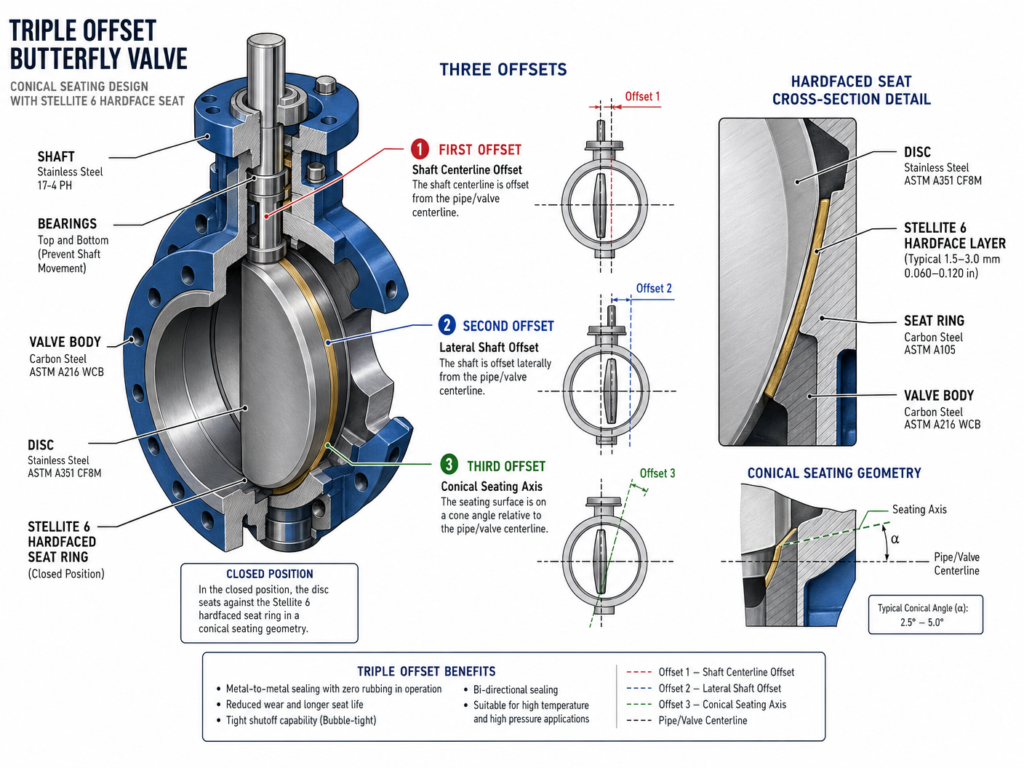
The triple offset design incorporates three distinct geometric offsets:
- Shaft Centerline Offset: The shaft is positioned behind the sealing plane, allowing for a continuous, uninterrupted seat ring.
- Lateral Shaft Offset: The shaft is offset laterally from the pipe centerline, creating a cam-like motion that lifts the disc out of the seat immediately upon opening.
- Conical Seating Axis: The seating surface is machined as an inclined cone, rather than a straight cylinder.

This unique geometry ensures that the valve disc only contacts the seat at the exact moment of full closure. There is absolutely zero rubbing or friction during the valve’s travel. When a Stellite 6 hardface is applied to both the disc edge and the seat ring of a TOV, the result is a metal-to-metal seal that is virtually immune to friction-induced wear.
Because the hardfaced surfaces do not grind against each other, the integrity of the Stellite layer is preserved. The valve relies solely on the compressive force of the torque to achieve a bubble-tight seal, effectively neutralizing the abrasive nature of the catalyst particles trapped between the sealing surfaces. This synergy of material science and mechanical engineering allows hardfaced triple offset valves to maintain zero-leakage performance throughout a full five-year FCCU turnaround cycle.
Specifying Valves for FCCU Erosion Service
When specifying valves for FCCU applications, engineers must look beyond basic pressure and temperature ratings. A comprehensive approach to valve selection is required to ensure long-term reliability.
The following table provides a practical guide to valve type and hardfacing selection by FCCU service position:
| Service Position | Fluid | Temp. Range | Recommended Valve Type | Recommended Hardfacing |
|---|---|---|---|---|
| Spent Catalyst Slide Valve (SCSV) | Dense-phase catalyst | 500–600°C | Slide valve with refractory lining | Stellite 6 weld overlay on disc and orifice |
| Regenerated Catalyst Slide Valve (RCSV) | Dense-phase catalyst | 650–720°C | Slide valve with refractory lining | Stellite 6 weld overlay on disc and orifice |
| Flue Gas Butterfly Valve | Flue gas + entrained catalyst | 600–720°C | トリプルオフセットバタフライバルブ | Stellite 6 on disc edge and seat ring |
| Expander Inlet/Bypass | High-velocity flue gas | 600–720°C | トリプルオフセットバタフライバルブ | Stellite 6 or Colmonoy 6 overlay |
| Slurry Oil Control Valve | Catalyst fines in heavy oil | 300–400°C | Severe service control valve | HVOF WC-Co or ceramic insert |
| Slurry Oil Isolation | Catalyst fines in heavy oil | 300–400°C | Metal-to-metal seated TOV | HVOF Cr₃C₂-NiCr or WC-Co |
Beyond valve type selection, engineers should adhere to the following principles:
Demand Non-Rubbing Designs. For critical isolation, specify metal-to-metal seated triple offset butterfly valves to eliminate friction wear. The non-rubbing closure mechanism is the single most important design feature for preserving the integrity of any hardface coating in catalyst service.
Specify Appropriate Hardfacing. Ensure that the hardfacing material matches the temperature and abrasion profile of the service. Stellite 6 weld overlays are generally preferred for high-temperature reactor/regenerator applications, while HVOF carbides may be suitable for lower-temperature, high-abrasion slurry services. Consult with a specialist manufacturer like カーターバルブ to confirm the optimal material selection for your specific conditions.
Adhere to Industry Standards. Ensure valves comply with relevant standards, including API 609 for butterfly valve design, API 598 for leakage testing, and NACE MR0175 / ISO 15156 if sour service conditions (H₂S) are present. For critical isolation service, consider specifying API 609 Category B (triple offset) valves, which are designed and tested to tighter tolerances than standard Category A designs.
Consider Body Protection. In highly erosive flow paths, the valve body itself may require protection. Specify cold-wall designs with internal refractory lining or hot-wall designs with hex-mesh and erosion-resistant castables where appropriate. This is especially important for slide valves and large-bore butterfly valves in direct catalyst service.
By understanding the mechanisms of valve erosion and investing in advanced hardface seat designs, refineries can significantly reduce the risk of unplanned outages, enhance process safety, and maximize the profitability of their Fluid Catalytic Cracking Units. To discuss your specific FCCU valve requirements with our engineering team, 連絡先 カーターバルブ for a technical consultation.
よくある質問(FAQ)
What causes valve erosion in an FCCU?
Valve erosion in an FCCU is primarily caused by the high-velocity impact and abrasion of the silica-alumina catalyst particles used in the cracking process. These particles are extremely hard and act like a sandblasting medium against the internal components of the valves.
Why do standard stainless steel valves fail in FCCU service?
Standard austenitic stainless steels, such as 316L, have a relatively low hardness (around HRC 25) and lose significant strength at the high operating temperatures of an FCCU (500°C to 715°C). They are quickly cut and worn away by the abrasive catalyst particles.
What is Stellite hardfacing, and why is it used?
Stellite is a family of cobalt-chromium-tungsten alloys known for their exceptional wear resistance, hardness, and ability to retain mechanical properties at high temperatures. Stellite 6 is commonly applied as a weld overlay on valve seating surfaces to protect them from catalyst erosion.
How does a triple offset butterfly valve prevent seat wear?
A triple offset butterfly valve utilizes a unique geometry with three distinct offsets that create a cam-like closure. This design ensures that the valve disc only contacts the seat at the final degree of closure, eliminating the rubbing and friction that causes rapid wear in conventional valves.
What are the consequences of a slide valve failure in an FCCU?
Failure of a slide valve, particularly the Spent Catalyst Slide Valve, can lead to a loss of the catalyst barrier between the reactor and regenerator. This allows hydrocarbons to mix with air in the regenerator, creating a severe risk of explosion, as seen in several high-profile refinery incidents.
What is the difference between a double offset and a triple offset butterfly valve for FCCU service?
A double offset butterfly valve still has a small degree of disc-to-seat contact during closure, which causes friction wear. A triple offset butterfly valve uses a third geometric offset (conical seating axis) to create a completely non-rubbing, cam-like closure. This eliminates friction-induced wear entirely, making it far superior for abrasive FCCU service.
How do I select the right valve for my FCCU application?
Selecting the right valve requires a detailed analysis of the service conditions, including the fluid type, temperature, pressure, particle concentration, and required cycle life. Carter Valves’ engineering team specializes in severe service valve selection for refinery applications. We recommend contacting our team with your process data sheet for a tailored recommendation.
参考文献
[1] Wikipedia Contributors. “Fluid catalytic cracking.” Wikipedia, The Free Encyclopedia.
[2] Oloruntoba, A., et al. “State-of-the-Art Review of Fluid Catalytic Cracking (FCC).” Energies, 2022.
[3] BLAC Inc. “FCCU Valves.” https://www.blacinc.com/fccu-valves
[4] Mann, B.S. “Corrosion and erosion performance of HVOF/TiAlN PVD coatings.” Wear, 2006.
[5] Hashim, M. “Fluid Catalytic Cracking Corrosion: Comprehensive Review.” LinkedIn Pulse, 2023.
[6] Valmet. “How to eliminate erosion and abrasion caused by catalyst fines in FCCU.” Flow Control Insights, 2013.
[7] Grace. “Troubleshoot FCC Reactor Level Control with Fluidization Principles.” 2024.
[8] U.S. Chemical Safety and Hazard Investigation Board (CSB). “Husky Superior Refinery Explosion and Fire Investigation Report.” 2022.
[9] Valve Magazine. “Hardfacing for Valves: Materials and Processes.” 2019.
[10] Stellite. “Stellite 6 Alloy – Technical Data.”
[11] Songer, K. “HVOF Coatings for Severe Service Valves.” Valve Magazine, 2025.
[12] API Standard 609. “Butterfly Valves: Double-flanged, Lug- and Wafer-type.” American Petroleum Institute.
[13] NACE MR0175 / ISO 15156. “Petroleum and natural gas industries — Materials for use in H2S-containing environments in oil and gas production.” NACE International.