





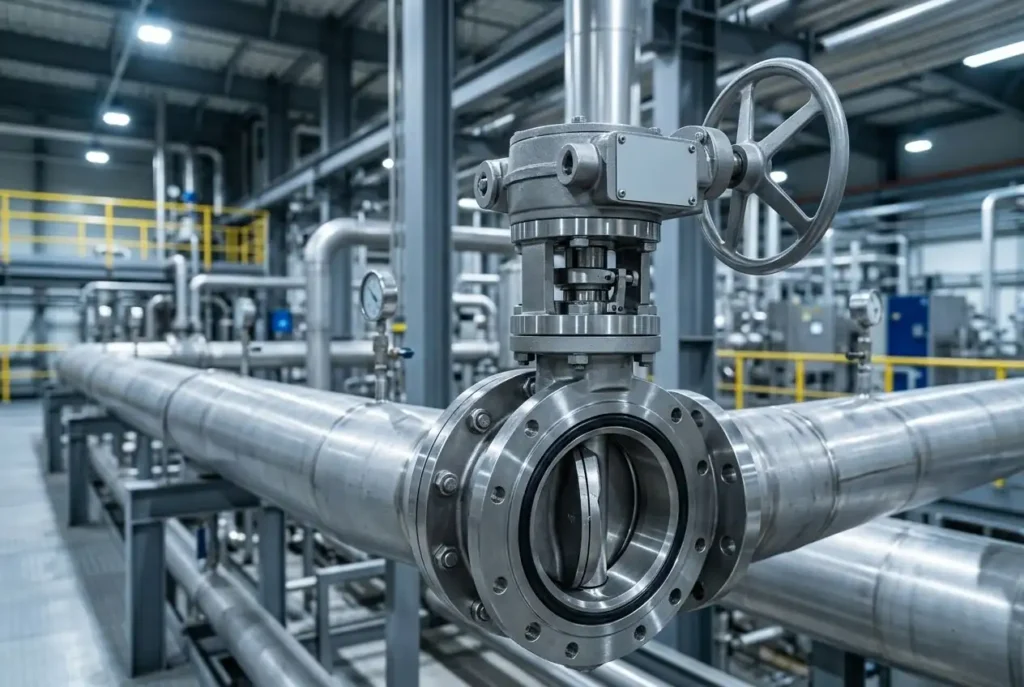
In industrial process plants, the reliability of isolation valves is a critical factor in maintaining safety, efficiency, and continuous operation. For decades, engineers have grappled with a persistent challenge in high-pressure and high-temperature environments: seat wear. Traditional butterfly valves and ball valves often suffer from friction-induced material degradation during their opening and closing cycles. This continuous rubbing leads to leakage, frequent maintenance, and ultimately, a higher total cost of ownership.
However, advancements in valve engineering have provided a definitive solution. The Triple Offset Valve (TOV) geometry represents a paradigm shift in isolation technology, offering a genuinely non-rubbing, zero-leakage performance. In this visual engineering breakdown, we will explore exactly how the triple eccentric butterfly valve design eliminates seat wear and why it has become the preferred choice for severe service applications.
New to butterfly valve types? Before diving into the geometry, you may find it helpful to read our overview on Types of Butterfly Valve: A Practical Guide for Industrial Applications to understand where the TOV fits in the broader valve landscape.
Table of Contents
The Mechanics of Wear: Why Traditional Valves Fail
To understand the brilliance of the triple offset design, we must first examine why conventional valves fail. In a standard concentric butterfly valve, the disc rotates on an axis located directly in the center of the pipe and the sealing ring. As the valve closes, the disc squeezes into a resilient rubber or elastomer seat. This design inherently causes the disc to rub against the seat for a significant portion of its 90-degree travel.
Even in double offset butterfly valves—where the shaft is moved behind the sealing plane and slightly to one side—there is still a brief period of rubbing contact just before the valve fully closes. In severe service conditions involving high temperatures, abrasive media, or frequent cycling, this continuous friction acts like sandpaper: it degrades the seat material, compromises the seal, and inevitably leads to leakage. The result is a shortened cycle life and an increased need for costly downtime and replacements. For a deeper dive into how TOVs compare to other isolation methods, you can read our comprehensive guide on Triple Offset Butterfly Valve vs Ball Valve.
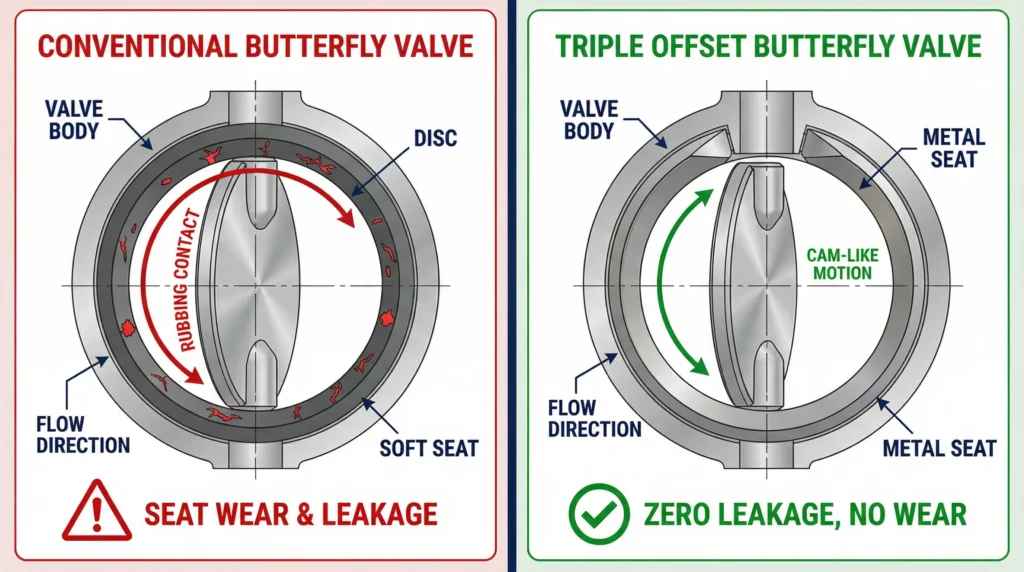
Figure 1: Conventional butterfly valves suffer continuous rubbing contact throughout their stroke (left), leading to seat wear and eventual leakage. Triple offset valves eliminate this problem entirely (right).
The table below summarizes the key failure modes associated with each valve type in severe service:
| Valve Type | Friction During Travel | Seat Material | Typical Cycle Life | Leakage Risk Over Time |
|---|---|---|---|---|
| Concentric Butterfly | High (continuous) | Elastomer / Rubber | Low | High |
| Double Offset Butterfly | Medium (near closure) | Elastomer / PTFE | Medium | Medium |
| Triple Offset Butterfly | None (non-rubbing) | Metal-to-Metal | Very High | Very Low |
| Ball Valve | Low (quarter-turn) | Soft or Metal | High | Low–Medium |
Deconstructing the Triple Offset Geometry
The secret to the TOV’s exceptional cycle life lies in its unique, three-dimensional geometric design. By introducing three distinct offsets, engineers have transformed the simple rotational movement of a butterfly valve into a sophisticated cam-like motion. Let us break down these three critical offsets clearly.
The First Offset — Shaft Behind the Sealing Plane
The valve shaft is positioned behind the plane of the sealing surface. This creates a continuous, uninterrupted sealing ring, allowing for a complete 360-degree seal without the shaft penetrating the seat. This is the same principle used in double offset valves.
The Second Offset — Shaft Centerline Displaced Laterally
The centerline of the shaft is displaced laterally from the centerline of the pipe bore. This offset creates a cam action during operation, helping to lift the disc away from the seat quickly as the valve opens, further reducing the contact time between the disc edge and the seat.
The Third Offset — The Conical Seating Axis
This is the defining feature of the triple eccentric butterfly valve design. The axis of the seating cone is tilted at an angle away from the centerline of the valve body. Instead of a simple cylinder, the sealing profile is machined as an inclined cone. When the valve closes, the disc does not slide into the seat—it swings in from the side, like a door closing into a conical frame. This is the geometric key that makes the entire “non-rubbing” principle possible.
When these three offsets work in harmony, they completely alter the closing mechanics of the valve, transforming a sliding action into a precise, cam-like engagement.
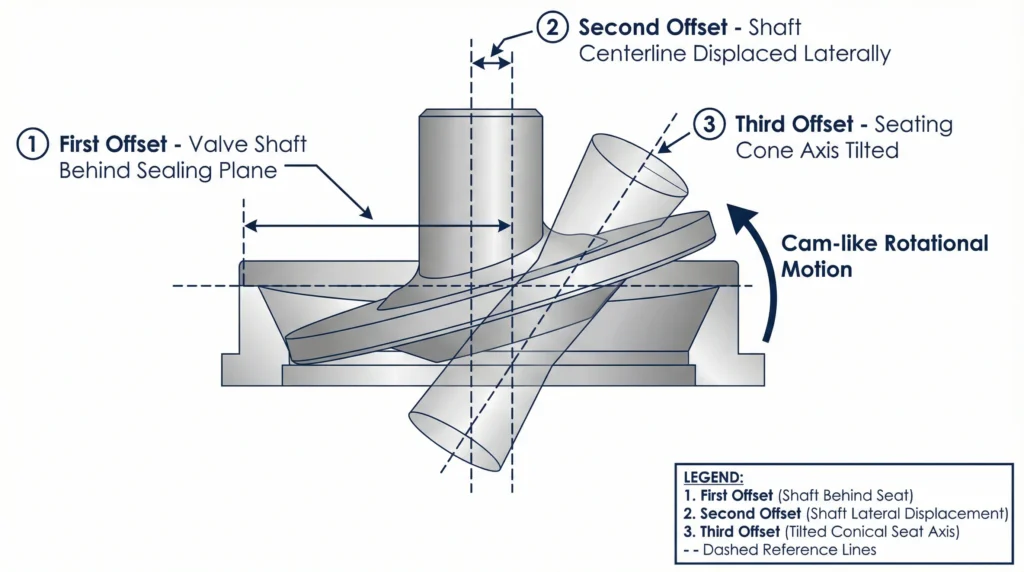
Figure 2: An annotated diagram illustrating how the three offsets (shaft position, centerline displacement, and cone axis tilt) combine to create the cam-like, non-rubbing closure motion.
The Non-Rubbing Advantage: Eliminating Seat Wear
The true engineering marvel of the triple offset geometry is its “non-rubbing” action. Because of the cam-like rotational motion created by the three offsets, the seal ring on the disc does not drag across the seat during travel.
As the valve approaches the closed position, the disc swings into place with clearance to spare. It is only at the absolute final degree of closure that the conical seal ring makes precise, uniform contact with the metal seat. The sealing forces are generated by the torque applied to the shaft, rather than by the disc wedging into the seat. When the valve opens, the disc lifts cleanly and instantly away from the seat.
This zero-friction travel completely eliminates the galling, tearing, and wear associated with traditional valves. The result is a non-rubbing seat butterfly valve that maintains bi-directional, bubble-tight shutoff over an exponentially longer cycle life. Furthermore, the absence of friction significantly reduces the operating torque required, allowing for smaller, more economical actuators.
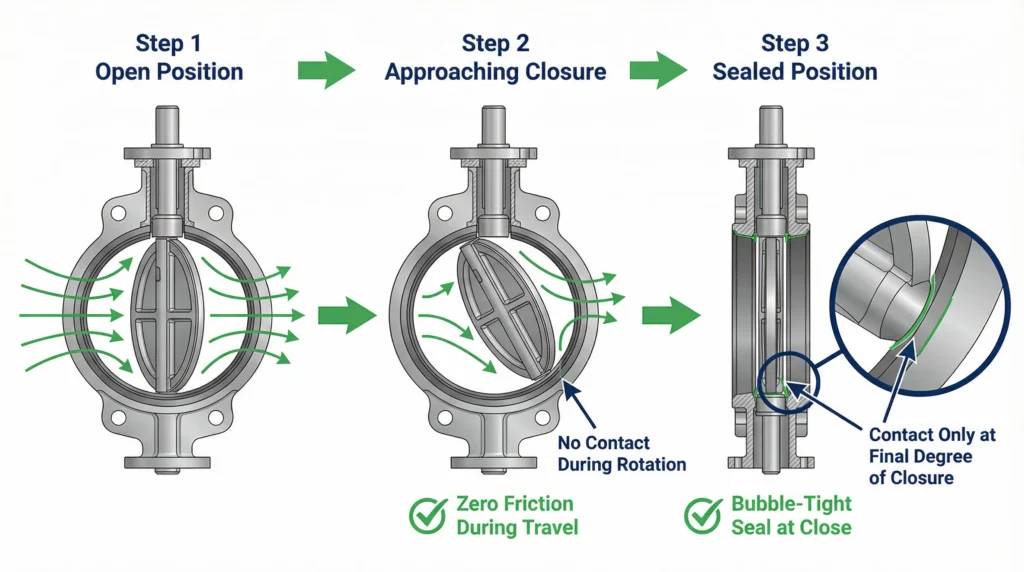
Figure 3: The three-step closure sequence of a triple offset valve. The disc travels freely without touching the seat until the very last moment, eliminating all friction-induced wear.
For applications demanding the highest level of pressure containment, explore our Ultra High-Pressure Triple Offset Butterfly Valve (CVS-288), engineered for critical isolation in ultra-high-pressure environments where absolute reliability is paramount.
Material Selection for Extreme Durability
While the geometry eliminates friction, the materials used in a TOV ensure it can withstand the harshest process conditions. Because the triple offset design relies on torque-seating rather than position-seating, it is perfectly suited for metal-to-metal sealing.
Unlike soft elastomer seats that melt or degrade at high temperatures, metal seats can handle extreme thermal cycling and abrasive media. The choice of seat material is driven by the specific service conditions:
| Material | Key Properties | Typical Application |
|---|---|---|
| Stellite 6 Hardfacing | Extreme hardness, erosion & high-temp resistance (up to 650°C) | Steam service, FCCU, catalytic cracking |
| Inconel 625 | Corrosion & oxidation resistance, wide temp range | Cryogenic LNG, high-temperature corrosive media |
| 316L Stainless Steel | Good corrosion resistance, cost-effective | General industrial, water, process gas |
| Duplex Stainless Steel | High strength, excellent chloride resistance | Offshore, marine, chemical processing |
By combining the frictionless triple offset geometry with these robust metal alloys, engineers can specify valves that deliver verifiable zero leakage in services where traditional valves would fail in weeks. For a deeper look at how seat materials affect valve selection, our article on Metal-to-Metal Seated Butterfly Valves: Engineering Principles, Standards, Materials, and Selection Criteria provides a comprehensive reference.
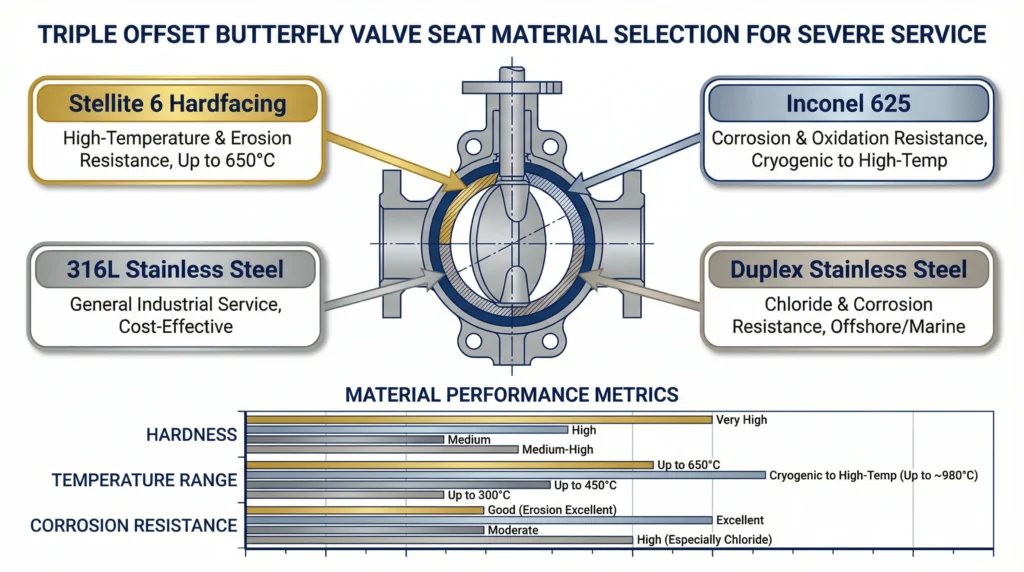
Figure 4: Seat material selection guide for triple offset butterfly valves in severe service. The right material choice is as critical as the geometry itself.
Where Triple Offset Valves Excel: Key Applications
The non-rubbing, metal-seated design of TOVs makes them the preferred isolation solution across a range of demanding industries. Understanding where they perform best helps engineers make the right specification decision.
Oil & Gas (Upstream, Midstream, Downstream): TOVs are widely used for critical isolation in high-pressure pipelines, compressor stations, and refinery processes. Their ability to handle high-temperature steam and corrosive hydrocarbons without seat degradation makes them indispensable. For a broader look at valve solutions for this sector, see our Oil & Gas Solutions page.
Molecular Sieve Service: The cyclic nature of molecular sieve dehydration units—where valves open and close multiple times per day—puts enormous stress on conventional seats. The non-rubbing TOV design is uniquely suited to survive thousands of cycles without wear. Learn more about Butterfly Valve Selection for Critical Isolation & Severe Service.
Cryogenic LNG: In liquefied natural gas applications, valves must maintain a reliable seal at temperatures as low as -196°C. Metal-to-metal seated TOVs, when combined with appropriate materials like Inconel, provide the stable shutoff required in these extreme cold environments.
Emergency Shutdown (ESD) Systems: ESD valves must achieve zero leakage and stroke rapidly under worst-case conditions. The TOV’s predictable, torque-seated closure makes it a natural fit for safety-critical applications.
Carter Valves: Engineering Your Isolation Solutions
At Carter Valves, we understand that in critical industrial processes, valve failure is not an option. With over 50 years of engineering-driven sealing reliability, we specialize in designing and manufacturing high-performance isolation solutions that meet the most demanding international standards, including ANSI, API, DIN, BS, JIS, and GB.
Our expertise extends beyond standard TOVs. We have pioneered the next generation of isolation technology with our Hexa (Six-Eccentric) Butterfly Valves. This advanced platform further refines the contact stress distribution around the full seat circumference, reducing operating torque by over 30% compared to standard triple-offset valves while maintaining true zero-leakage performance up to 1100°C. If you are curious about how the six-eccentric design compares to the triple offset, our article Six-Eccentric vs Triple Offset Butterfly Valve: What’s the Real Difference in Sealing and Wear? offers a detailed technical comparison.
Whether you are managing high-pressure steam, cryogenic LNG, or corrosive chemical processing, Carter Valves provides the verification-led quality and lifecycle support your plant requires. Our Services & Capabilities team supports your project from initial selection and actuator matching through to commissioning guidance and long-term maintenance planning.
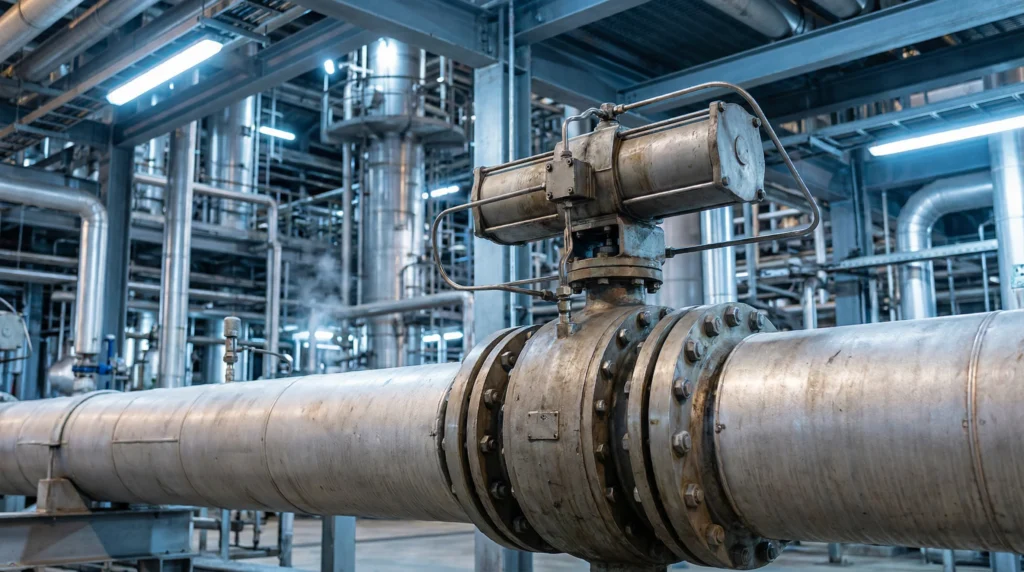
Figure 5: A triple offset butterfly valve with pneumatic actuator installed in a high-pressure oil and gas processing facility—a typical application where the non-rubbing, metal-seated design delivers long-term reliability.
Ready to upgrade your isolation valves? Contact our engineering team today to discuss your specific application requirements. You can also explore our full range of Isolation Valves to find the right solution for your facility.
Frequently Asked Questions
What is the main difference between double offset and triple offset butterfly valves?
A double offset valve moves the shaft behind and to the side of the sealing plane, which reduces friction but still allows some rubbing contact near the point of closure. A triple offset valve adds a third geometric offset—a tilted conical seating axis—which completely eliminates rubbing throughout the entire stroke. The disc only contacts the seat at the absolute final moment of closure, making the TOV a genuinely non-rubbing design.
Can a triple offset butterfly valve achieve zero leakage?
Yes. Thanks to the torque-seated, metal-to-metal conical design, high-quality TOVs can achieve bi-directional, bubble-tight zero leakage. This performance level meets the requirements of stringent international standards, including API 598 Class VI and ISO 5208 Rate A, making them suitable for critical isolation and emergency shutdown applications.
What applications are best suited for triple offset butterfly valves?
TOVs are ideal for severe service applications where traditional valves fail prematurely. Common applications include high-pressure steam isolation, cryogenic LNG service, high-temperature refinery processes (such as FCCU and molecular sieve dehydration), critical emergency shutdown (ESD) systems, and any service involving abrasive or corrosive media that would rapidly degrade a soft seat.
How does the triple offset design affect valve torque?
Because the disc does not rub against the seat during travel, friction is virtually eliminated. This significantly lowers the operating torque required to open and close the valve, which in turn allows for the use of smaller, more cost-effective actuators. This reduction in actuator size also lowers the total installed cost and reduces long-term energy consumption.
Are triple offset valves suitable for high-temperature service?
Absolutely. Because TOVs utilize metal-to-metal seating—often enhanced with hardfacing alloys like Stellite 6—they do not rely on elastomers that degrade under heat. Standard TOVs can reliably operate in temperatures from cryogenic (-196°C) up to approximately 650°C. Advanced six-eccentric designs, such as Carter Valves’ Hexa platform, extend this capability up to 1100°C.
What standards govern triple offset butterfly valve design and testing?
The primary standard for butterfly valves is API 609, which covers both Category A (resilient-seated) and Category B (high-performance and triple offset) designs. Pressure testing is governed by API 598 and ISO 5208. Fire-safe testing may be required per API 607 or API 6FA depending on the project specification.
How does the triple offset valve compare to a ball valve for high-pressure isolation?
Both valve types can achieve tight shutoff, but they differ significantly in weight, face-to-face dimensions, and cost—especially at larger diameters. A triple offset butterfly valve is considerably lighter and more compact than an equivalent ball valve, which reduces installation costs and structural support requirements. For a detailed head-to-head comparison, see our article on Triple Offset Butterfly Valve vs Ball Valve.
References
American Petroleum Institute. API Standard 609: Butterfly Valves — Double-flanged, Lug- and Wafer-type. 8th ed. Washington, D.C.: API Publishing Services, 2021. https://www.api.org/products-and-services/standards/important-standards-announcements/standard-609
American Petroleum Institute. API Standard 598: Valve Inspection and Testing. 10th ed. Washington, D.C.: API Publishing Services, 2016. https://www.api.org/products-and-services/standards
International Organization for Standardization. ISO 5208: Industrial valves — Pressure testing of metallic valves. Geneva: ISO, 2015. https://www.iso.org/standard/63777.html
International Organization for Standardization. ISO 15848-1: Industrial valves — Measurement, test and qualification procedures for fugitive emissions — Part 1: Classification system and qualification procedures for type testing of valves. Geneva: ISO, 2015. https://www.iso.org/standard/63836.html
The Engineering Toolbox. “Valve Types and Applications.” https://www.engineeringtoolbox.com/valves-d_453.html
Valve World Magazine. “Triple Offset Butterfly Valves: Design Principles and Severe Service Applications.” https://www.valve-world.net