





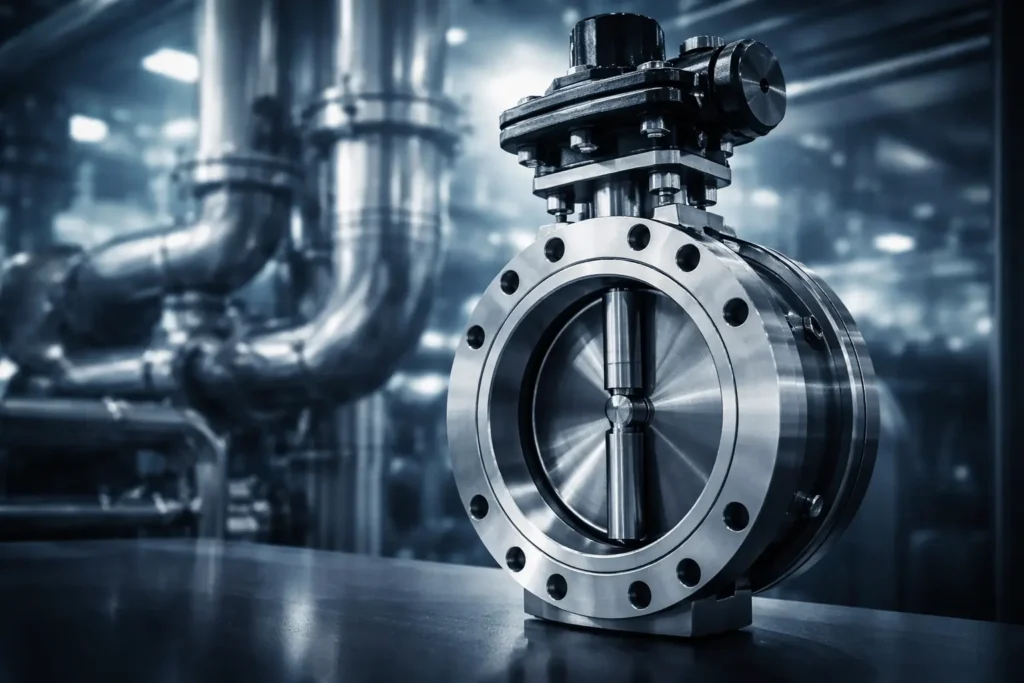
Butterfly Valve Fugitive Emission Standards: ISO 15848-1 vs API 641
In modern industrial facilities, a valve’s ability to hold fluid is no longer enough; it must also prevent invisible gases from escaping into the atmosphere. These unintentional leaks, known as fugitive emissions, are a primary source of Volatile Organic Compounds (VOCs) and greenhouse gases in refineries, chemical plants, and oil and gas operations. As environmental regulations tighten globally, specifying “Low-E” (Low Emission) valves has become a critical requirement for piping engineers and plant managers.
However, the landscape of fugitive emission testing standards is notoriously complex. Specifiers are frequently confronted with a confusing array of acronyms—ISO 15848-1, API 624, API 641, and TA Luft. A common mistake in the industry is arbitrarily requesting API 624 certification for butterfly valves, a standard that is fundamentally incompatible with quarter-turn valve designs. This article breaks down these standards, compares their requirements, and explains how to correctly specify low-emission butterfly valves for your next project.
What Are Fugitive Emissions in Valves?
Fugitive emissions refer to the unintentional release of gases or vapors from pressurized equipment. In industrial valves, the primary source of these emissions is the dynamic seal—specifically, the stem or shaft packing where the moving component exits the pressurized valve body. A secondary, though less common, source is the static body joints and gaskets.
The impact of fugitive emissions extends beyond environmental concerns. While the release of methane and benzene contributes significantly to air pollution, these leaks also represent a direct financial loss of valuable product and pose severe safety risks to plant personnel.
Regulatory bodies such as the U.S. Environmental Protection Agency (EPA) enforce strict Leak Detection and Repair (LDAR) programs, utilizing methods like EPA Method 21 to monitor emissions. Facilities failing to meet these stringent air quality targets face substantial fines and operational shutdowns.

Deconstructing ISO 15848-1: The Global Standard
ISO 15848-1 is the main international standard for testing fugitive emissions from industrial valves. It is widely used because it applies to both isolation valves and control valves, including quarter-turn designs such as butterfly valves.
The standard evaluates the whole valve assembly, not just one sealing point. It tests leakage from the stem or shaft seals and from the body joints, which gives specifiers a more complete picture of real-world valve performance.
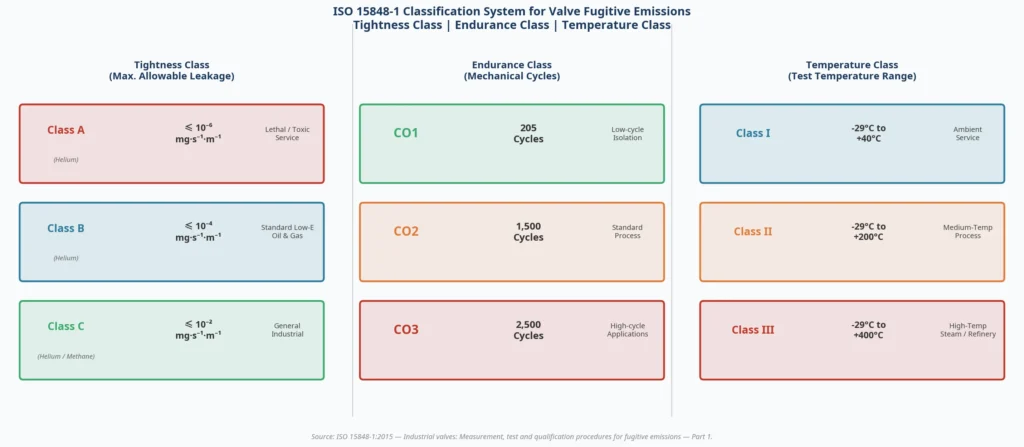
ISO 15848-1 classifies valve performance in three ways: tightness, endurance, and temperature. Together, these categories show how much a valve leaks, how long it can maintain that performance, and under what thermal conditions it was tested.
Tightness Classes (A, B, and C)
The Tightness Class defines the maximum allowable leakage rate, measured using either Helium or Methane as a tracer gas.
- Class A: This is the most stringent “zero leakage” standard, requiring a leakage rate of ≤ 10⁻⁶ mg·s⁻¹·m⁻¹ using Helium. It is typically reserved for lethal, highly toxic, or specialized vacuum services and often requires bellows seal technology.
- Class B: Considered the industry benchmark for standard Low-E valves in oil, gas, and petrochemical applications. It mandates a leakage rate of ≤ 10⁻⁴ mg·s⁻¹·m⁻¹ using Helium. This class provides an excellent balance of high performance and practical manufacturability.
- Class C: The least stringent class, allowing ≤ 10⁻² mg·s⁻¹·m⁻¹ using Helium or Methane, suitable for general industrial services where emissions are less critical.
Endurance Classes
Endurance Class shows how many mechanical cycles a valve can complete while still meeting its leakage target. For isolation valves, ISO 15848-1 uses three main endurance levels: CO1 (205 cycles), CO2 (1,500 cycles), and CO3 (2,500 cycles).
A higher endurance class usually indicates stronger long-term sealing performance. For buyers and specifiers, that can mean lower maintenance needs and more reliable service over time.
Temperature Classes
Temperature Class defines the temperature range used during testing. This is important because valve sealing performance can change significantly when equipment is exposed to heat, cooling, or thermal cycling.
In practical terms, the temperature class helps confirm whether a valve was tested under conditions similar to its intended service. A valve that performs well only at ambient temperature may not deliver the same emissions performance in hotter refinery or chemical-processing environments.
Why ISO 15848-1 Matters
ISO 15848-1 matters because it gives engineers a consistent way to compare fugitive-emission performance across valve designs. Instead of relying on general marketing claims such as “low emission,” specifiers can evaluate a valve using defined leakage, endurance, and temperature criteria.
For butterfly valves, ISO 15848-1 is especially useful because it is not limited to rising-stem designs. That makes it one of the most relevant standards when writing performance-based specifications for quarter-turn low-emission valves.
API 624 vs. API 641: Which Standard Applies to Butterfly Valves?
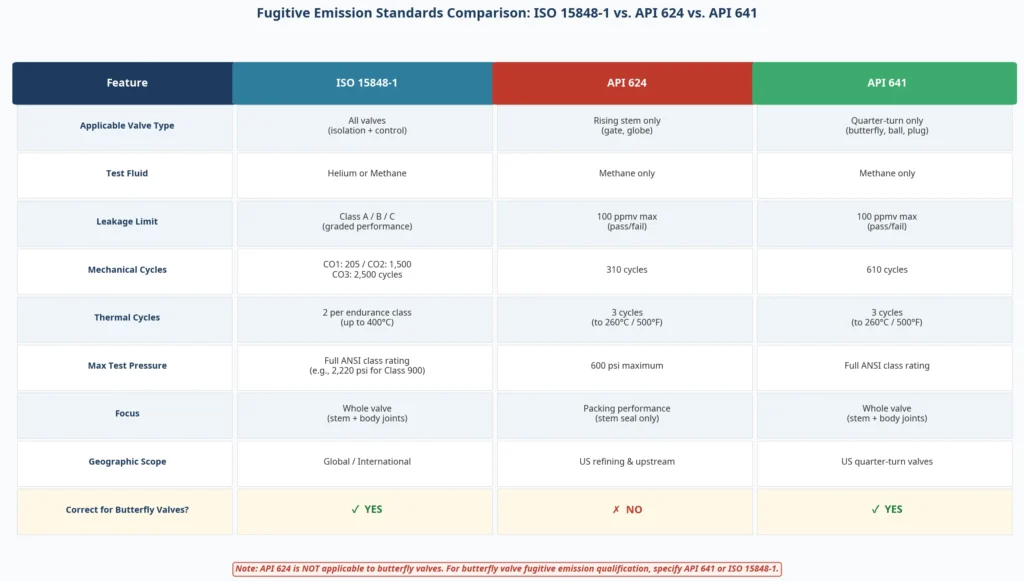
API 624 does not apply to butterfly valves. API 624 is for rising stem valves, such as gate and globe valves. API 641 is the correct API standard for quarter-turn valves, including butterfly, ball, and plug valves.
API 624: For Rising Stem Valves
API 624 covers fugitive-emissions type testing for rising stem valves equipped with graphite packing. It evaluates the sealing performance of the packing system in the stuffing box, not the entire quarter-turn valve design.
The test uses methane as the test medium and requires 310 mechanical cycles plus three thermal cycles up to 260°C (500°F). To pass, leakage must remain at or below 100 ppmv.
Because butterfly valves are quarter-turn valves, API 624 is not the correct specification for them.
API 641: For Quarter-Turn Valves
API 641 was developed specifically for quarter-turn valves. It is the correct standard to reference for butterfly valves when fugitive-emissions performance is required.
Like API 624, API 641 uses methane and applies a 100 ppmv pass/fail leakage limit. However, API 641 is more demanding for quarter-turn service, requiring 610 mechanical cycles and three thermal cycles up to 260°C (500°F).
The key difference is scope: API 624 evaluates packing performance in rising stem valves, while API 641 evaluates the fugitive-emissions performance of the entire quarter-turn valve assembly.
Practical Specification Guidance
For a butterfly valve, specifying API 624 is a technical mistake. The correct API reference is API 641. If the project uses broader international leakage-class requirements, specifiers may also consider ISO 15848-1, but for API-based quarter-turn valve testing, API 641 is the right standard.
TA Luft and Regional Requirements
For projects based in Europe or those adhering to European environmental directives, the German TA Luft (Technical Instructions on Air Quality Control) standard is frequently specified. Historically referencing the VDI 2440 guideline, the revised TA Luft directive now largely aligns with the international ISO 15848-1 standard.
To comply with TA Luft, valves operating at temperatures up to 250°C must typically demonstrate a leakage rate below 10⁻⁴ mbar·l/s·m, which closely corresponds to the rigorous requirements of ISO 15848-1 Class B.
Engineering Butterfly Valves for Low Emissions
Achieving compliance with ISO 15848-1 Class B or API 641 requires sophisticated engineering. It is not simply a matter of inserting better packing material; the entire shaft seal architecture must be optimized.
High-performance and Triple Offset Butterfly Valves possess inherent advantages for low-emission service. The non-rubbing geometry of the triple offset design significantly reduces friction and wear on the shaft during operation, inherently extending the life of the dynamic seal compared to traditional designs. Furthermore, the metal-to-metal body seal eliminates the risk of body joint leakage.
To achieve certified Low-E performance, manufacturers implement several critical design features:
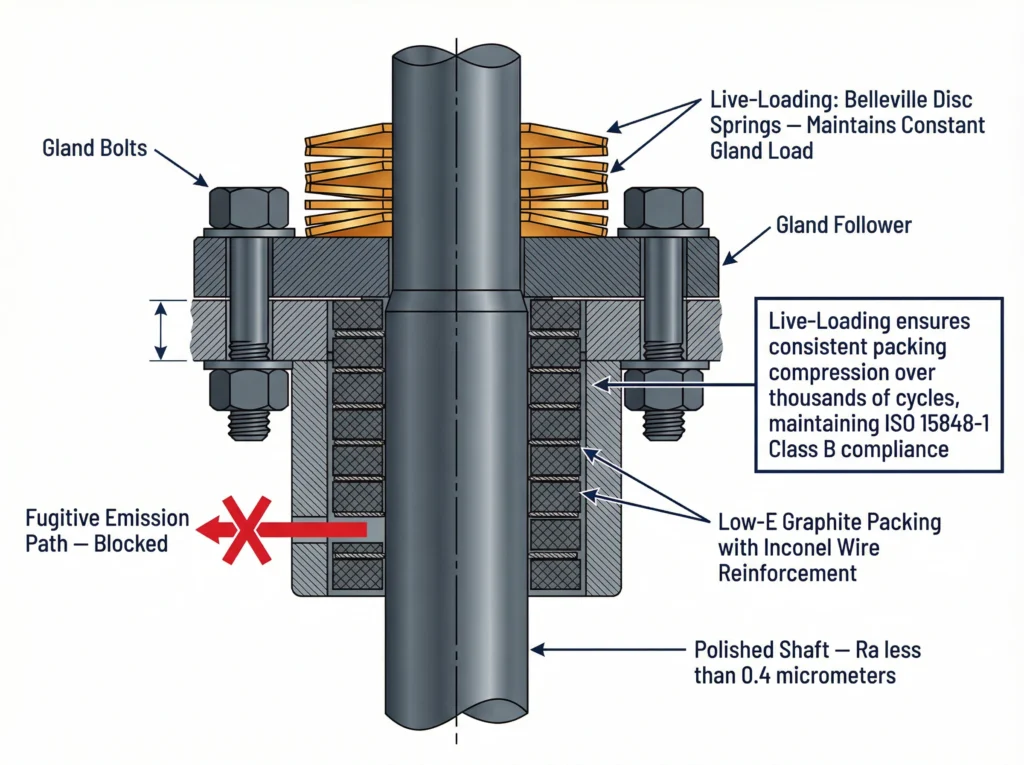
- Live-Loaded Packing Systems: Traditional packing glands loosen over time due to thermal cycling and mechanical wear. Low-E valves utilize Belleville disc springs (conical spring washers) installed on the gland bolts. These springs provide continuous, active compression (“live-loading”) on the packing, compensating for wear and maintaining a constant seal over thousands of cycles.
- Superior Shaft Finish: The valve shaft must be machined and polished to a mirror-like finish, typically with a roughness average (Ra) of less than 0.4 micrometers. This prevents the formation of microscopic channels where tracer gases like Helium could escape.
- Advanced Packing Materials: Standard graphite is often insufficient. Low-E designs utilize high-density, die-formed graphite packing rings reinforced with Inconel wire to prevent extrusion and maintain structural integrity under high pressure and temperature.
Carter Valves: Certified Low-Emission Solutions
At Carter Valves, we understand that environmental compliance is non-negotiable for modern industrial operations. Our engineering team is dedicated to providing isolation solutions that protect both your process and the environment.
Our advanced Hexa Butterfly Valves and high-performance platforms are meticulously engineered with live-loaded, Low-E shaft seal architectures. By combining ultra-smooth shaft finishes with premium Inconel-reinforced graphite packing, our valves are designed to meet and exceed the stringent requirements of ISO 15848-1 and API 641.
Whether you are upgrading an existing refinery unit to comply with EPA LDAR programs or specifying valves for a new chemical processing facility, Carter Valves provides the certified reliability you need.
Ensure your next project meets the highest environmental standards. Contact our engineering team today to discuss your specific fugitive emission requirements, or explore our complete range of Isolation Valves to find the right Low-E solution for your application.
Frequently Asked Questions
Can I specify API 624 for a butterfly valve?
No. API 624 is exclusively for rising stem valves (like gate and globe valves). For quarter-turn valves such as butterfly valves, you should specify API 641 or ISO 15848-1.
What is the difference between ISO 15848 Part 1 and Part 2?
ISO 15848-1 is a rigorous, destructive type-testing standard used to validate a valve’s design and prototype. ISO 15848-2 is a non-destructive production acceptance test used for routine quality assurance on batches of valves that have already passed Part 1 type testing.
Is Helium or Methane better for fugitive emission testing?
Helium is a smaller molecule than Methane, making it more penetrating and capable of detecting microscopic leaks, which is why it is required for the stringent ISO 15848-1 Class A and B. Methane is used for API standards as it closely simulates real-world hydrocarbon emissions, but it requires strict safety protocols due to its explosive nature.
Do I need ISO 15848-1 Class A tightness for standard hydrocarbon service?
Generally, no. Class A is extremely stringent and typically requires specialized, expensive technology like bellows seals, which are usually reserved for highly toxic or lethal services. Class B is the accepted industry standard for Low-E valves in standard oil, gas, and petrochemical applications.
How does live-loading improve fugitive emission performance?
Live-loading uses Belleville springs on the gland bolts to apply continuous, dynamic pressure to the packing. As the packing naturally wears down or consolidates over thousands of operational cycles, the springs expand to maintain a constant compressive force, preventing leaks without requiring manual retightening.
References
International Organization for Standardization. (2015). ISO 15848-1:2015 – Industrial valves — Measurement, test and qualification procedures for fugitive emissions — Part 1: Classification system and qualification procedures for type testing of valves.
American Petroleum Institute. (2016). API Standard 641: Type Testing of Quarter-turn Valves for Fugitive Emissions.
American Petroleum Institute. (2014). API Standard 624: Type Testing of Rising Stem Valves Equipped with Graphite Packing for Fugitive Emissions.
U.S. Environmental Protection Agency. Method 21 – Determination of Volatile Organic Compound Leaks.
Valve World Americas. (2021). Fugitive Emission Testing for Valves: ISO 15848-1 vs. API 624 – What is the Difference?