





Engineered for the Extreme: High-Performance Valve Solutions for Oil & Gas
Reliability where it matters most: From subsea depths to downstream refining
Chemical & Process Control: Absolute Purity, Zero Contamination
Precision control. Safe containment. Verified reliability for aggressive media
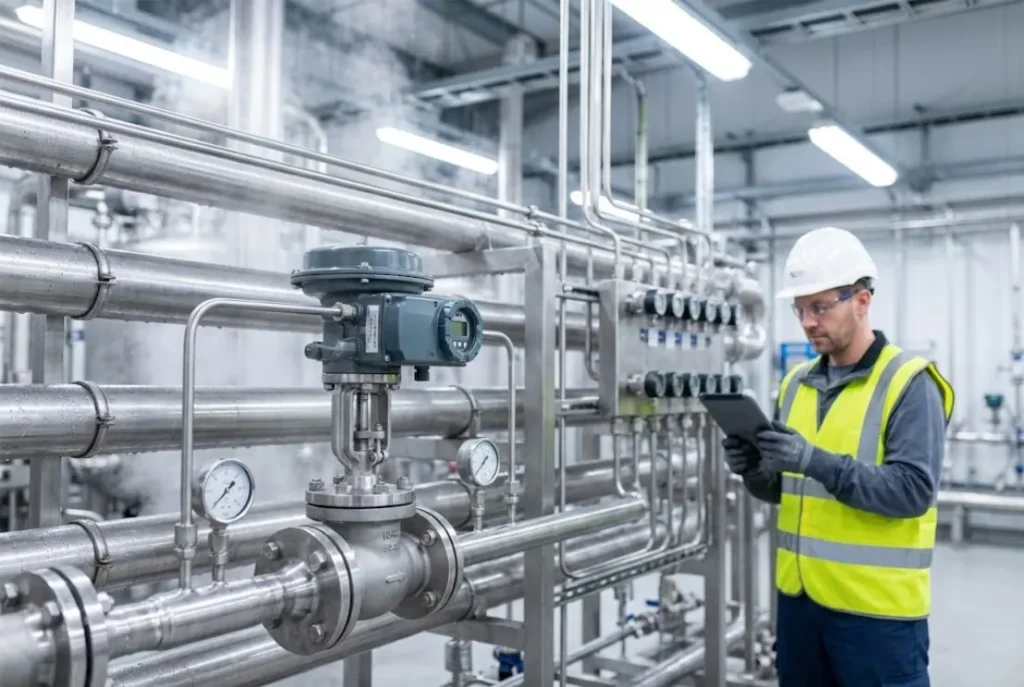
Chemical and process plants run on tight tolerances—where small deviations in flow, pressure, or temperature can cause off-spec product, yield loss, corrosion damage, safety incidents, and unplanned shutdowns. The challenge is intensified by aggressive chemicals, continuous duty cycles, thermal cycling, and stringent emissions expectations. In these environments, valves aren’t just components—they’re control points that protect people, assets, and compliance.
CARTERUS manufactures valve-related products and engineered control solutions for chemical & process applications, helping operators and EPCs address the real failure modes that drive risk.
Corrosion & Chemical Incompatibility
Fugitive Emissions & Containment Risk
Control Instability
Maintenance Burden & Downtime
How CARTERUS responds: engineered materials, sealing, and control—backed by documentation
We match valve type + materials/lining + sealing architecture + actuation/positioning to your operating window, then support projects with submittal-ready documentation.
Application Strategy & Project Deliverables
Built for hazardous and severe service environments—focused on lifecycle reliability, stable containment, and predictable project execution.
Material and Corrosion Strategy (Application-Specific)
Alloy and lining options are selected for your media, concentration, and temperature—supporting long service life and reduced leakage risk.
Containment-Focused Sealing Options
Packing and sealing configurations are designed to improve stability through cycling and reduce external leakage pathways in hazardous service.
Process Control Performance
Automation-ready valves, positioners, and feedback options improve response, repeatability, and visibility—supporting tighter control and fewer trips.
Project-Ready Deliverables
Datasheets, drawings, and inspection/test documentation are aligned to project QA expectations (scope-dependent), improving approval speed and reducing rework.
Contact a CARTERUS Engineer
Send your media, concentration, temperature, pressure, line size, and duty cycle, plus any emissions/standards requirements. We’ll recommend a fit-for-service valve and control configuration with the documentation package your project needs.


Precision, Purity, and Repeatability for Fine & Specialty Chemical Manufacturing
In fine and specialty chemicals, product value is directly tied to purity, consistency, and batch-to-batch repeatability. Valves are not just flow-control components—they influence contamination risk, cleanability, yield, and safety across charging, reaction, transfer, sampling, and cleaning operations.
We concerns are:
Preventing cross-contamination (dead legs, trapped media, seal shedding, cleaning residues)
Reliable CIP/SIP performance (drainability, surface finish, repeatable cleaning)
Chemical resistance across multiple products (acids, bases, solvents, reactive media)
Fast changeovers and maintainability (in-line service, minimal downtime)
Trust signals (material traceability, surface finish documentation, certificates, testing, and consistent manufacturing quality)
CARTERUS manufactures valve products designed for purity-critical chemical service—focused on contamination control, chemical compatibility, and maintainable designs for modern multi-product plants.
1. Valves That Reduce Contamination Risk in Batch Processing
In batch synthesis, even trace contamination—from a previous batch, cleaning agents, or valve internals—can compromise quality and trigger batch rejection, rework, or regulatory issues. Many standard industrial valves have cavities and crevices where media can stagnate, creating persistent cleaning challenges and cross-contamination risk.
How CARTERUS helps: hygienic, cavity-conscious designs and inert wetted materials
Cavity-reduction and drainable flow paths
We offer valve designs selected to reduce holdup volume and stagnation points:
Cavity-filled ball valve configurations (where applicable) to reduce voids around the ball and minimize trapped media
Weir-style diaphragm valves for applications requiring isolation of the process fluid from moving parts and a more cleanable, pocket-minimized flow path
CIP/SIP-friendly construction
For processes using Clean-in-Place (CIP) and Sterilize-in-Place (SIP) or similar validated cleaning cycles, we support designs that improve cleanability and repeatability:
Surface finish options (including polished internal surfaces) to reduce adhesion and improve rinse-out
Drainability-focused configurations to support effective flushing and minimize residue retention
Materials and seals selected to maintain integrity under repeated thermal and chemical exposure (application-dependent)
Chemically inert, compliant wetted materials
To protect product integrity, wetted materials can be specified based on your media and purity requirements, including:
316L stainless steel for general chemical service where appropriate
Nickel alloys (e.g., Hastelloy®) for aggressive corrosives and elevated conditions (application-dependent)
Fluoropolymer seats/seals such as virgin PTFE and TFM™ options where chemical compatibility and low extractables are critical (spec-dependent)
FDA-compliant material options where required by the process and regulatory context
Trust builders (what buyers typically need)
Wetted material specifications and traceability documentation as required
Surface finish documentation where specified
Seal/seat material certifications upon request (project-dependent)
2. Multi-Purpose Reactors & Frequent Changeovers (Uptime Without Compromise)
Multi-purpose plants need rapid product changeovers while handling a wide range of incompatible or corrosive media. The pain points are:
Downtime during cleaning and inspection
Material compatibility across many chemistries
Valve degradation (corrosion, swelling, seal wear) leading to leaks and drift
Repeatable isolation during charging, cleaning, and batch holds
How CARTERUS helps: chemically resistant valves designed for changeover efficiency
Broad chemical compatibility with lined valves
For many multi-product lines, PFA/PTFE lined valves can simplify compatibility challenges:
The fluoropolymer liner isolates the valve body from the process media, supporting resistance to many acids, bases, and solvents (final selection depends on concentration and temperature)
Reduces corrosion risk and helps maintain product integrity when switching between different media
Often lowers total cost vs. deploying exotic alloys everywhere (application-dependent)
Maintainable designs for faster turnaround
To support quick inspection and service during scheduled changeovers, we offer configurations such as:
Three-piece body ball valves for in-line access to internal components
Top-entry options (where applicable) to simplify maintenance access without fully removing the valve from the line
This reduces labor and time during preventative maintenance and validation cycles.
Repeatable shutoff for batch control
In batch operations, reliable shutoff supports:
Clean isolation during CIP/SIP and charging
Reduced leak-by that can affect reaction control, yields, and cleaning effectiveness
Consistency across cycles—especially when thermal cycling and varied chemistries are involved
Why CARTERUS
Application engineering support
We help map valve selection to your process realities: media compatibility, cleaning method, cycling rate, temperature/pressure, and contamination risk points.
Documentation and repeatability
Fine chemical plants buy confidence. We support project submittals with clear documentation (datasheets, drawings, material specs, and test/inspection records as required).
Designed for lifecycle performance
Valves are selected not only for initial compatibility, but for durability under repeated cleaning, cycling, and changeovers—helping reduce unplanned maintenance and batch risk.
Polymers & New Materials: Mastering Extreme Process Conditions
Polymer and advanced-materials production puts valves in some of the toughest services in manufacturing—high-viscosity melts, solids-laden slurries, abrasive catalysts, and continuous duty cycles. In these processes, valve performance directly affects uptime, product quality, and safe operation. Problems like dead zones, solidification, seat wear, and leakage can quickly become unplanned shutdowns or off-spec production.
CARTERUS manufactures valve solutions purpose-built for polymer and new-materials service. Our designs focus on:
Flow integrity (full-bore pathways, minimized stagnation)
Temperature management (jacketed designs for viscosity control)
Severe-service durability (metal seating, hard coatings, anti-erosion features)
Reliable automation (torque sizing and control packages matched to real duty)
1. Valves for High-Viscosity Media in Polymer Production
Engineers searching “valves for molten polymer,” “jacketed ball valve,” or “polymer slurry valve” are typically addressing:
Solidification risk if temperature drops or stagnation occurs
High pressure drop and poor flow behavior in restricted valve geometries
Dead zones where material can build up, degrade, or contaminate product
High operating torque and unreliable shutoff in thick media
Cleaning and grade-change efficiency (pigging, purge, turnaround time)
How CARTERUS helps: jacketed, full-bore ball valves for viscous service
Full-bore (full-port) ball valves are a common choice for viscous melts and heavy slurries because they provide a straight-through flow path and reduce areas where material can hang up.
Full-bore flow path
Straight-through geometry helps reduce pressure drop and limits cavities where viscous material can accumulate and harden
Supports smoother flow and more predictable operation in high-viscosity duty
Thermal management with heating jackets
Jacketed valve bodies can be designed for steam or hot oil circulation to maintain media temperature and viscosity at the valve and adjacent piping interface
Helps reduce freeze-off risk during normal operation and transient events (startup, shutdown, grade changes)
Actuation sized for real polymer duty
Thick media can require higher breakaway and running torque—especially after dwell periods
We size actuators and accessories to match duty conditions and ensure reliable opening/closing performance
Pigging and line cleaning compatibility
Full-bore designs can support pigging strategies where required for cleaning between products or during shutdown/maintenance planning
2. Metal-Seated Ball Valves for Abrasive Catalyst Handling
In catalyst and solids-laden slurry service (e.g., silica-based catalysts, polyolefin catalyst systems), common failure modes include:
Rapid seat wear and leakage in soft-seated valves when abrasive particles embed and score sealing surfaces
Erosion damage driven by high velocity, turbulence, or frequent cycling
Short maintenance intervals leading to production loss and high lifecycle cost
Unpredictable shutoff performance as sealing surfaces degrade
How CARTERUS helps: severe-service metal-seated ball valves
For abrasive slurries, metal-seated designs with engineered surface protection are often selected to improve resistance to wear and maintain shutoff performance longer than soft-seated approaches.
Hard-coated trim for erosion resistance
Wear-resistant coatings can be applied to balls and seats using proven thermal spray methods (e.g., HVOF)
Common coating families include tungsten carbide and chromium carbide, selected based on media, temperature, and wear mechanism
Coatings help protect sealing interfaces from particle-driven erosion and scoring
Seat geometry that manages particle intrusion
Scraper or wiping seat features can help reduce particle entrapment at the sealing line during actuation
This design approach supports more stable sealing performance in solids-laden services
Robust metal-to-metal sealing strategy
Precisely machined and finished metal interfaces can provide repeatable shutoff behavior in services where soft seats are prone to rapid degradation
The goal is longer service life, fewer interventions, and more predictable isolation performance
High-Purity Valves for Sterility, Cleanability, and Audit-Ready Compliance
Pharmaceutical and biotechnology manufacturing requires equipment that protects product sterility and process integrity while supporting global regulatory expectations. For high-purity and aseptic services, valves are not commodity components—they directly affect:
Contamination control (microbial, particulate, cross-contamination)
Cleanability and sterilization (CIP/SIP cycle integrity, drainability)
Validation and audit readiness (traceability, material certificates, standardized documentation)
CARTERUS manufactures high-purity valve solutions and provides documentation packages designed to support sterile process requirements and GMP compliance.
1. Sanitary & Aseptic Valves for Pharma and Biotech
Engineers searching “aseptic diaphragm valve,” “sanitary valve for SIP,” or “high purity valve 316L electropolished” are usually focused on preventing common failure modes:
Dead legs / crevices that can harbor bioburden
Non-drainable geometries that retain fluids and compromise cleaning
CIP/SIP fatigue that degrades elastomers or sealing performance over time
Incompatible materials/finishes that increase corrosion risk or complicate validation
Standard industrial valves are often unsuitable because they may introduce cavities, packing interfaces, or surface conditions that are difficult to clean and validate in aseptic service.
How CARTERUS helps: aseptic weir-style diaphragm valves
Weir-style diaphragm valves are a widely used choice for aseptic boundaries because the diaphragm isolates the process media from the actuator and eliminates packing-related leak paths.
Hygienic, cleanable flow path
Diaphragm creates a separation between product-contact media and valve mechanics
Geometry can be specified to support cleanability and drainability (installation orientation and piping design remain important)
Design intent: reduce internal pockets where residue or bioburden can accumulate
Materials and finishes aligned to high-purity service
Body materials: high-purity 316L stainless steel options; corrosion-resistant alloys (e.g., Hastelloy® C-22®) available for aggressive chemistries where required
Surface finish: polished wetted surfaces; electropolishing available to improve cleanability and surface passivation (finish targets specified per project)
Diaphragm materials: options based on duty cycle and chemistry (commonly EPDM for steam robustness and PTFE-based options for chemical resistance), with compliance documentation available
Designed for CIP/SIP duty
Configurations are selected to withstand repeated cleaning and sterilization cycles, with diaphragm selection and maintenance intervals aligned to process conditions.
2. Full Traceability and Documentation for GMP / FDA Expectations
For GMP environments, buyers typically search “valve MTR EN 10204 3.1,” “heat traceability,” “USP Class VI seals,” and “FDA compliant elastomers.” The pain point is rarely just the hardware—it’s audit risk.
A missing or inconsistent documentation trail can lead to:
Delays in qualification (IQ/OQ/PQ)
Audit findings and corrective actions
Batch impact (quarantine risk, investigation workload)
Rework costs (re-validation, replacement)
How CARTERUS helps: audit-ready documentation packages
We support validation and procurement needs with structured documentation that links the installed valve to verifiable material and quality records.
Material traceability for metallic components
MTRs typically provided to EN 10204 3.1 (project-dependent)
Traceability back to the originating heat/lot, with chemical and mechanical property verification
Permanent marking (e.g., heat/ID marking on the body) to correlate the installed component to documentation in the field
Compliance documentation for non-metallic wetted parts
Certificates provided as applicable to the selected elastomers/fluoropolymers, commonly including:
FDA compliance statements for relevant material requirements (e.g., food/drug contact polymers)
USP Class VI compliance (when specified)
TSE/BSE statements (where required by customer standards)
Certificates of Conformance (CoC) tied to lot/batch where applicable
Quality system support
Documentation control is managed under a quality management system (e.g., ISO 9001, if applicable to your operation), supporting completeness and consistency for audits and validation.
Reliable Valve Performance for Corrosive and Hazardous Service
Commodity chemical plants run continuous, high-throughput processes where downtime and leaks carry outsized cost and risk. Media such as chlorine, strong acids, and concentrated alkalis can be highly corrosive, reactive, and hazardous—making valve selection a critical safety and reliability decision.
Maybe you looking for:
Correct material selection (compatibility by concentration and temperature)
Containment and leak prevention (fugitive emissions, toxic exposure, environmental risk)
Standards and documentation (cleaning requirements, QA, traceability, test records)
Total cost of ownership (alloy vs lined tradeoffs, service life, maintenance burden)
CARTERUS manufactures valve products engineered for severe chemical service—combining material science, sealing design, and project-ready documentation to support long-term plant integrity and stable operation.
1. Valves for Chlorine, Strong Acids, and Concentrated Alkalis
In basic chemicals, “corrosion” is rarely a single variable. Compatibility depends on media composition, moisture content, concentration, temperature, pressure, and cycling. A valve that performs in one condition may fail quickly in another.
Typical pain points
Premature corrosion leading to leakage or seizure
Incorrect alloy selection due to incomplete process conditions
Safety and compliance risk from toxic/hazardous releases
Unplanned shutdowns and difficult maintenance in aggressive services
How CARTERUS helps: application-specific materials + containment-focused design
We address corrosive services by matching valve design + metallurgy + sealing strategy to the exact operating window.
Chlorine service (wet vs dry matters)
Chlorine service is highly sensitive to moisture. Even small amounts of water can shift corrosion behavior and increase risk. Chlorine applications also often specify cleaning and preparation controls to reduce contamination and reactivity concerns.
CARTERUS approach
Corrosion-resistant alloy options used in chlorine service (application-dependent)
Controlled cleaning/drying and protected packaging processes available for chlorine-designated valves to support industry expectations (often aligned with practices referenced by groups such as The Chlorine Institute, where required by project specs)
Strong acids (H₂SO₄, HCl, HNO₃, etc.)
Acid resistance is strongly dependent on concentration and temperature—the same acid can be manageable at one concentration and extremely aggressive at another.
CARTERUS approach
Alloy options for severe acid duty (application-dependent), including nickel-based alloys commonly used in chemical service
Support for material selection based on process conditions, not just the chemical name
Concentrated alkalis (e.g., caustic soda)
Hot, concentrated caustic can drive specific failure modes in some stainless grades (including stress corrosion cracking), making material choice and sealing detail critical.
CARTERUS approach
Material options selected for alkali duty and operating temperature
Designs that prioritize stable sealing and long-term maintainability
Containment and sealing (trust priority in hazardous media)
For hazardous services, buyers often prioritize external leakage control as much as internal shutoff.
CARTERUS sealing options (configuration-dependent)
Live-loaded packing systems to help maintain gland stress through cycling and wear
Robust body joint sealing strategies to reduce potential leak paths
Submittal support for packing, gasket, and materials documentation per project requirement
2. Corrosion-Resistant Lined Valves for Aggressive Media
Solid exotic-alloy valves can be the right answer—but often at a high cost, especially in large diameters or across many lines. Plants frequently look for a solution that balances:
Chemical resistance
Safety/containment
Budget and standardization across multiple services
How CARTERUS helps: PTFE/PFA lined valve solutions
Lined valves can deliver broad chemical resistance by isolating the valve body from the process fluid.
How lined valves work
A structural body (commonly carbon steel or ductile iron, depending on design) is paired with a fluoropolymer liner (often PTFE or PFA) that covers wetted surfaces. This liner serves as the chemical barrier, while the body provides mechanical strength.
Why plants use PTFE/PFA linings
Broad chemical resistance for many acids, alkalis, and solvents (application-dependent)
Standardization: fewer material changes across the plant can simplify purchasing and spare strategy
Cost efficiency versus solid nickel alloy in many applications
Performance considerations (shows professionalism and builds trust)
Lined valves are not “one-size-fits-all.” Proper selection should account for:
Temperature limits and thermal cycling
Pressure rating and vacuum conditions
Permeation considerations for certain chemicals
Mechanical damage risk (solids, abrasion)
Proper grounding/anti-static considerations if required by service
Typical lined valve formats
Lined ball valves and lined butterfly valves (selection depends on diameter, pressure, shutoff needs, and operating frequency)