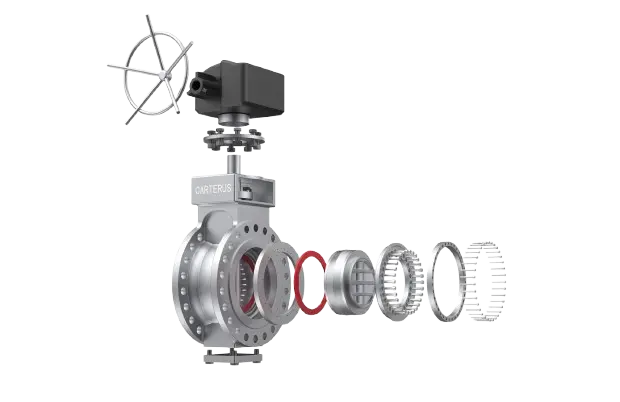





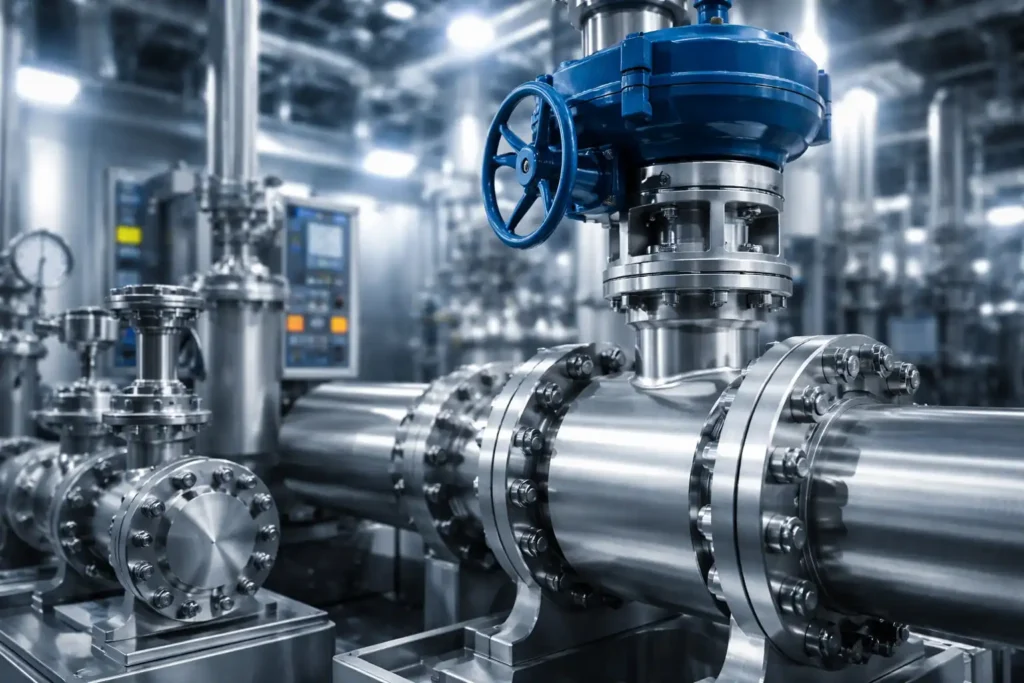
When a valve datasheet claims “bi-directional zero leakage”, it’s not just a nice-to-have feature. In severe service, it can be the difference between stable operation and recurring shutdowns, emissions issues, safety incidents, or product losses.
For high-performance valves like the カルタス六角バタフライバルブ, “bi-directional zero leakage” is a statement about how the valve seals, how it behaves under pressure from either side, and how reliably it shuts off in demanding conditions.
Let’s break it down in practical terms.
Table of Contents
What “Bi-Directional” Really Means
A bi-directional valve is designed to provide shutoff regardless of flow direction.
In real plants, flow direction isn’t always guaranteed:
- Start-up and shutdown can reverse pressure differentials
- Bypass lines and recirculation loops can change “upstream” and “downstream”
- Certain processes see pressure from either side depending on operating mode
- Maintenance or rerouting can unintentionally flip orientation
A valve that is only “uni-directional” may seal well in one direction but leak when the pressure pushes from the opposite side. A bi-directional design eliminates that dependency.
Bottom line: bi-directional means you can count on tight shutoff whether pressure is applied from the left or the right side of the valve.
What “Zero Leakage” Means
“Zero leakage” means the valve achieves tight shutoff—no measurable leakage across the closed valve—when tested under specified conditions.
In many industrial projects, the requirement is essentially:
- No visible leakage
- No bubble leakage
- No detectable flow rate across the seat
- Often aligned with recognized shutoff performance expectations (project specs vary)
In severe service, the goal isn’t only passing a factory test once. It’s maintaining that tight shutoff despite:
- High pressure and high temperature
- Thermal cycling (hot/cold swings)
- Dirty or erosive media
- Pressure spikes
- Mechanical vibration and pipe movement
- 頻繁なサイクリング
Bottom line: zero leakage is about a sealing system that remains stable and tight under the realities of harsh service.
Put Together: What “Bi-Directional Zero Leakage” Promises
When you combine the two terms, here’s what the claim is telling you:
The valve can shut off tightly with no leakage, even when pressure is applied from either side of the disc.
This is especially valuable for:
- Isolation duties on critical lines
- Safety-related shutoff points
- Energy and steam systems
- High-value or hazardous media
- Any application where leakage leads to product loss, emissions, contamination, or risk

Why Severe Service Makes This Hard (and Why Offsets Matter)
Traditional butterfly valves seal by pressing a soft seat against the disc. That can work in clean, moderate conditions. But in severe service, soft seats can be damaged, extruded, or degraded.
High-performance offset designs are built to solve a core problem:
the seal should not rub, grind, or scrape during operation, and it should seat in a controlled way at the end of travel.
That’s where multi-offset geometry matters.
The leakage problem in harsh duty usually comes from:
- Seat/disc wear caused by friction during cycling
- Misalignment as temperature and pressure change
- Seal deformation under high differential pressure
- Damage from particles trapped at the seat
A robust multi-offset design aims to:
- Reduce or eliminate rubbing during opening/closing
- Create a precise seating action at closure
- Maintain contact stress where it matters (without over-stressing components)
- Support metal-to-metal sealing strategies for high temperature and aggressive service
How a Hexa-Offset Design Supports Bi-Directional Zero Leakage
While specific engineering details depend on the manufacturer’s geometry and sealing system, a ヘキサ・オフセット concept is typically positioned as an advanced evolution of offset technology with a focus on:
- Controlled seating mechanics (seal engages at the end of stroke, not throughout the travel)
- Minimized friction and wear (helps preserve shutoff performance over many cycles)
- Stable sealing under pressure from either side (supports true bi-directional behavior)
- Higher reliability in extreme temperature and pressure ranges (where soft seats struggle)
The practical result is a valve intended to deliver tight shutoff without relying on a soft, easily damaged sealing element, and without being dependent on a single pressure direction.
What Buyers and Engineers Should Ask to Confirm the Claim
If “bi-directional zero leakage” is important for your application, don’t stop at the headline. Ask for proof in the form of test scope and conditions, such as:
- What pressure was used during leakage testing?
- Was it tested in both directions at rated differential pressure?
- What medium was used (air, water, process media simulation)?
- After cycling, does it still meet zero leakage?
- At temperature (hot test), does shutoff remain tight?
- What is the allowable leakage definition used in the test report?
A strong severe-service valve story usually includes:
- direction-specific leakage validation (both ways)
- cycling validation
- pressure/temperature boundary clarity
- seat durability rationale
検証可能なゼロ・リーク
Sealing surface profile tolerance. Through verifiable micron–level precision engineering, we have physically eliminated the possibility of leakage, ensuring absolute safety and environmental compliance throughout the entire lifecycle.
Sealing surface roughness approaching mirror finish, further ensuring flawless sealing performance.
Why This Feature Sets a “New Standard”
In many industries, “acceptable leakage” used to be tolerated because it was hard to avoid. Today, the cost of leakage is higher:
- Emissions compliance pressure
- Safety expectations
- Higher value of product and energy
- Demand for lower maintenance and longer run times
A valve designed for bi-directional zero leakage is essentially designed to support modern expectations: tighter isolation, fewer surprises, and better long-term performance in harsh duty.
Bi-directional zero leakage means the valve provides tight shutoff with pressure applied from either side, not just in the “preferred” direction.
For severe service, this matters because real operating conditions are messy: pressure reversals happen, temperature moves hardware, and abrasive media punishes weak sealing designs.
That’s why valves like the カルタス六角バタフライバルブ position this feature as a serious performance benchmark: it targets the exact combination most plants struggle to achieve at the same time—tight shutoff, durability, and direction independence.
よくあるご質問
Why is “bi-directional” important in real applications?
Because flow and pressure aren’t always one-way. Startups, shutdowns, bypass lines, backpressure, and operating upsets can reverse differential pressure. A bi-directional valve keeps isolation reliable even when conditions change.
What does “zero leakage” actually mean in practice?
“Zero leakage” typically means no detectable leakage during the specified shutoff test conditions (pressure, medium, duration). Projects may define it as “no visible leakage,” “bubble-tight,” or equivalent criteria depending on the standard used.
Is “zero leakage” guaranteed forever?
No valve can promise perfect sealing under every possible condition for its entire life. “Zero leakage” applies within rated design limits and test conditions, and it depends on proper installation, clean seating surfaces, and avoiding damage from debris or misuse.
How is this different from standard butterfly valves?
Many standard butterfly valves rely on soft seats and may seal best in one preferred direction or degrade faster in severe service. Severe-service offset designs aim to reduce seat wear and maintain reliable shutoff under higher pressure/temperature and harsher media.
What makes severe service sealing difficult?
Severe service can involve:
- high temperature and thermal cycling
- high differential pressure
- abrasive/dirty media (particles)
- corrosion or coking
- vibration and pipe movement All of these can compromise seat integrity or alignment, leading to leakage.
How does a Hexa-Offset design help achieve tight shutoff?
A multi-offset geometry generally aims to:
- reduce rubbing between sealing surfaces during operation
- control how the seal engages at closure
- maintain stable sealing contact under changing pressure and temperature This supports longer-lasting tight shutoff, especially in harsh duty.
Does bi-directional zero leakage mean the valve can be installed in either direction?
Usually yes, that’s one of the advantages. However, you should still follow the manufacturer’s installation guidance for orientation, actuator position, and any directional markings if provided.
Can it handle pressure from both sides equally?
That’s the intent of a true bi-directional design. Still, always confirm the rated pressure class, test direction requirements, and any limitations tied to seat type, temperature, or service media.
What tests should we ask for to validate “bi-directional zero leakage”?
Ask for:
- leakage test results showing both directions
- test pressure(s) and duration
- test medium (air/water)
- cycling test results (before/after leakage)
- temperature range or hot testing if relevant This is the fastest way to separate marketing language from proven performance.
What applications benefit most from bi-directional zero leakage?
Common examples include:
- critical isolation points in refineries and petrochemical plants
- steam and high-temperature services
- power generation and turbine auxiliaries
- hazardous media lines where emissions or exposure must be minimized
- lines with possible backpressure or flow reversal
What are common causes of leakage even in high-performance valves?
- debris trapped at the seat during closure
- scratched or damaged sealing surfaces
- misalignment from poor piping support
- operating beyond rated pressure/temperature
- improper actuator sizing or travel stops not set correctly