




Every industrial fluid system eventually hits the same wall: as pipeline pressures climb and flow rates increase, the raw mechanical force required to open or close a valve becomes impractical. Oversized springs crack under thermal cycling. Massive actuators demand power supplies that don’t exist on remote sites. And direct-acting designs that work perfectly at 50 psi become dangerously unstable at 1,500 psi.
This is the exact problem the pilot operated valve was designed to solve. By redirecting the system’s own fluid energy to do the mechanical work, these valves deliver precise, reliable control at pressures and flow rates that would be physically impossible for simpler designs.
This guide explains how pilot operated valves work from first principles, covers the four distinct valve families that use this mechanism, and gives you the practical decision logic to know when a pilot operated design is the right call — and when it isn’t.
What Is a Pilot Operated Valve?
A pilot operated valve is a two-stage pressure relief or control device that manages the inlet and outlet of a main valve. While they are similar to spring-loaded valves, they are the optimal alternative solution for achieving maximum pressure and maximum capacity. These valves provide outstanding performance for overpressure protection.
Originally considered a niche solution for withstanding high back pressure or improving system stability, their exceptional ability to optimize valve selection is frequently overlooked. Due to their compact design and high-pressure capabilities, these valves are heavily utilized in the oil and gas industry, particularly in upstream offshore applications.

How a Pilot Operated Valve Works
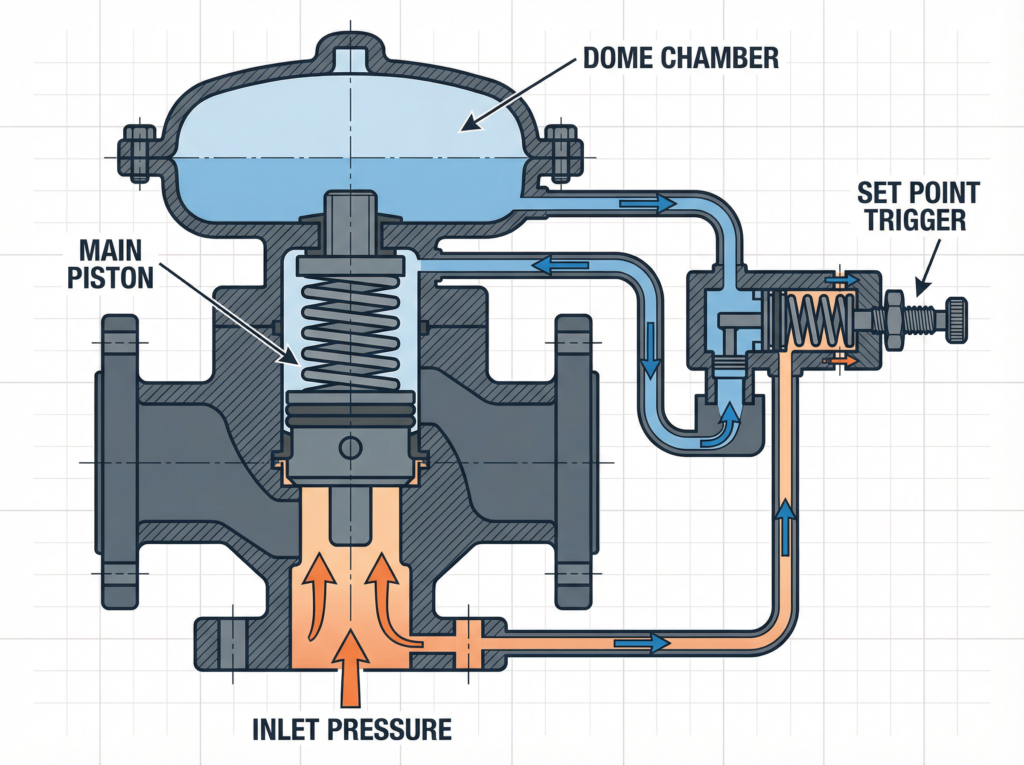
The core mechanism relies on differential area and pressure balance. Understanding this makes every other aspect of pilot operated valve behavior predictable.
Any pilot operated valve is designed to withstand significantly higher back pressure than a standard spring-loaded valve. The main valve piston is protected and balanced by the pilot device, eliminating fragile components that are prone to failure.
The main valve maintains the same pressure at both the inlet and the dome — the dome being the upper section of the main valve where downward force is applied to the piston due to a variation in cross-sectional area.

When system pressure increases and reaches the set point, the pilot opens. This action disconnects the upper section of the piston from the inlet pressure. The trapped pressure in the dome is vented directly to the atmosphere (or downstream), creating a vacuum effect that allows the inlet fluid to push the piston upward, opening the main valve and releasing its total capacity.
However, when multiple valves are connected to the same flare header, superimposed back pressure can exceed the inlet pressure, and the resulting upward force could prematurely open the main valve. The pilot control prevents this. When pressure is transmitted from the main valve inlet to the dome cavity via interconnecting tubing, a positive load is applied to the main valve disc. This sealing load exists because the dome sealing area is typically 30% larger than the inlet seat area. The higher the system pressure, the tighter the valve seals.
The Advantages of Pilot Operated Valves
A pilot operated valve is the ideal choice when there is a significant pressure drop, as its modulating and regulating capabilities are unmatched. Many accessories can be connected to a pilot valve much more easily than to a spring-loaded valve. It also offers superior size-to-capacity ratios and pressure capabilities compared to spring-loaded alternatives.
Pilot operated valves can be connected directly to your vessel using static or remote sensing lines. The pilot valve controls the main valve and allows it to maintain its open position regardless of pressure drops at the inlet.
This mechanism is applied across four distinct valve families, each solving a different engineering problem:
1. Pilot Operated Safety Relief Valves (POSRV)
In overpressure protection, the standard spring-loaded safety valve has a fundamental limitation: as system pressure approaches the set point, the upward fluid force begins to partially overcome the spring, causing the valve to simmer and leak.
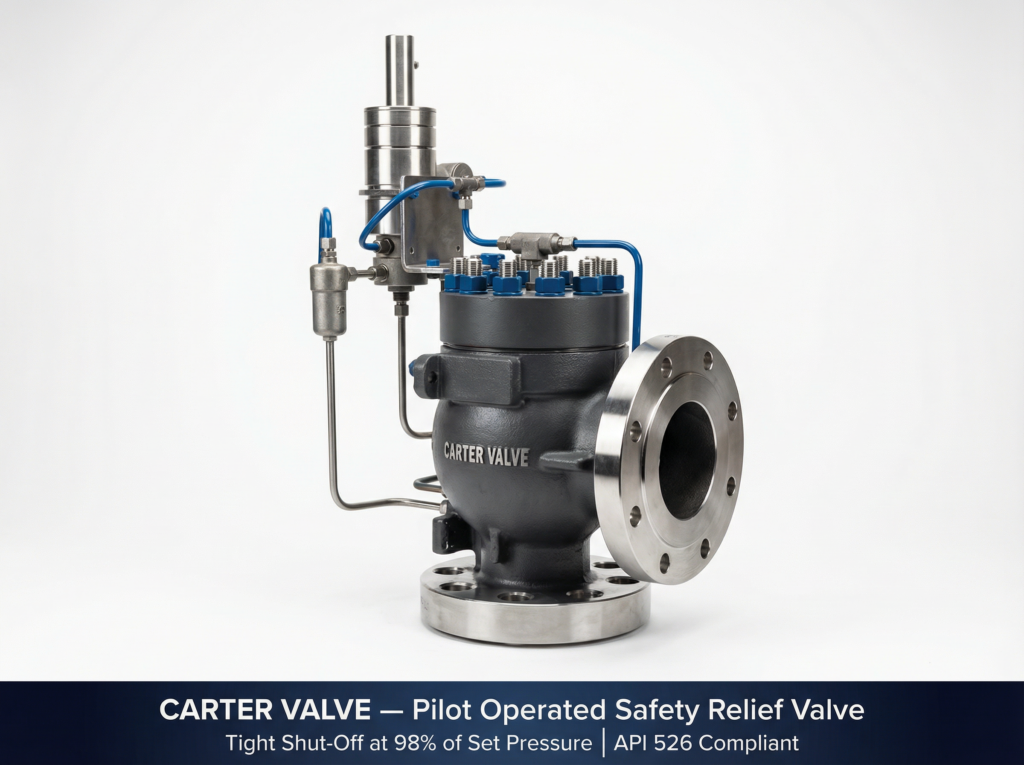
A pilot operated safety relief valve eliminates this problem entirely. Because the dome pressure actively seals the main valve, the valve remains bubble-tight until the exact moment the pilot triggers — even at 98% of set pressure. This allows process engineers to run systems closer to their MAWP, recovering capacity that would otherwise be lost to conservative operating margins.
For critical overpressure protection in refinery and petrochemical service, our API 526 full nozzle safety valves are designed to meet the full-bore capacity and blowdown requirements of pilot operated configurations.
2. Pilot Operated Pressure Reducing Valves
When stepping down high-pressure steam or gas to a stable downstream pressure, a direct acting pressure reducing valve works well for low-flow applications. But as flow demand increases, direct acting valves suffer from droop — the outlet pressure falls below the set point as the valve opens wider.
A pilot operated pressure reducing valve eliminates droop by separating the sensing function from the actuation function. The result is a nearly flat pressure curve across the full flow range — critical in 電力およびエネルギー・アプリケーション.
Our direct acting pressure reducing valve covers low-to-medium flow scenarios. For high-flow, high-accuracy steam letdown stations, the pilot operated configuration is the correct specification.
3. Pilot Operated Check Valves
A standard check valve allows free flow in one direction and blocks reverse flow mechanically. A pilot operated check valve adds a pilot port. When pressurized fluid is applied to the pilot port, it drives an internal piston that mechanically pushes the check valve poppet off its seat, enabling controlled reverse flow. The primary application is load holding in hydraulic systems, ensuring loads do not drop if a hose fails.
4. Pilot Operated Solenoid Valves
Opening a large-diameter valve directly with an electromagnetic coil requires a massive, power-hungry solenoid. A pilot operated solenoid valve uses a tiny, low-power coil to open a small pilot orifice. The system’s own fluid pressure then bleeds off the dome, allowing inlet pressure to lift the main seal.
Our pneumatic on-off specialty valves follow the same pilot-operated logic, using instrument air as the pilot medium to control larger process flows.
Direct Acting vs. Pilot Operated: The Selection Decision
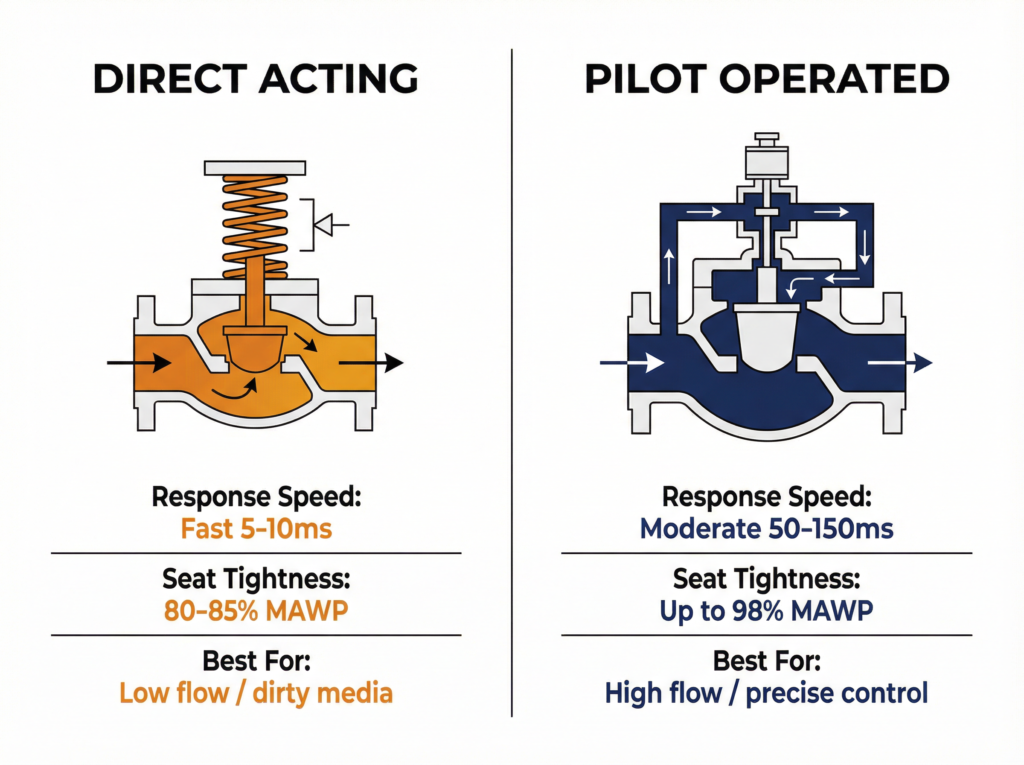
The choice between these two architectures is not a matter of preference — it is a function of system parameters. The table and graphic below capture the core trade-offs.

| Selection Factor | Direct Acting | Pilot Operated |
| Flow Capacity | Low to medium | High to very high |
| Pressure Accuracy | Moderate (droop under high flow) | Excellent (flat pressure curve) |
| Response Speed | Very fast (5–10 ms) | Slower (50–150 ms) |
| Seat Tightness Near Set Point | Simmers at ~80–85% of set pressure | Tight up to ~98% of set pressure |
| Media Cleanliness Required | Low (tolerates particulates) | High (pilot orifices block easily) |
| Minimum Differential Pressure | None required | Required (varies by design) |
The most common specification error is applying a direct acting valve to a high-flow application to save money on the initial purchase. The resulting pressure droop causes downstream equipment to operate outside design parameters.
Common Failure Modes Engineers Must Know
Pilot operated valves are reliable, but their reliability is conditional on clean fluid. The three most common failure modes are:
Pilot orifice blockage. The pilot sensing lines and internal orifices are small. Pipe scale, weld slag, or degraded elastomers will block them. The fix is proper upstream filtration and a Y-strainer or integral pilot filter on the valve.
Freeze-up in cold climates. Static fluid trapped in the pilot dome and sensing lines can freeze in outdoor installations, locking the main valve in the closed position. Heat tracing on the pilot lines is mandatory in cold environments.
Pilot set point drift. Over time, the small spring inside the pilot valve can relax or corrode, causing the set point to drift. Annual testing and recertification per API 510 or local pressure vessel codes is not optional.
For applications where valve reliability is mission-critical, our ESD valve selection guide covers the additional considerations for emergency shutdown service.
What Makes CARTER’s Valves Different?

Carter Technologies manufactures a comprehensive range of purpose-built pilot operated relief valves. They represent the most advanced pilot operated valve designs available, delivering bubble-tight shut-off at up to 98% of set pressure.
These valves guarantee minimal product loss, prevent the severe consequences of oversizing, and drastically reduce environmental contamination during relief events across all industries. We provide exceptional service and engineered solutions, continuously expanding our pilot operation capabilities to meet evolving market demands. This dedication positions Carter Valves as the undisputed pressure relief solution provider for any industrial application.
If you are working through a valve selection for a high-pressure steam, gas, or process fluid application, our team is available to review your process data and recommend the appropriate configuration. Explore our full range of control valves そして self-acting regulators to see how pilot operated technology fits into a complete fluid control strategy.
For a detailed technical consultation, contact the Carter Valves engineering team through our contact page.
Carter Valves supplies engineered flow control solutions for oil and gas, chemical, power, and industrial process applications. Our engineering team is available for technical consultation on valve selection, sizing, and specification.