





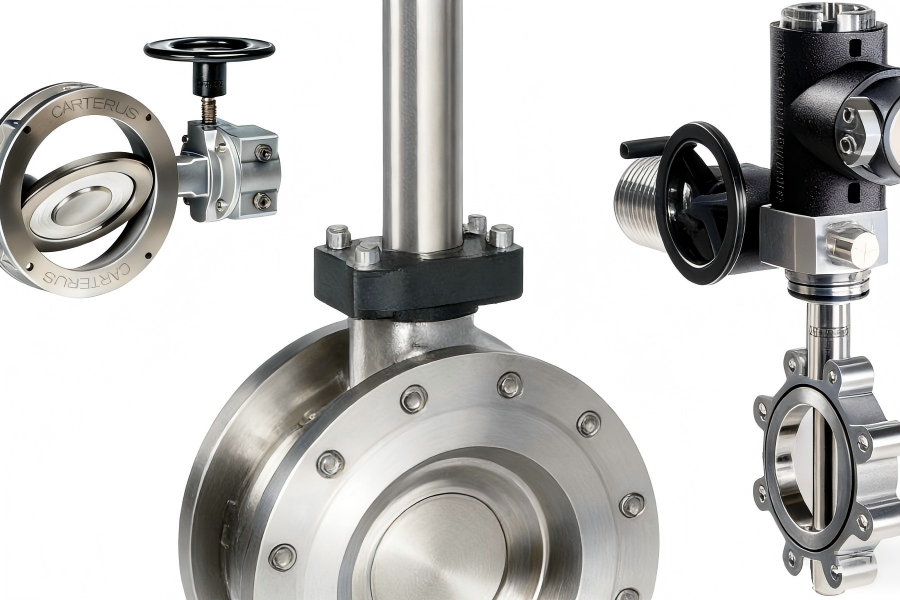
USA Carter Valve Inc. announces the launch of the CARTERUS صمام فراشة سداسي المركز, a severe-service isolation solution developed for applications where predictable shutoff performance, controlled sealing behavior, and long-term mechanical stability are required under demanding operating conditions.
As part of Carter Valve’s expanding portfolio of engineered صمامات الفراشة solutions, the CARTERUS platform reinforces the company’s long-standing focus on critical-service flow control. The product range positions the صمام فراشة سداسي المركز سداسي الجاذبية المبردة as a flagship offering, supported by صمام فراشة الإزاحة المزدوج عالي الأداء, صمامات فراشة الإزاحة الثلاثية, صمامات الفراشة ذات الجلسات المعدنية إلى المعدنية, و isolation valves specified for tight shutoff or zero-leakage duties when defined by applicable service conditions, standards, and test methods.
This product launch is directed at procurement managers, project engineers, EPC contractors, and operations and maintenance leaders who are responsible for specifying, purchasing, commissioning, and operating valves in critical and severe service. Typical evaluation environments include, but are not limited to, molecular sieve systems, high-temperature FCCU units, and cryogenic LNG isolation services—applications where conventional valve designs often face accelerated wear, unstable sealing behavior, or shortened service life.
Rather than positioning the CARTERUS as a general-purpose product, Carter Valve presents it as a purpose-built Six-Eccentric Butterfly Valve platform intended to address recurring isolation challenges in harsh industrial environments—where temperature, pressure, media properties, and operating cycles impose sustained mechanical and thermal stress on traditional sealing concepts.
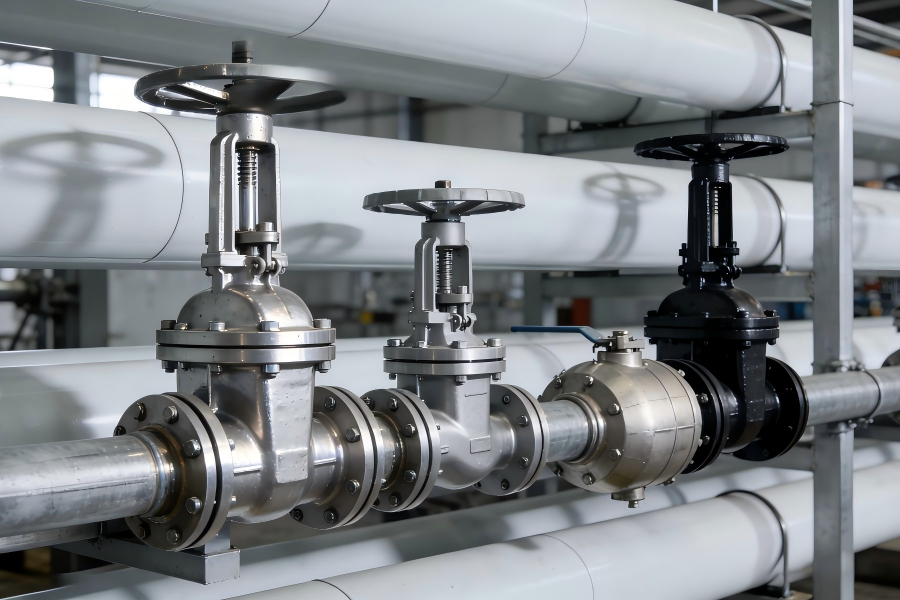
Why Severe-Service Isolation Demands a Different Valve Philosophy
In many industrial plants, valves that perform adequately in moderate service conditions begin to reveal limitations when exposed to harsher operating regimes. Severe service typically involves one or more of the following factors:
- Elevated temperatures and repeated thermal cycling
- High differential pressure or frequent pressure transients
- Abrasive, dirty, or particle-laden media
- Corrosive, erosive, or coking process environments
- Mechanical vibration, piping movement, or structural misalignment
- High cycle counts or long dwell times in the closed position
In these conditions, traditional concentric or soft-seated designs can experience accelerated wear, unstable sealing, and frequent maintenance—driving unplanned downtime, increased fugitive emissions, and higher life-cycle costs.
By contrast, modern severe-service valve design focuses on engineered geometry and controlled sealing mechanics to deliver stable performance over extended operating life, aligning with engineering best practices as outlined in API 609 Butterflies Valve Standards و ASME Valve Testing and Pressure Classes.
From a project and asset management perspective, these realities translate into tangible risks:
- Unplanned maintenance interventions and shortened service intervals
- Increased fugitive emissions or product losses
- Safety and process stability concerns at critical isolation points
- Higher lifecycle costs due to premature refurbishment or replacement
- Reduced confidence during startups, shutdowns, and process upsets
For these reasons, modern specifications increasingly favor offset and multi-offset butterfly valve designs for demanding isolation duties—particularly where metal-to-metal sealing or controlled seating mechanics are required to maintain performance over time.
The Engineering Rationale Behind Multi-Offset Butterfly Valve Geometry
Offset butterfly valve designs were developed to address a fundamental mechanical challenge: how sealing surfaces engage and disengage during operation.
In a conventional concentric design, the disc remains in contact with the seat through a large portion of the operating stroke. This continuous sliding contact increases operating torque, promotes wear, and makes long-term sealing performance more sensitive to debris, surface damage, and thermal distortion.
Multi-offset designs modify this behavior by shifting the shaft and sealing geometry so that:
- The disc moves away from the seat early in the opening stroke
- Contact between sealing surfaces is minimized during rotation
- The seal engages primarily at the end of the closing stroke
- Seating occurs in a controlled, cam-like manner rather than through continuous rubbing
Triple offset butterfly valves have become a widely accepted solution in high-temperature and metal-seated applications for this reason. The Six-Eccentric Butterfly Valve concept extends this principle further by refining the spatial relationship between the disc, shaft, and sealing surfaces to better control contact stress, seating alignment, and load distribution at closure.
The objective is not to eliminate contact—contact is essential for sealing—but to control precisely when, where, and how that contact occurs, and how it behaves under differential pressure from either side of the valve.
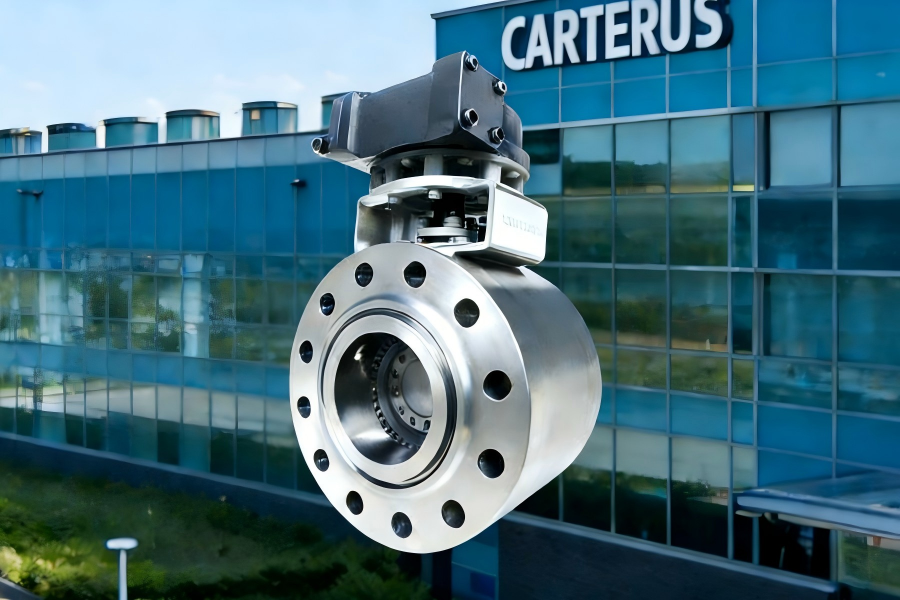
Introducing the CARTERUS Six-Eccentric Butterfly Valve Platform
The CARTERUS platform is designed as a severe-service isolation solution rather than a general-purpose shutoff valve. Its six-eccentric geometry and sealing concept are intended to support:
- Controlled seating at the end of the closing stroke
- Reduced friction and wear during opening and closing
- Stable sealing behavior under differential pressure from either direction
- Compatibility with metal-to-metal sealing strategies for high-temperature or aggressive media
- Predictable mechanical behavior across thermal and pressure cycles
While the exact configuration of materials, surface treatments, and sealing elements depends on the specific application, the six-eccentric concept is fundamentally used to manage the kinematics of closure—that is, the path and orientation by which the disc approaches the seat and establishes sealing contact.
For engineers and buyers evaluating a Butterfly Valve solution for critical service, this approach has several practical implications:
- Lower risk of seat damage during frequent cycling
- More consistent shutoff performance over extended operating periods
- Improved tolerance to thermal distortion and mechanical movement
- Reduced dependence on a single preferred pressure direction for sealing
Any claim of “zero leakage” or “tight shutoff” must always be understood within a clearly defined test scope and service envelope. Carter Valve positions the CARTERUS platform to support such requirements when they are explicitly specified—based on pressure class, temperature range, test medium, acceptance criteria, and applicable standards or procedures.
Bi-Directional Shutoff: A Practical Requirement in Real Plants
In real operating facilities, pressure direction is not always fixed. During startups, shutdowns, bypass operation, or abnormal process conditions, the pressure differential across a valve may reverse. In systems with recirculation loops, parallel trains, or complex manifolds, the “upstream” and “downstream” sides can change depending on the operating mode.
A valve specified for bi-directional shutoff is intended to maintain its sealing function regardless of which side is pressurized, within its rated design limits. For critical isolation points, this is not a convenience feature—it is a risk management requirement.
The six-eccentric geometry used in the CARTERUS design is intended to support stable sealing behavior under pressure from either side by:
- Maintaining controlled contact stress at the sealing interface
- Reducing sensitivity to disc deflection or seat distortion
- Avoiding reliance on pressure-assisted sealing from only one direction
As with any severe-service valve, users should confirm this performance through documented test results that clearly state test pressure, medium, duration, and acceptance criteria in both directions
Typical Applications for Six-Eccentric and Severe-Service Butterfly Valves
Final valve selection must always be based on a detailed process and mechanical specification. However, severe-service butterfly valves are commonly evaluated for applications such as:
- Molecular sieve systems, where high temperatures, frequent cycling, and particulate contamination challenge conventional sealing designs
- FCCU (Fluid Catalytic Cracking Unit) services, where temperature, erosion, and operational transients place high demands on valve internals
ربما تكون مهتماً ب Fluid Catalytic Cracking overview. - LNG and cryogenic isolation duties, where low temperatures, thermal contraction, and strict leakage requirements require careful control of materials and geometry
- High-temperature or high-pressure process isolation in refining, petrochemical, chemical, and power generation facilities
- Critical isolation points where leakage has safety, environmental, or production consequences
In each of these cases, the value of a صمام فراشة سداسي المركز lies not in a single headline metric, but in how the valve behaves over time as conditions evolve and components are exposed to real operating stresses.
Carter Valve’s Application-Driven Engineering Philosophy
Carter Valve’s product strategy centers on custom-engineered butterfly valve solutions rather than one-size-fits-all offerings. Alongside the CARTERUS six-eccentric platform, the company’s portfolio includes:
- High-performance butterfly valves for demanding but moderate service ranges
- Triple offset butterfly valves for high-temperature and metal-seated applications
- Metal-to-metal seated butterfly valves for abrasive, erosive, or high-temperature duties
- Isolation valves specified for tight shutoff or zero-leakage requirements when defined by project standards, test methods, and acceptance criteria
For procurement teams and EPC contractors, this approach supports a more application-specific selection process, where materials, sealing systems, actuation, and testing scope can be aligned with actual service conditions rather than relying solely on catalog ratings.
How to Evaluate “Zero Leakage” in a Procurement Context
In industrial specifications, “zero leakage” is not a universal or self-defining term. It must always be tied to explicit test conditions and acceptance criteria, such as:
- Test pressure (often a percentage of rated pressure or full differential pressure)
- Test medium (air, nitrogen, water, or another specified fluid)
- Test duration and stabilization time
- Measurement method (visual inspection, bubble test, or quantified leakage rate)
- Acceptance criteria (no visible leakage, no bubbles, or a defined maximum allowable rate)
For severe-service valves, additional questions are often relevant:
- Was the leakage test performed in both pressure directions?
- Was the valve tested before and after cycling? If so, how many cycles?
- Was high-temperature or cryogenic testing performed, if applicable?
- What assumptions or limitations apply to the test results?
The CARTERUS platform is positioned to support such requirements when they are clearly specified and verified, but—as with any critical isolation valve—final performance must always be validated against project-specific criteria.
You may want to know the meaning and importance of تسرب صفري ثنائي الاتجاه.
Supporting Long-Term Reliability in Critical Isolation
Even the most robust صمام الفراشة design depends on correct installation, operation, and maintenance. In severe service, common causes of performance degradation include debris ingress, surface damage during maintenance, piping-induced misalignment, operation outside rated limits, or improper actuator adjustment.
A six-eccentric design can reduce sensitivity to some of these factors—particularly those related to wear and friction during cycling—but it does not eliminate the need for sound engineering practice and disciplined maintenance procedures.
الخاتمة
The launch of the CARTERUS Six-Eccentric Butterfly Valve reflects USA Carter Valve Inc.’s continued commitment to application-driven, engineered butterfly valve solutions for critical service. By extending multi-offset sealing principles into a six-eccentric geometry, the company is addressing the practical realities faced by engineers and operators in severe-service environments.
For procurement managers, EPC teams, and plant operators, the key takeaway is not a single performance claim, but a design philosophy: one that prioritizes controlled seating mechanics, reduced wear, and stable sealing behavior under changing pressure and temperature conditions—within clearly defined and verifiable test and service limits.
When evaluated rigorously against actual process requirements, severe-service butterfly valves such as the CARTERUS six-eccentric platform can play a central role in supporting safer, more reliable, and more predictable plant operation.اتصل بنا us to start a technical discussion about your critical isolation requirements.